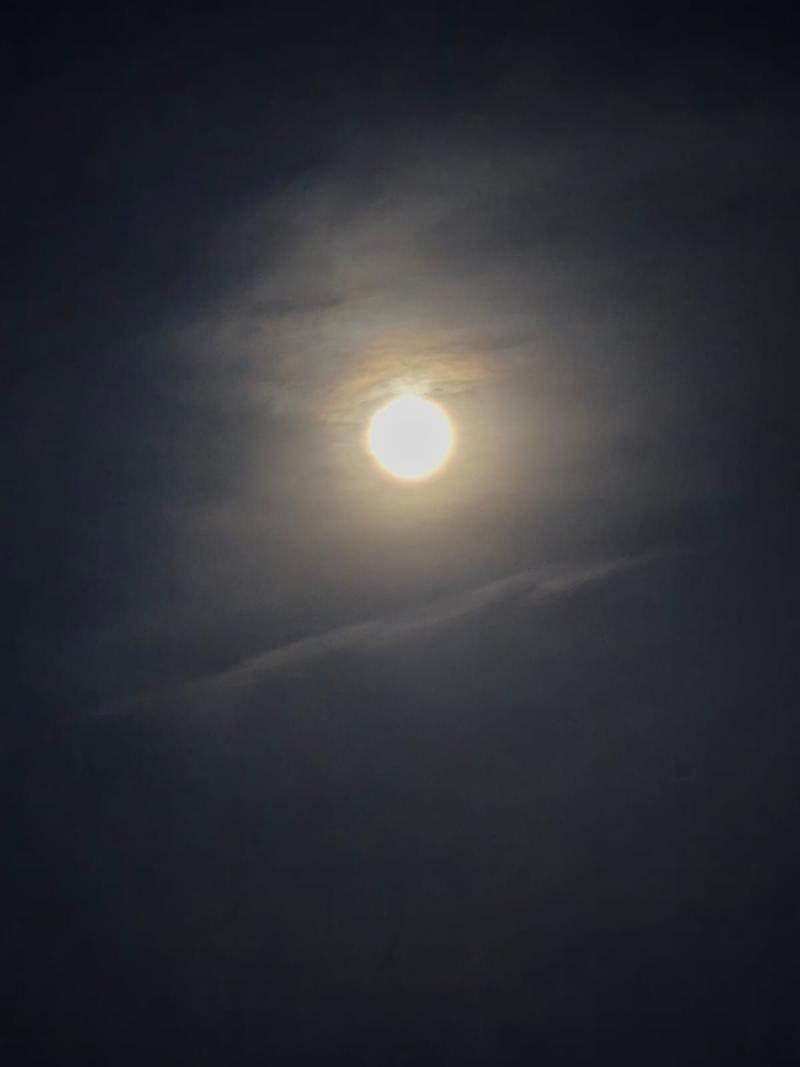
Moody moonlight, but it needs a clear subject, stronger craft, and a sense of place to work as hire‑worthy landscape photography.
Thanks for sharing this, Lorena. If your aim is to be hired for landscape work, this frame is a start but not yet a portfolio piece. It’s essentially a sky study: a bright moon centred in a dark field with a faint diagonal band of cloud. That simplicity gives mood, but it doesn’t show a location, craft with light, or a considered composition—three things clients look for. What did you want the viewer to feel and where are we meant to be? Including the land itself is what turns a sky into a landscape.
TECHNICAL EXECUTION ★★
The moon is heavily blown out, so no surface detail remains, and the surrounding sky is soft and noisy—likely high ISO from a handheld capture. The file feels low‑resolution and a touch hazy, with little micro‑contrast in the clouds. White balance is neutral, but the tone range is compressed, giving muddy midtones. For a full moon, you’ll need a much shorter exposure (start around 1/125s, f/8, ISO 100—the “Looney 11” principle) and a tripod or stabilised telephoto to hold sharpness. Shooting RAW and exposing for the highlights would retain detail while keeping noise down.
COMPOSITION ★★
The moon sits near the centre of a tall frame with large areas of empty darkness; the eye arrives and stops. The faint diagonal cloud helps, but it’s not strong enough to justify so much negative space. A vertical orientation doesn’t add anything here, because there’s no foreground or horizon to anchor the scene. Consider placing the moon on a third and using a foreground—tree line, ridge, building—to give scale and depth. How might this feel if the moon rose behind a known landmark, filling one third while the land led us in?
LIGHTING ★★
The haze gives a gentle halo, but the core is overexposed and the rest is underexposed, leaving little texture to work with. Because the moon is a sun‑lit object, it needs daylight‑like exposure; exposing for the sky will always blow it out. Shooting at blue hour, when ambient light slightly lifts the landscape, would help balance the scene. Alternatively, wait for thinner cloud to shape the light without smothering detail. Right now the light doesn’t sculpt anything—it just produces a hot spot.
STORY ★
There’s no clear sense of place, season, or scale—just a bright disc in darkness. Landscape images that win work usually communicate a location and a moment: the moon rising over a pier, fog spilling through a valley, headlights tracing a mountain road. Without a foreground or human touch, there’s no narrative hook. What location could you pair with the moon to say something about that place—coastline, desert, skyline?
IMPACT ★★
The mood is quiet, but the scene is generic and easy to scroll past; there are countless similar moon shots with no anchor. Stronger technical control and a deliberate composition around a recognisable subject would raise the presence dramatically. To reach five stars, the image would need a compelling foreground, crisp exposure on the moon, and a timed moment that feels specific and memorable.
CONSTRUCTIVE NEXT STEPS
- Plan an alignment between the moon and a foreground subject (tree, ridge, building) using an app like PhotoPills or TPE; shoot from a tripod with a 200mm+ lens to keep the moon large and place it on a third for balance.
- Expose for the moon: start around 1/125s, f/8, ISO 100, manual focus at infinity; if including dark land, bracket 2–3 exposures on a tripod and blend gently to keep it natural.
- Shoot at blue hour or moonrise/moonset when ambient light lifts the landscape and reduces the extreme contrast; avoid thick haze that erases texture.
- In post, reduce highlights to recover the halo, add subtle dehaze/contrast to the cloud band, and crop to a stronger ratio that removes dead space and places the subject with intent.
AI Version 2.12