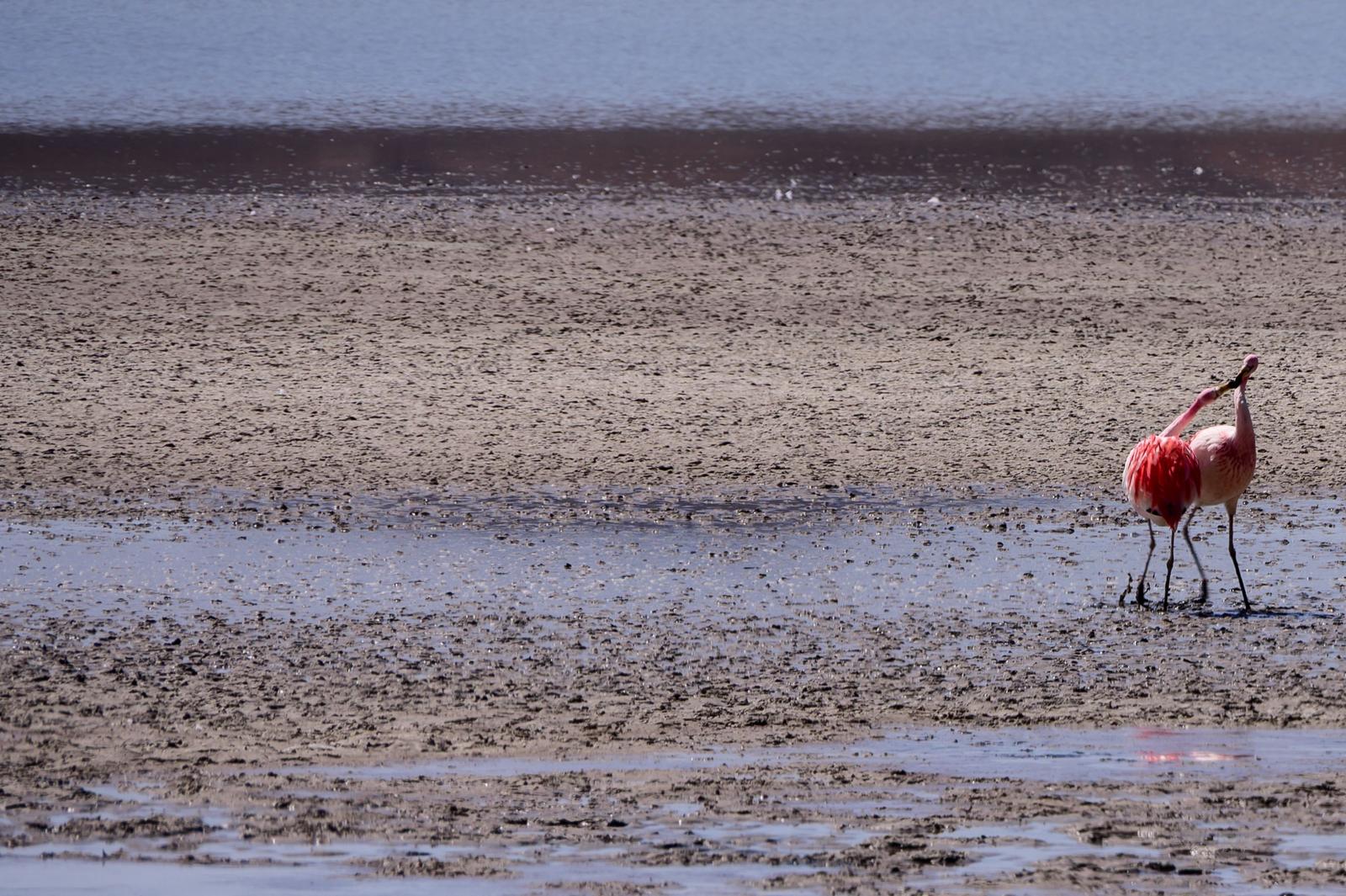
A gentle scene with two flamingos and a vast, lonely salt flat—serene, but the subject feels distant.
Thanks, Dany. This reads as a wildlife/travel image aiming to show the smallness of the birds against the breadth of the Bolivian flats. The pink pair and their soft reflection are the hook; their necks meet in a nice, quiet gesture. Right now the frame is dominated by empty mud and heat‑shimmered water, so the interaction gets a bit lost. Did you want the emptiness to be the primary subject, or the flamingos’ connection? Your answer to that will dictate how tight you frame and when you shoot.
TECHNICAL EXECUTION ★★★
Exposure is broadly fine and colours look natural—no heavy processing, which suits the scene. Detail on the birds is acceptable but not crisp; distance and heat shimmer flatten micro‑contrast, and the small subject size makes softness more noticeable. The background band of water shows atmospheric distortion, typical of midday on salt flats. If this was at a long focal length, a faster shutter and a touch more micro‑contrast on the birds would help them read more cleanly. Early‑morning cooler air also reduces shimmer. Watch for small bright specks in the mud near the birds; selective de‑emphasis would tidy those.
COMPOSITION ★★
The flamingos are squeezed against the right edge with acres of empty space to the left. Negative space can be powerful, but here it feels redundant because the mud texture is repetitive and doesn’t add information. The birds are the emotional centre yet occupy a tiny portion of the frame, so the viewer’s eye drifts. A lower viewpoint could have lifted their heads against the water rather than busy mud, giving cleaner separation. What would a tighter vertical crop around the birds and their faint reflection do for your intent—would it keep the sense of place while restoring presence?
LIGHTING ★★
This looks like hard midday light: flat on colour, high glare on the wet patches, and little shape on the flamingos. It’s serviceable for a record, but it doesn’t bring out feather texture or tone. Dawn or late afternoon at these lakes gives softer light, warmer colour, and catchlights in the eye that lift the birds. Back or side light would also outline the bodies and add depth to the scene. Consider how a slight shift in time could turn the light from neutral to expressive.
STORY ★★
There’s a hint of interaction—the two heads angled together—but distance mutes it. Without a stronger behaviour (feeding, mirrored steps, a wing stretch) the frame leans towards landscape with incidental wildlife. The vastness of the flats could be the story, yet the texture lacks a secondary element (tracks, ripples, other birds) to make that narrative sing. Waiting for a synchronised moment or including more of a reflection would add tension. What behaviour were you hoping to catch, and how long did you stay with them?
IMPACT ★★
The colours of the birds against muted earth tones are pleasing, but the image doesn’t linger because the key moment is small and the frame feels empty rather than intentionally spacious. A stronger gesture or a more intentional crop would raise the punch. As it stands, it functions as a calm record of place, not a memorable wildlife moment. Aim for either a bold environmental statement with purposeful geometry and scale, or a closer, behaviour‑led frame.
CONSTRUCTIVE NEXT STEPS
- Reframe decisively: try a tight vertical or 4:5 crop centred on the two flamingos and their reflection, removing most of the left-hand mud so they’re not pressed against the right edge.
- Return in softer light (dawn/late afternoon). Position for side or backlight to carve feather texture and catchlights; keep ISO low and shutter around 1/1000s for waders.
- Change viewpoint: get lower to separate heads against the water rather than mud, and use a wider aperture to soften the background texture.
- Wait for behaviour—mirrored walking, feeding with heads down, or a pre‑flight run. Those gestures will give the scene the moment it’s missing.
AI Version 2.12