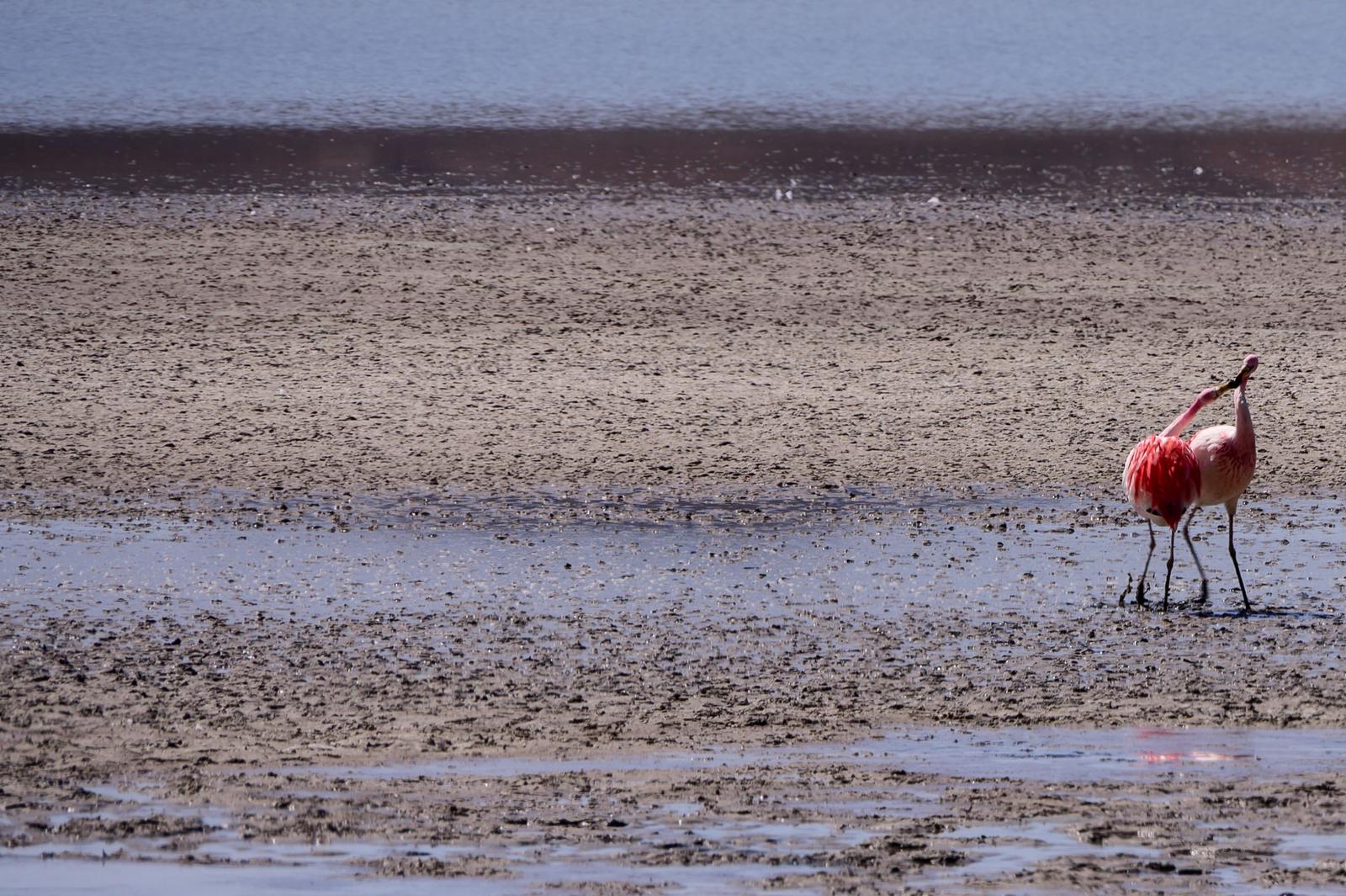
A sweet flamingo moment gets swallowed by too much mud and midday light.
Thanks for sharing this, Dany. If you prefer landscapes, you have two strong routes with wildlife: commit to environmental wildlife (animals small in frame but placed with purpose in a crafted landscape), or commit to a wildlife portrait (fill the frame, eyes sharp, behaviour clear). Here you’ve caught a lovely gesture — the two flamingos touching bills — but they’re small and pushed against the right edge, so the moment gets lost. This sits between genres: part landscape, part wildlife, without fully delivering either. Decide first: were you trying to show the vastness of the flats with the flamingos as accents, or the intimacy of their interaction? That choice will dictate lens length, distance, and framing next time.
TECHNICAL EXECUTION ★★
Exposure is broadly fine and colours are natural, but the birds are too small for critical detail and appear slightly softened by distance and heat shimmer. Wildlife images usually hinge on tack‑sharp eyes; at this scale that’s impossible to judge. Midday conditions have also reduced micro‑contrast. For moving waders, aim for 1/1000–1/2000s, AF‑C with a small zone, and stop down around f/6.3–f/8 to keep both heads crisp if they interact. A longer lens (400–600mm) or getting closer would lift the file quality considerably. A tighter crop is workable, but there isn’t enough pixel detail here for a strong print.
COMPOSITION ★★
The birds are squeezed near the right edge, facing out, with a large expanse of featureless mud dominating the frame. Negative space can be powerful, but it needs structure — a leading water channel or a strong graphic line — which isn’t present here. A panoramic crop could remove much of the empty foreground and centre band, then place the pair on a third facing into space. Alternatively, if this is meant to be an animal portrait, go far tighter so their gesture becomes the clear subject. Ask yourself: what is the hero of the frame — the landscape’s scale, or the flamingos’ connection?
LIGHTING ★★
This looks like hard midday sun: flat colour, little modelling on the birds, and shimmer over the distant water. Flamingos glow beautifully in low, warm light where feathers and reflections come alive. Early or late light would add shape and catchlights to the eyes, and even backlight could make those pinks sing through the feathers. Overcast can also work to soften contrast on the pale plumage. Right now the light records the scene but doesn’t help tell the story.
STORY ★★★
The beak‑to‑beak interaction hints at courtship or bonding — that’s your strongest element. Unfortunately the distance and scale make it hard to read, and the surrounding mudflats don’t add additional context or tension. Waiting for a clearer behaviour (wing stretch, synchronized feeding, or a mirrored pose) would strengthen the narrative. Consider how a lower viewpoint might separate the birds from the background and give them presence. What moment were you waiting for, and did you shoot a short burst to catch the peak gesture?
IMPACT ★★
The scene is calm but easy to pass by because the subjects don’t command the frame and the light is indifferent. A decisive choice — either bold environmental framing with graphic lines, or a tight behavioural portrait — would add bite. Cleaner edges and stronger light would also raise memorability. To reach five stars you’d need a clearer subject hierarchy, engaging behaviour, and light that adds mood.
CONSTRUCTIVE NEXT STEPS
- Decide your intent at the location: environmental wildlife or portrait. For environmental, place the birds on a third and use visible features (water channels, shoreline bands) as compositional anchors; for portraits, use 400–600mm, aim for 1/1000–1/2000s, AF‑C, and fill at least a quarter of the frame with the subject.
- Shoot at first/last light. Position so the birds face the sun to get catchlights; try slight backlight when they preen to light the translucent feathers.
- Change viewpoint and spacing: get lower if safe and permitted, and leave space in front of the direction they’re looking; avoid pinning them to the frame edge. A panoramic crop here removing most of the bottom mud and placing the pair left of centre would already help.
- Prioritise behaviour. Watch for preening, wing flaps, mirrored poses or take‑offs; shoot short bursts to catch peak gesture and keep both heads separated from each other and the background.
AI Version 2.12