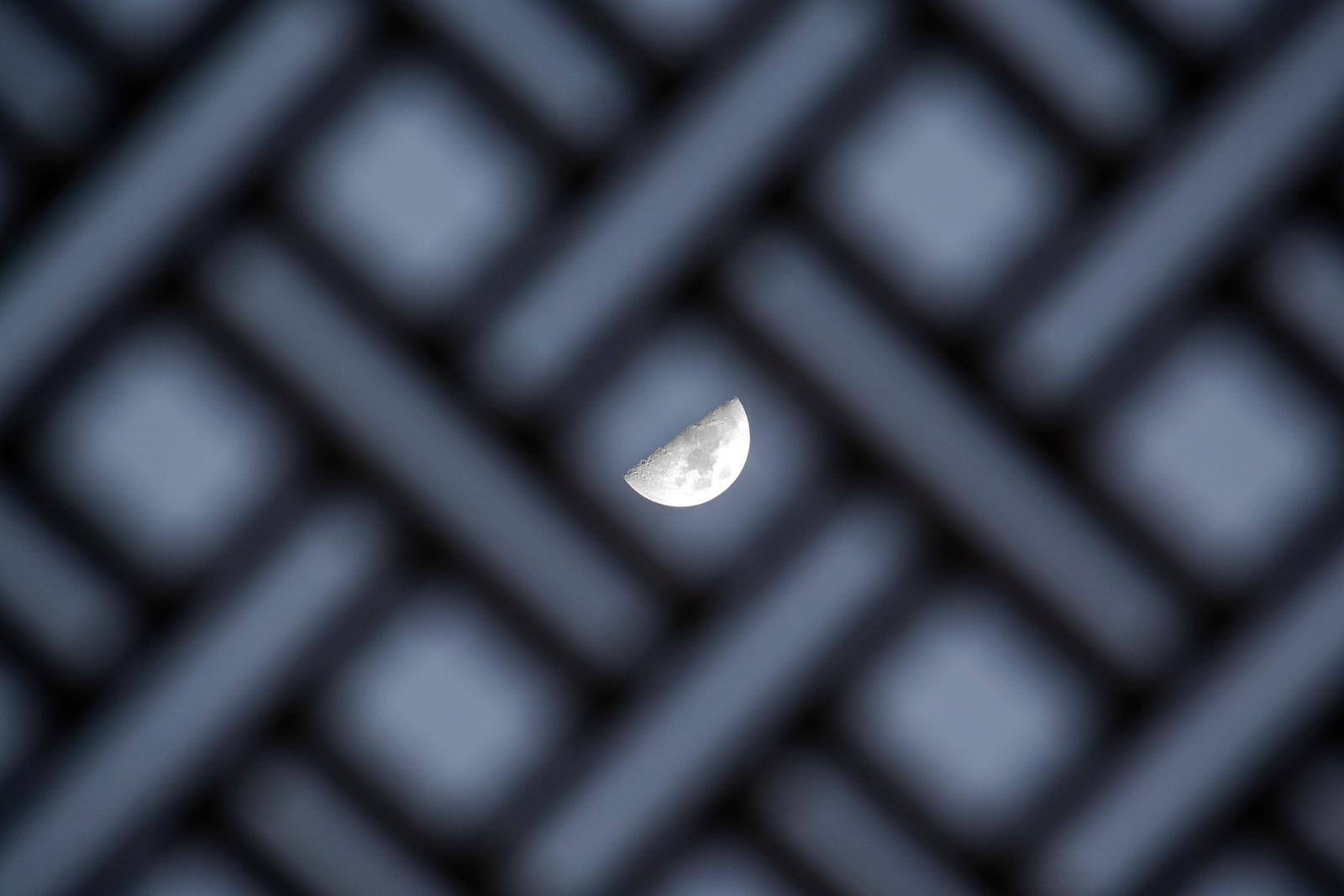
A neat idea: the moon caged by a soft, geometric lattice.
Thanks, Lasha. Your intention reads clearly—the blurred ceiling pattern becomes a gentle frame while the half‑moon sits as the bright anchor. This falls into fine art/abstract territory more than landscape, and the concept of nature framed by man‑made geometry is the strongest part. The softness of the lattice does lend a dreamy feel, though the moon’s placement and the degree of blur keep the image from fully landing the “ethereal” mood. Ask yourself: do you want the pattern to quietly suggest space, or to be a graphic character in its own right? Committing more boldly to one of those options would strengthen the result.
TECHNICAL EXECUTION ★★★★
The moon is acceptably sharp with visible detail along the terminator, and exposure is handled well—no garish halos or heavy processing. Focus fall‑off on the near lattice is smooth and free from ugly artefacts. I do see a touch of softness on the lunar edge, likely atmospheric shimmer or a shutter speed a tad slow for a long focal length; a crisper moon would elevate the file. Noise is low and colour feels natural, with a restrained palette that suits the subject. To reach five stars, lock in a “moon exposure” in manual and shoot a short burst from a tripod to counter micro‑shake and turbulence.
COMPOSITION ★★★
The diagonal grid creates a pleasing rhythm, but the moon sits almost dead‑centre and not quite within a single clean diamond—so the framing idea doesn’t fully resolve. Because the lattice repeats, the eye wanders among the soft squares before resting on the moon, weakening your focal hierarchy. A tiny shift so the moon sits precisely in the centre of one opening—or a deliberate placement on a third—would add intent. Likewise, a slight rotation to align the diagonals with the frame corners would tidy the geometry. Consider a tighter or square crop to remove redundant repeats and concentrate the design.
LIGHTING ★★★
The light is essentially the moon itself against a muted blue‑grey field; it’s clean and calm. The contrast between the bright lunar surface and the subdued lattice supports your mood, but the surrounding tone is uniformly flat, so the scene lacks depth beyond the sharp/soft contrast. A touch more separation—either slightly darker lattice or a fractionally lower moon exposure to reveal extra crater detail—would add polish. This is competent, but not yet atmospheric.
STORY ★★★
The idea of the natural world glimpsed through human structure is clear and interesting. There’s a hint of tension—moon versus grid—that gives the frame purpose beyond a simple sky shot. However, the story stops at the concept; no extra layer (scale cue, perfect alignment, or a revealing phase of the moon) deepens it. What feeling do you want the lattice to convey: confinement, protection, or playful geometry? Pushing that choice in‑camera would strengthen the narrative.
IMPACT ★★★
The image is pleasant and thoughtful, and the restrained palette helps. The idea is good, but the almost‑there framing and modest sharpness keep it from being a “stop‑and‑stare” frame. With more precise placement and a crisper moon, this could be a memorable minimalist piece. Right now it lands as a solid study rather than a finished statement.
CONSTRUCTIVE NEXT STEPS
- Place the moon deliberately: use live‑view grid lines and micro‑adjust your position so the moon sits exactly inside one diamond opening; rotate so the lattice diagonals run corner‑to‑corner.
- Commit to the role of the lattice: either go wider aperture and move closer so it melts into a creamy wash, or stop down (f/11–f/16) to give it more definition—avoid the halfway softness that looks accidental.
- Nail the moon exposure and sharpness: tripod, manual focus on the moon, ISO 100–200, around 1/125–1/250 s at f/8 as a starting point; shoot a short burst to beat atmospheric shimmer.
- In post, use a subtle radial mask to reduce exposure and clarity on the lattice by ~0.3–0.5 stop while adding a touch of local contrast to the moon; consider a tighter or square crop to cut repetitive shapes.
AI Version 2.12