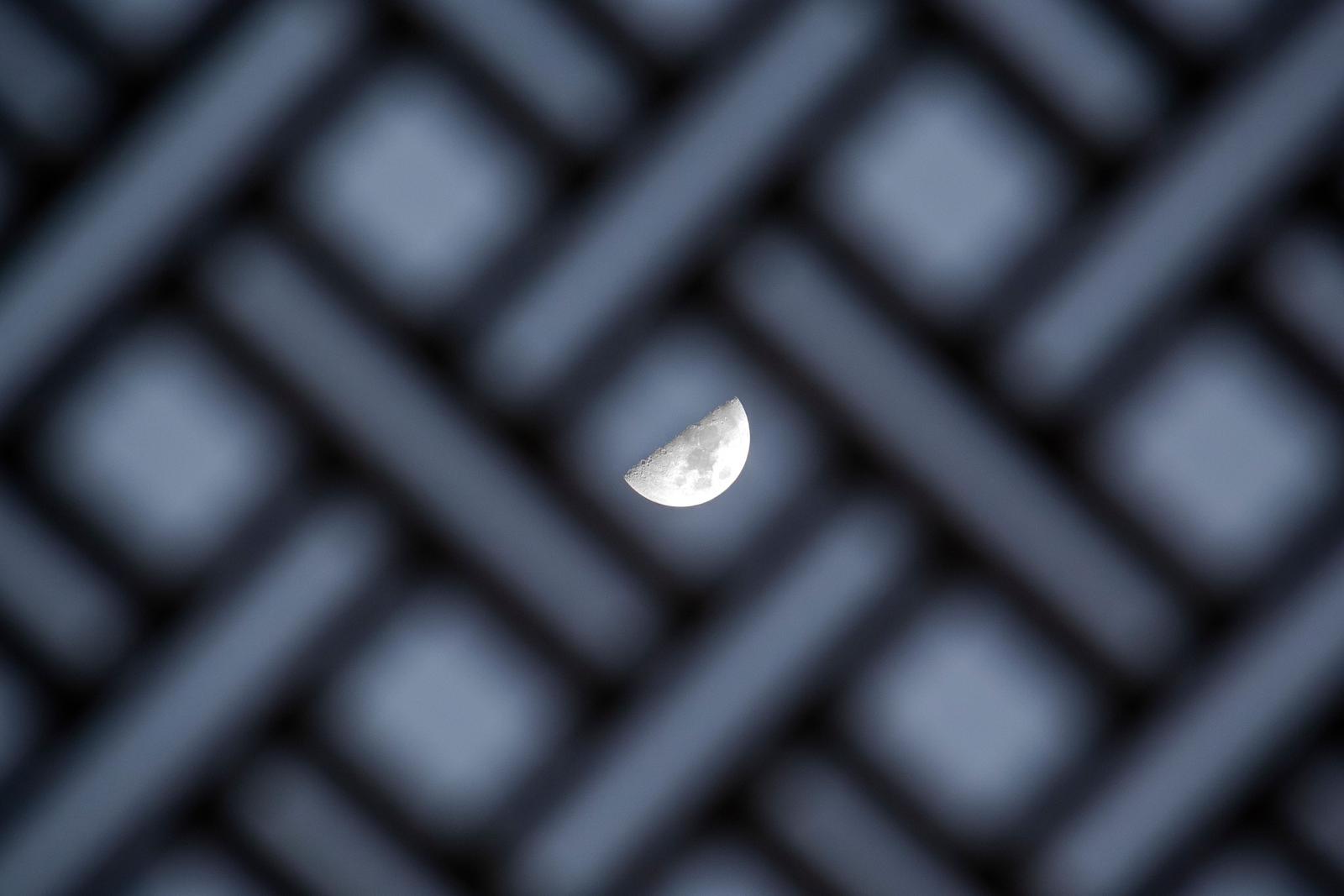
A clean, graphic idea — the moon pinned inside a soft lattice — that nearly lands a stronger punch.
That description fits what you’ve made: a minimal, fine‑art leaning night study where a sharply rendered moon sits inside an out‑of‑focus geometric grid. The concept is solid and visually readable at a glance. This sits between fine art and a touch of astrophotography, using the fence as a foreground frame. The crisp lunar detail against the soft, repeating diamonds is the photograph’s strongest asset. One question for you: were you aiming for perfect, mathematical symmetry or a more casual off‑centre tension? Deciding that upfront would help steer both framing and post work.
TECHNICAL EXECUTION ★★★★
The exposure on the moon is well controlled — highlights aren’t blown and there’s readable texture along the terminator. Focus on the moon is crisp, and the shallow depth of field renders the foreground pattern as a soft, uniform blur. I can see a hint of edge haloing on the bright lunar rim, likely from sharpening or high local contrast; keep that subtle for print. Noise is low and colour is neutral, which suits the restrained mood. For absolute tack‑sharp detail, a faster shutter (around 1/250s or faster) with manual focus via live view works well since the moon moves quickly across the frame.
COMPOSITION ★★★
The idea of “moon inside a diamond” reads immediately, but the central placement makes the image feel static. The lattice diagonals are strong, yet they don’t line up with the frame edges in a way that feels deliberate — it’s close, not exact, which weakens the graphic intent. You could go two ways: commit to perfect geometry (moon centred exactly within one diamond, diagonals precisely corner‑to‑corner), or push tension by placing the moon off‑centre along a diagonal intersection. The very wide horizontal crop also leaves a lot of similar blur at the sides; a tighter square or 4:5 around the dominant diamond would concentrate the idea.
LIGHTING ★★★
The moon provides its own hard, directional light, which you’ve handled well. The fence blur sits in a gentle, cool dusk tone that doesn’t compete with the subject. Still, the light isn’t adding extra drama or mood beyond contrast, so it feels functional rather than expressive. A slightly darker rendering of the lattice would deepen separation and make the moon pop without turning the frame into a gimmicky vignette.
STORY ★★★
The concept hints at distance and separation — a celestial body seen through a man‑made barrier. It’s a clear idea, but it doesn’t evolve as you look longer; there’s little tension beyond the initial read. Consider how a specific choice (perfect confinement vs. near‑escape off a corner) could sharpen that theme. What feeling do you want first — order, constraint, or a small act of visual disobedience?
IMPACT ★★★
The graphic contrast gives the shot immediate presence, and the restraint in colour helps. However, because the geometry isn’t nailed or intentionally broken, the picture sits between bold design and casual capture. With tighter control of framing and a more decisive crop, this could step up from “nice idea” to a memorable print‑worthy piece.
CONSTRUCTIVE NEXT STEPS
- Decide the visual stance before shooting: either precision (moon centred perfectly within a single diamond, diagonals aligned to the frame) or tension (place the moon on a diagonal intersection a third from centre). Move your position a few centimetres to refine alignment.
- Try a tighter crop — square or 4:5 — around the dominant diamond to reduce repetitive blur at the sides and concentrate the concept.
- Use manual focus and a fast shutter (≈1/250s–1/500s), with aperture around f/2.8–f/4 to keep the fence soft while maintaining lunar detail; ISO as needed to hold shutter speed.
- In post, apply a subtle radial mask: add a touch of texture/clarity only on the moon and slightly darken/desaturate the lattice to increase separation. Watch for halos along the lunar rim and reduce sharpening there.
AI Version 2.12