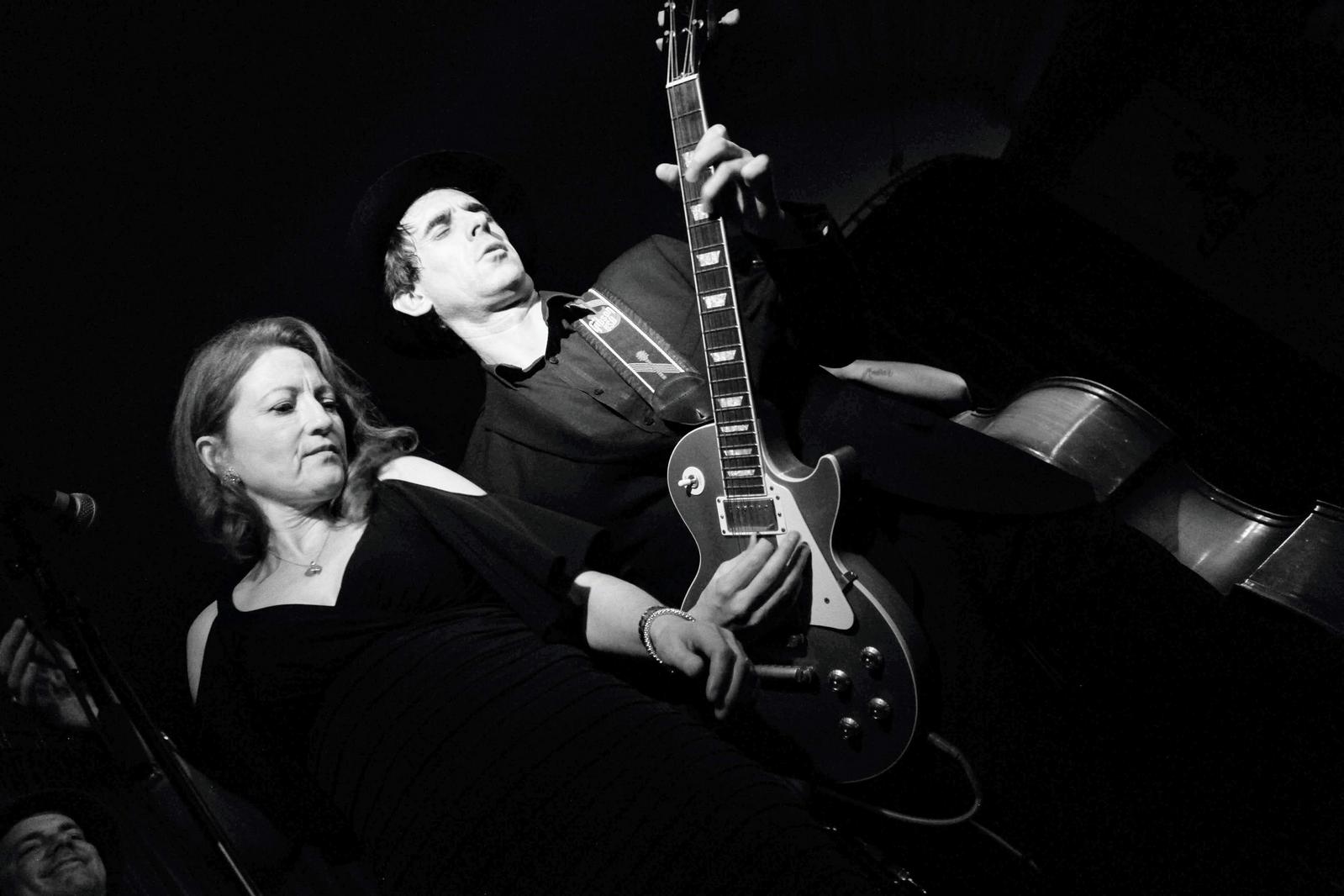
A gritty, low‑angle slice of stage energy with strong diagonals, held back by clutter on the edges.
Thanks for sharing this, Stuart. You’ve caught a lively live‑music moment — the guitarist mid‑riff with that bent‑back posture and the singer poised in the foreground — which sits between performance portrait and small‑venue documentary. The black‑and‑white treatment fits the mood and keeps attention on expression and gesture. My notes below focus on what’s visible: the technical handling is solid for a dark stage, while compositionally the left edge (microphone stand and partial face) and the cropped guitar headstock are the main obstacles. As you keep learning, ask yourself: is the picture about the guitarist’s solo or the relationship between the two performers? That decision should drive where you stand, what you include, and when you press the shutter.
TECHNICAL EXECUTION ★★★★
The file looks clean for a stage environment — good detail in the faces and jackets with blacks holding together nicely. Focus appears acceptable on the singer and close to the guitarist’s face; the strumming hand shows a touch of motion blur that suits the scene. Tonal separation in the monochrome conversion is handled well, with no obvious clipping or muddy midtones. I don’t see heavy processing artefacts, which keeps it honest. To push this to five stars, aim for slightly crisper focus on the guitarist’s eyes and manage highlight hotspots on his forehead with either a touch of negative exposure compensation on capture or a local burn in post.
COMPOSITION ★★★
The diagonal tilt and the guitar neck cutting across the frame create momentum that suits live music. However, the left edge is busy: the microphone stand runs parallel to the singer and a partial face peeks in at the bottom left, both dragging the eye away from the main action. On the right, the bright double‑bass body competes for attention, and the guitar headstock is cropped uncomfortably at the top edge, making the frame feel cramped. There’s also a large patch of dead black space upper left that doesn’t add much. A tighter, decisive crop to lose the stray face and stand, or a slight step to your right when shooting, would simplify the scene and let the diagonal of the guitar lead cleanly. What made you choose this strong tilt — and would a subtler angle have carried the energy without introducing so many edge distractions?
LIGHTING ★★★★
Stage spots give you punchy contrast and good separation from the background. The light skims the singer’s face and shoulder nicely, while raking across the guitarist to highlight his expression and hand position. There are a couple of small hotspots on the guitarist’s forehead and nose, but they’re not fatal. The rest of the frame falls off into black in a pleasing way that keeps the mood gritty. For the next level, watch for moments when both faces catch a similar quality of light, or slightly underexpose (‑1/3 EV) to hold the brightest skin detail and lift the shadows selectively later.
STORY ★★★
There’s a readable moment: the guitarist is in full flow and the singer looks down, perhaps listening between lines. The energy of his posture tells us “solo,” but the lack of connection between the two performers keeps it from becoming a stronger shared moment. The stray face at bottom left hints at the room but confuses the narrative, and the bright double‑bass body on the right doesn’t contribute to the specific story you’re telling here. If your intent was the electric chemistry of a duo, wait for a glance, a lean‑in, or matching gestures; if it’s the guitarist’s solo, isolate him more cleanly. What exact beat of the song were you hoping to freeze — the start, the apex bend, or the release?
IMPACT ★★★★
The frame has presence: a moody monochrome, strong diagonal guitar line, and a believable sense of the venue. It feels like you were in the thick of it, not sniping from afar, which gives authenticity. The edge clutter and cramped crop hold it short of being unforgettable, but the core is strong enough to stop a viewer. Clean up those borders and time a more connected beat and this could easily jump a level. Consider building a series from the same gig to amplify the impact through sequencing.
CONSTRUCTIVE NEXT STEPS
- Reframe decisively at capture: from your position, take a half‑step right and slightly higher to clear the microphone stand and exclude the partial face; either include the full guitar headstock or crop tighter above the pickups so it doesn’t look accidentally chopped.
- Time for connection: shoot short bursts around vocal pauses and guitar peaks, aiming for a shared glance or mirrored body angle; those micro‑interactions lift the frame from “performance” to “moment.”
- Settings for small stages: use 1/250–1/400s, f/2.8–f/3.2, and raise ISO as needed to keep the hands crisp while retaining some motion feel; set exposure manually once the lights are stable to avoid the meter chasing spotlights.
- Post‑processing: burn the bright double‑bass highlight and the microphone stand by about 0.3–0.5 stops, add a gentle dodge to both faces, and clone/heal the tiny face bottom left if you keep this frame; a slight midtone contrast (clarity) on the guitar can add bite.
AI Version 2.12