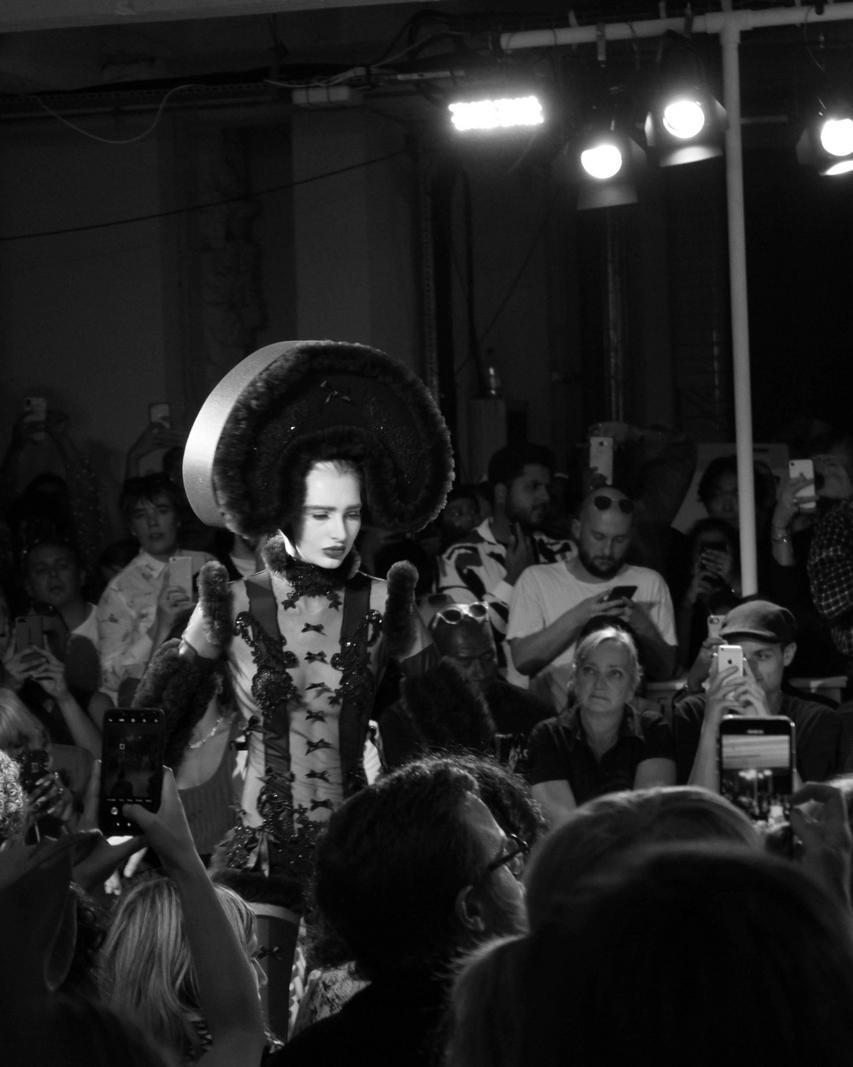
A gritty, high‑contrast slice of the runway that captures the theatre and the chaos in one frame.
That pressure shows in a good way — you’ve brought back the feeling of being there. This sits between fashion and documentary: the dramatic headpiece and styling are the hook, while the forest of phones and the bright rigging place us at a live show. Being quick is the job on a runway; next time, speed is about pre‑decisions — AF‑C, a minimum shutter, and exposing for the spots so you’re free to chase moments. Do you want your viewer to feel the frenzy of the crowd, or to focus purely on the garment? Deciding that early will guide how tight you frame and where you stand.
TECHNICAL EXECUTION ★★★
The exposure holds the model’s face and garment reasonably well, and the black‑and‑white conversion avoids nasty mixed colour casts from stage lights. However, the bank of lights at the top right is blown and pulls the eye hard; while expected on a runway, it still reads as a technical distraction. Sharpness on the face looks acceptable but not biting — likely from a modest shutter or slight AF lag while the subject moved. Noise in the darker audience areas is fine for reportage, but the midtones on the face could use a touch more clarity to reveal makeup and texture. For a cleaner result under these conditions, aim for AF‑C with a single point on the face, 1/500–1/800s, auto‑ISO capped, and dial in around −0.7 EV to protect highlights.
COMPOSITION ★★
The model is centred and commanding, but the frame is crowded with very bright, high‑contrast elements — especially the illuminated rig and white pole at the top right. These compete directly with the headpiece, which should own the frame. Several phones intrude at the bottom and left edges; they add context but are too prominent and create messy borders. The headpiece sits tight to the top, leaving little breathing room, which heightens the cramped feeling. A decisive crop from the top to remove the lights, and from the left to reduce the phones, would immediately strengthen the hierarchy. When shooting, a slightly lower angle and a longer focal length would lift the model against a cleaner background and compress away distractions — would that have been possible from your position?
LIGHTING ★★
Runway spotlights give you punch and shape, which suits the theatrical styling, but here they’re harsh and inconsistent. The face is lit but a touch flat compared with the richly textured headpiece and sleeves, so the garment detail doesn’t quite pop. The blown fixtures at the top right overpower the subject and create a secondary “sun” in the frame. Black‑and‑white helps control colour chaos, yet the tonal balance still favours the background lights over the model. Slight, targeted dodging on the face and upper torso and burning down the fixtures would rebalance attention.
STORY ★★★
The moment communicates the spectacle of fashion week: a striking look, a serious expression, and a sea of spectators raising phones. That tension between performance and observation is interesting and honest. What’s missing is a peak gesture — the model’s stride, a clear hand position, or a micro‑expression that adds bite to the frame. Because the show context is so strong, you can lean into it: either isolate the look for editorial clarity or go wider to make the audience’s behaviour the subject. Which story do you want to tell most — the craft of the outfit or the culture around it?
IMPACT ★★★
The headpiece and styling naturally deliver punch, and the bustle of phones gives immediacy. Impact is reduced by the competing bright hardware and the slightly tentative framing, which makes the image feel more like a strong outtake than a hero frame. With tighter control of edges and highlights, this could be publication‑worthy as a runway reportage image. Aim for a cleaner, punchier anchor on the model so the drama reads first and the environment second.
CONSTRUCTIVE NEXT STEPS
- In camera: set AF‑C with a single point on the face, 1/500–1/800s, auto‑ISO (cap around ISO 6400) and −0.7 EV; this protects the stage highlights and keeps the subject crisp as they walk.
- Positioning: if possible shoot from slightly lower and longer (e.g., 135–200mm at f/2.8–f/3.5) to lift the model above the crowd and compress away background clutter.
- Editing: crop hard from the top to remove the light bank and right‑side pole, and from the left to tame the phones; then burn the remaining hot spots and dodge the face/torso to make the garment lead.
- Timing: fire in short bursts as the front foot lands and the shoulders open — that step usually gives a confident line and cleaner separation of arms from the torso.
AI Version 2.12