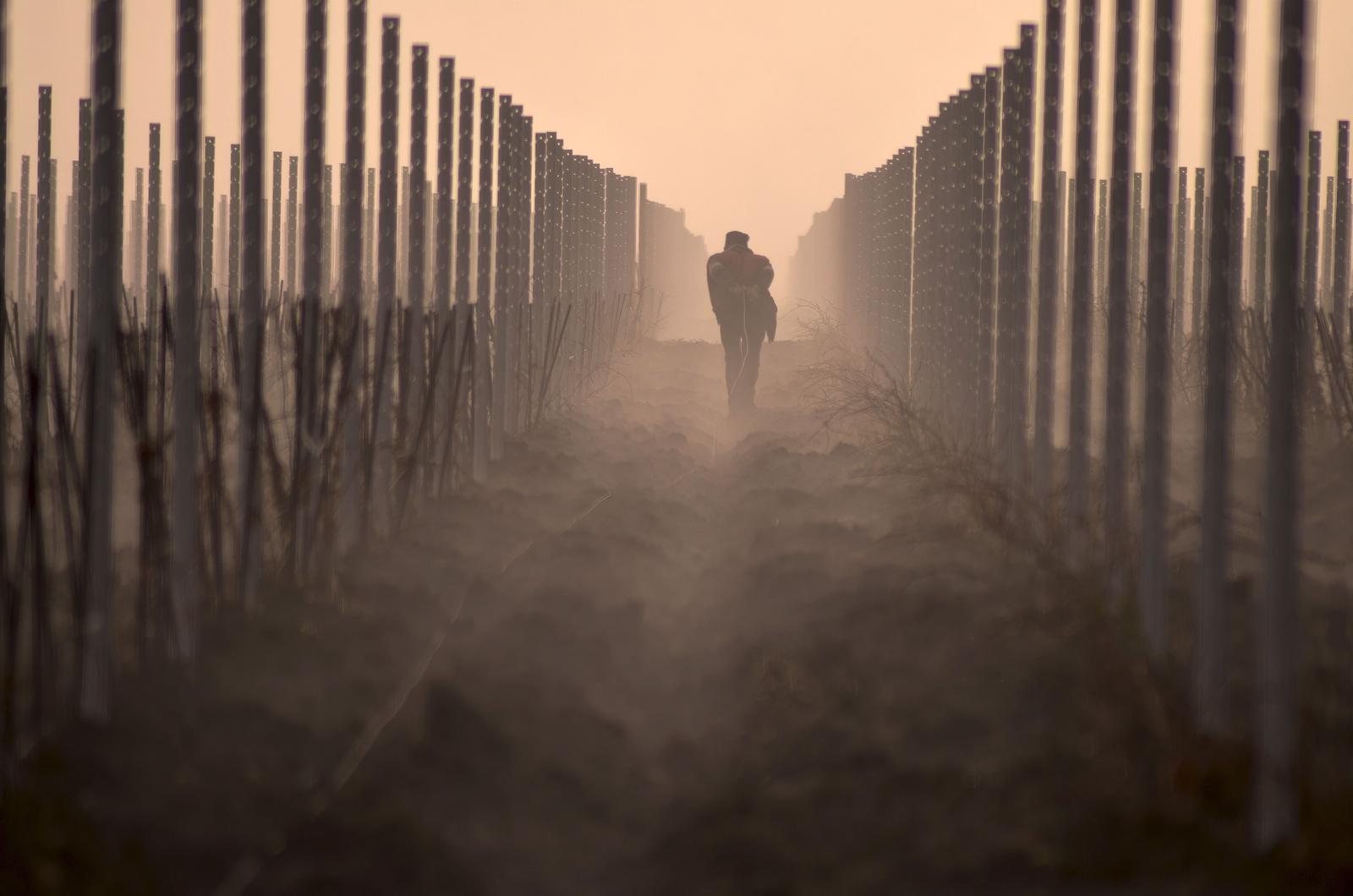
A quiet, dusty corridor with a lone walker — strong atmosphere and rhythm.
This reads as travel/documentary with a fine‑art sensibility: a worker or traveller moving through rows of posts, swallowed by dust and warm air. The repeating uprights create a tunnel that pushes the eye to the small human figure in the centre. The restraint in colour and processing fits the mood well. I’ll judge it on those terms, focusing on the visible choices in frame rather than any stated intent. One question for you: were you deliberately aiming for a near‑silhouette and anonymity, or would a clearer gesture from the person have helped your story?
TECHNICAL EXECUTION ★★★★
Exposure is handled confidently: the backlit haze holds detail without blocking up the shadows, and nothing feels overcooked. The warm, muted palette looks natural and free from heavy processing. Overall sharpness is adequate, though the dust lowers micro‑contrast and the figure reads a touch soft; if unintentional, a faster shutter (around 1/500s) would have kept the person crisper without losing mood. I don’t see distracting noise or artefacts. Vertical lines look straight and consistent across the frame. To reach five stars, I’d want slightly more bite around the subject—either through crisper focus or a subtle, local contrast lift.
COMPOSITION ★★★★
The corridor of posts forms excellent leading lines and symmetry that naturally funnel us to the walker. Central placement suits that geometry and the sense of distance. However, the heavy, muddy foreground occupies a lot of the lower frame without adding much new information; trimming some of it would concentrate attention. The figure is small and nearly swallowed by the haze—powerful, but it risks feeling anonymous rather than purposeful. Would stepping forward a few metres, or waiting until the walker was one pole closer, have strengthened presence while keeping the vanishing point tension? A near‑perfect frame, just held back by the proportion of empty foreground and the smallness of the human element.
LIGHTING ★★★★
The warm backlight and dust create a lovely veil that softens everything and sets the mood. The posts catch just enough light to define structure without glare. The figure has a faint rim but could use a touch more separation from the mid‑tones behind them; a step later in the sun’s angle or slight repositioning could have given a stronger outline. Colour temperature is consistent and not pushed. With a tad more edge light—or selective dodging to emphasise the outline—this would reach the top tier.
STORY ★★★
There’s a clear sense of place and time: dust in the air, work rows, a solitary figure heading down the line. What’s missing is a specific moment—the walker’s gesture is closed, and we can’t read what they’re doing or feeling. A stronger stride, a turned profile, or a second person deeper in the tunnel would add a thread of tension or connection. As it stands, it’s atmospheric but a little generic. What single gesture would tell us whether this is toil, routine, or relief at day’s end?
IMPACT ★★★★
The repeating posts and warm haze make a memorable visual signature, and the restrained edit helps the picture breathe. It’s easy to sit with this image for a moment. The lack of a decisive human gesture keeps it from being truly unforgettable. Strengthen the subject’s presence—or the action—and this could become a standout frame in a series about this place and work.
CONSTRUCTIVE NEXT STEPS
- Timing and gesture: shoot a short burst and wait for a clean open stride or a profile turn so the figure’s limbs and posture read clearly against the haze; this single change will add character.
- Refine the frame: crop 10–15% from the bottom to reduce the muddy foreground and place the walker slightly lower in the frame; consider stepping forward a few metres next time to increase subject size while keeping the corridor lines.
- Exposure control: if softness was unintentional, use ~1/500s with a modest ISO bump to hold the silhouette sharp; if you prefer motion, keep it around 1/125s but lean into it so the blur feels deliberate.
- Post‑processing: apply a subtle radial dodge and a touch of local dehaze/clarity around the walker, and clean a few stray twigs along the path that catch the eye; keep global contrast gentle to preserve the dusty mood.
AI Version 2.12