Strong geometry meets human graft in a place that feels unmistakably real.
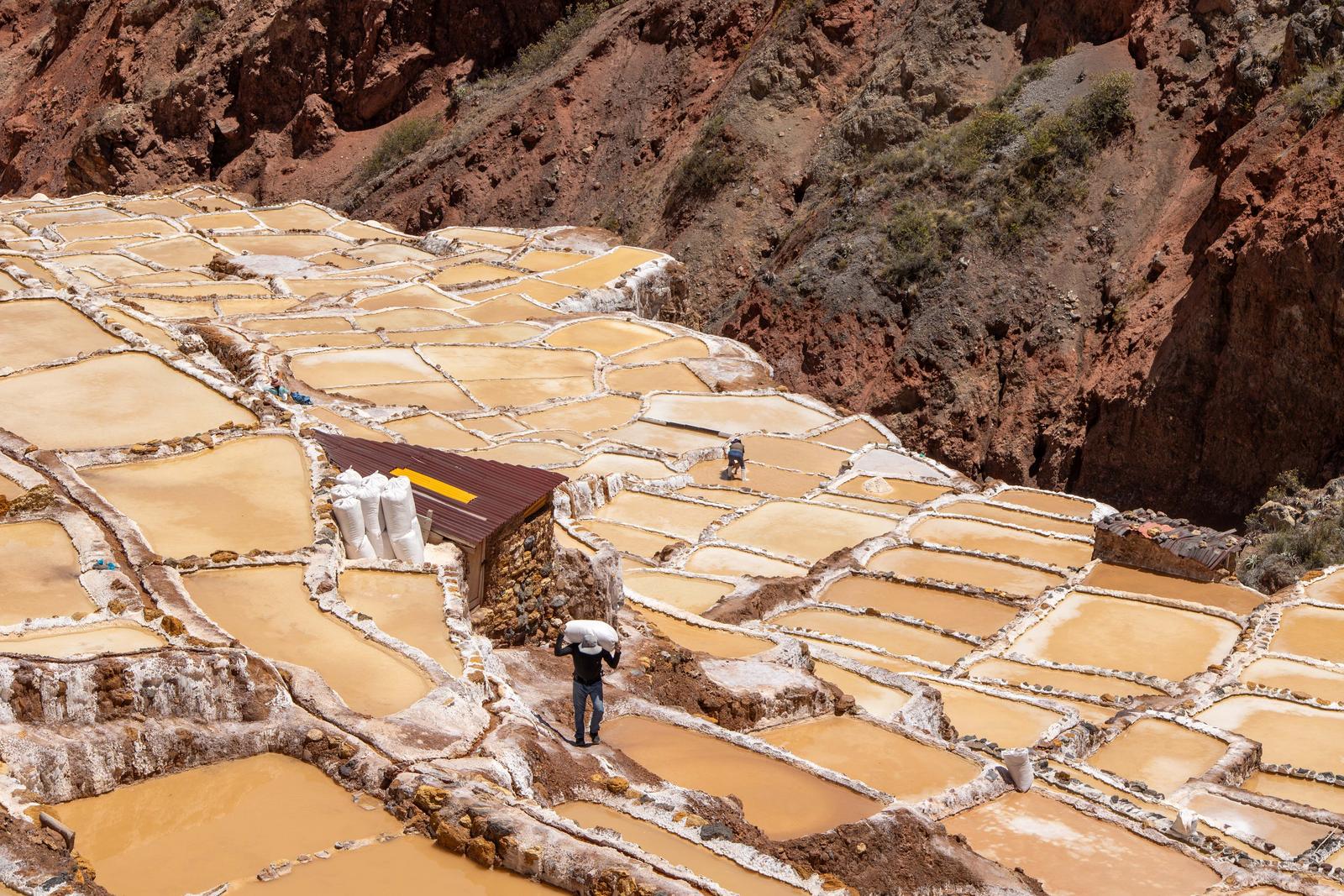
You’ve seen the right tension here: the patchwork of salt pans versus the smallness of the workers. As travel/documentary this works well, especially with the man carrying the sack in the lower centre and the second worker echoing him further up. The graphic rhythm is the backbone; the people give it scale and purpose. My only push-back is distance and midday light — both keep the scene descriptive rather than gripping. Did you consider moving a few metres to place the carrier on a third and isolate him against a single pan?
TECHNICAL EXECUTION ★★★★
Focus is crisp across the frame; the granular salt edges and the rock face hold detail, suggesting a sensible aperture (around f/8–f/11) and stable shutter. Exposure is controlled despite the reflective surfaces; no obvious clipping on the white rims. Colour is warm and natural for the iron-rich brine, and there’s no heavy processing or halos — good restraint. Midday light introduces a few specular hotspots and a slight yellow cast that makes the palette feel uniform; a small decrease in yellow/orange saturation would help. File quality looks clean with no visible noise or artefacts, easily printable.
COMPOSITION ★★★★
The repeating pans create strong geometry, and the diagonal path the carrier is on gives the eye a route through the image. The small building with white sacks provides a secondary anchor, and the second worker adds a nice echo in scale. However, the top-left quadrant is a large expanse of similar shapes with little payoff, so the energy disperses there. The brightest elements (the white sacks and the yellow strip on the roof) pull attention away from the worker slightly. A tighter crop from the top-left and a step or two to position the carrier on the lower-left third would concentrate the story while keeping the graphic rhythm.
LIGHTING ★★★
This is hard, high sun. It’s functional and honest, but it flattens the ridges and makes the colour palette more monotone than it needs to be. Early/late sun would rake across the pans and carve out texture, or thin cloud would soften glare and open dynamic range. A circular polariser here could tame reflections on the brine and deepen tones without looking processed. As it stands, the light documents well but doesn’t add much mood.
STORY ★★★★
The human element is present and respectful: a worker bearing a load and another scraping a pan. That immediately explains the place and the labour involved, which many similar salt-pan shots miss. The distance keeps us observers rather than participants, so the emotional pull is modest. Waiting for a clear stride or a moment of interaction between the two workers would elevate it. What outcome were you hoping for from the carrier — a mid-step silhouette, a pause, or a look toward the building?
IMPACT ★★★★
The graphic forms plus small figures deliver a strong sense of place and scale; it’s immediately readable as Maras. The picture holds attention thanks to pattern and craft, not gimmicks. The harsh light and slightly distant viewpoint keep it shy of unforgettable. With tighter framing on the labour and more shaped light, this could be a standout frame in a travel set.
CONSTRUCTIVE NEXT STEPS
- Field craft: if possible, return in early/late light or thin overcast; use a polariser to cut glare from the brine and enrich the white salt rims.
- Positioning: move a few metres left/right and slightly lower to place the carrier on a third and against a single pale pan for clean separation; keep the diagonal pathway as a leading line.
- Timing and settings: wait for a decisive step or transfer of the sack; aim for 1/500–1/1000s at f/8–f/11, ISO as needed, to freeze the gesture sharply.
- Post: crop 10–20% from the top-left to remove the weaker repetition; subtly burn the white sacks and the yellow roof strip; dodge the two workers and the nearest salt ridges to guide the eye; consider cloning the stray bright bag near the lower right edge.
AI Version 2.12