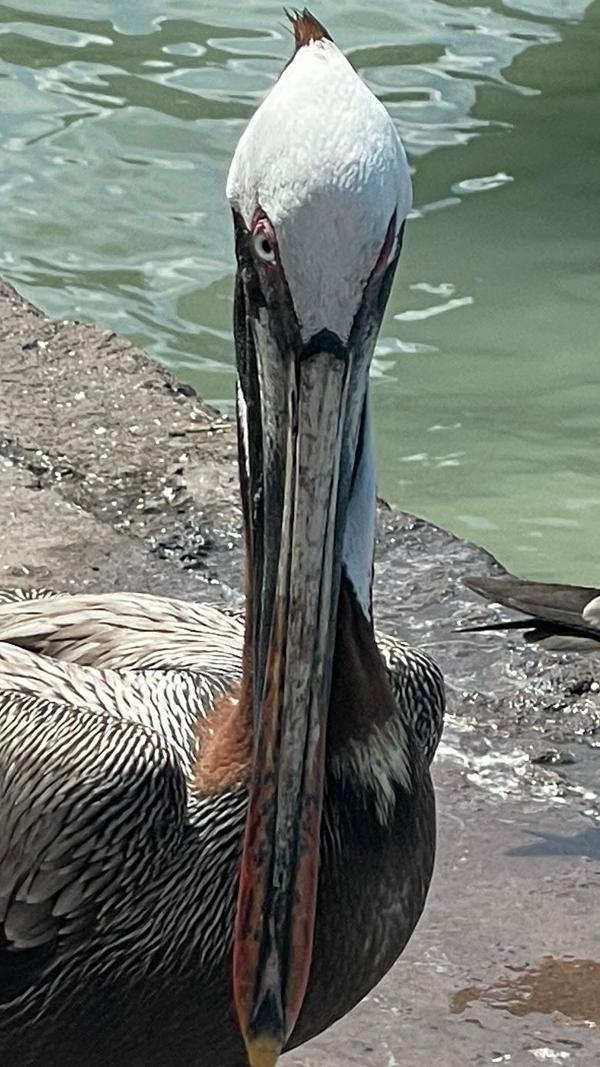
A striking head‑on pelican portrait with presence, but hampered by harsh light and stray background clutter.
This reads as wildlife — a close, front‑on portrait of a pelican by the water. Your strongest choice is the bold symmetry of the bill running like a column through the centre, and the pale eye peering out from the shaded face. I’ll frame my comments with that intent: an intimate character study rather than behaviour. What drew you to the head‑on viewpoint — the graphic geometry of the beak or the challenge of eye contact? Knowing that helps decide how low you go, how tight you crop, and how much background you allow.
TECHNICAL EXECUTION ★★★
Focus looks acceptable on the beak with decent detail along the grooves; the eye is a touch soft, which weakens the connection a little. Exposure is mostly controlled, though the white crown is pushing the highlights and the shaded face goes quite dark, suggesting strong midday sun. Colour feels natural and not over‑processed, but there’s a slight “phone sharpened” crispness on edges. I can’t see problematic noise or artefacts, and the water background is clean enough. To reach five stars you’d want pin‑sharp focus on the eye, cleaner micro‑detail in the feathers, and a file that holds both the white crown and deep shadows without strain — ideally from a longer lens with lower ISO and precise AF on the eye.
COMPOSITION ★★★
The straight‑on, centred framing plays nicely with the pelican’s natural symmetry and creates a confrontational mood. However, the background dock on the left and the partial bird creeping in from the right dilute that clarity; they’re small but bright and pull the eye. The beak is very close to the bottom edge which feels cramped; a little breathing room would let the shape ‘sit’. A slightly lower viewpoint would also separate the beak from the horizon line and reduce the slab of concrete behind the head. Ask yourself: if the story is the stare, what can leave the frame without weakening that message?
LIGHTING ★★
This looks like hard midday light: bright crown, deep facial shadows and little modelling across the head. The lack of a strong catchlight makes the eye feel dull, while the contrast exaggerates texture on the beak without giving pleasing shape to the plumage. A step into open shade, or shooting early/late, would soften the whites and reveal more feather detail. Even a small change of angle to use the water as a bright, indirect reflector would help. For a top rating, aim for gentle side light that sculpts the face and leaves a clear, lively catchlight in the eye.
STORY ★★★
As a character portrait it works — the direct stare and monumental beak give personality. The working‑harbour context is hinted by the concrete edge and water, though the half‑bird on the right feels like accident rather than meaningful layer. There’s no behaviour (preening, yawning, fishing) to elevate it beyond a static moment. Waiting for a gesture — a gape, a shake, or the pouch draining — would add that extra beat of narrative. What behaviour were you hoping for, and how long did you give this bird to deliver it?
IMPACT ★★★
The graphic, almost totemic front view has punch, and the species’ character carries the frame. Impact drops with the harsh light and distracting edge elements, which make it feel more like a close snapshot than a crafted wildlife portrait. Clean background, sharper eye, and softer light would move this towards a portfolio keeper. Ethical note: your distance looks close; always prioritise the bird’s comfort and avoid crowding, especially at piers where they’re habituated but still vulnerable.
CONSTRUCTIVE NEXT STEPS
- Change the angle and height: kneel or shoot from slightly lower so the beak separates from the dock edge and sits against water only; leave a little more space below the tip.
- Wait for behaviour: stay patient for a gape, preen or head‑shake; use burst mode around 1/1000s, AF‑C with a single point on the near eye to nail the decisive frame.
- Control the background: take one step left to exclude the partial bird on the right; if that’s impossible, clone it out along with the bright specks on the dock in post.
- Subtle processing: lift shadows on the face by ~0.3–0.5 stops, reduce highlights on the crown, and add a small local dodge and clarity to the eye to create a clean catchlight.
AI Version 2.12