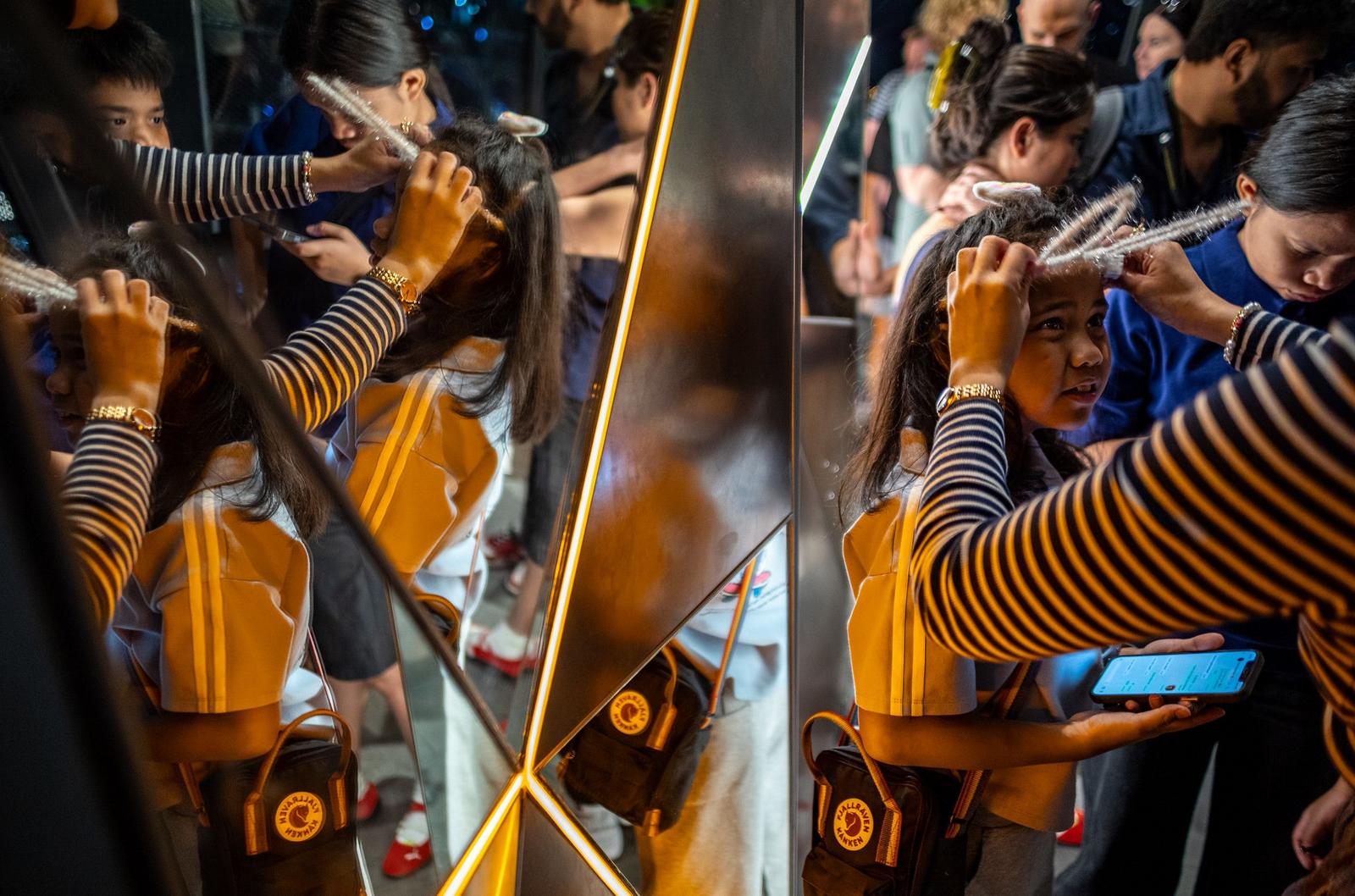
A lively, layered moment where mirrors turn a small gesture into a mini‑spectacle.
Yes, Peter — this reads as a successful street photograph: you’ve caught a human interaction (a child being fitted with fluffy ears) and used the mirrored panels to build layers. The strongest elements are the child’s face on the right and the repeated hands adjusting the headpiece in the reflections on the left. It sits squarely in the street/documentary space. Where it could improve is clarity of anchor: there’s a lot to look at and the brightest distractions (the phone screen, the logo on the bag) compete with the child’s expression. Ask yourself: were you intending the “real” face to be the hero, or one of the reflections? Deciding that in the moment would guide your framing and timing.
TECHNICAL EXECUTION ★★★★
Focus is good on the child’s face and hands, which gives us a solid anchor amid the bustle. Exposure handles tricky mixed lighting well; the warm strip light along the mirror is controlled and adds atmosphere without blowing out. Colours feel natural for a night interior—no heavy processing visible. Minor quibbles: the phone screen is a hotspot and the overall contrast is a touch high, making busy areas busier. A little selective control in post would refine it further. For a five‑star technical score I’d want that bright screen tamed and the key face micro‑sharpened to stand out a fraction more.
COMPOSITION ★★★
The mirrored facets give you excellent raw material for a layered frame, and the seam acts like a central spine. However, there’s visual competition: the phone at lower right, the logo on the bag, and multiple background heads fight the child’s expression. The moment would read more cleanly if you committed either to the right‑hand “real” scene with one strong reflection, or to a more symmetrical abstraction using the reflections as the subject. A half‑step left could have placed the child’s face into a darker wedge and reduced background mergers. Consider how a tighter crop from the left (losing the far‑left reflection) or from the bottom (trimming the logo) might strengthen the hierarchy. What would the frame feel like if the phone were excluded or hidden behind the arm?
LIGHTING ★★★★
The warm edge light from the mirror adds colour contrast against the cooler ambient and carves shape into the hands and face. Reflections bounce light around in an interesting way, and you’ve avoided ugly glare on the glass. Skin tones hold up despite the mix, which is not easy in this environment. A slight burn on the phone screen and the orange strip would keep attention on the child’s eyes. For five stars I’d want the key face lit a touch more cleanly—perhaps by waiting for the hands to open briefly so light falls on the eyes.
STORY ★★★★
There’s a clear moment: a child being helped into playful ears amid a crowd, with curiosity written on her expression. The reflections multiply the action and suggest the bustle of a public event. It feels candid and respectful; we’re close, but not intrusive. The only thing holding it back is competing activity that muddies the read at first glance. If you’d caught a micro‑expression—smile, raised brow—or a pause with hands outstretched mid‑air, it would elevate to a more decisive instant.
IMPACT ★★★
The scene is engaging and the mirror geometry is eye‑catching, so it holds attention. Yet the competing bright elements blunt the punch, and the centre seam splits the narrative rather than unifying it. With a clearer hero (face or reflection) and slightly cleaner edges, this would land much harder. Think about whether you want this to be a portrait‑moment framed by mirrors, or an abstract mirror study with a human beat—picking one will boost memorability.
CONSTRUCTIVE NEXT STEPS
- Commit to a hero: either frame so the child’s real face plus one reflection dominate (crop left to just beyond the central seam), or go symmetrical and make the reflections the subject; don’t sit in-between.
- Manage hotspots and hierarchy in post: burn the phone screen 0.7–1.0 stops, slightly desaturate the orange strip, and dodge the child’s eyes and cheek by 0.3–0.5 stops to pull the viewer in.
- Reposition by a half‑step to place the face against a darker gap in the background and to hide the logo/phone; wait for a micro‑gesture (hands mid‑air or a grin) for a cleaner, peak moment.
- If possible, shoot a short burst at 1/250s or faster and f/2.8–f/4 to freeze the adjusting hands and keep the face tack‑sharp while letting the background soften slightly.
AI Version 2.12