Graphic groundwork and a clear idea, but the moment never quite arrives.
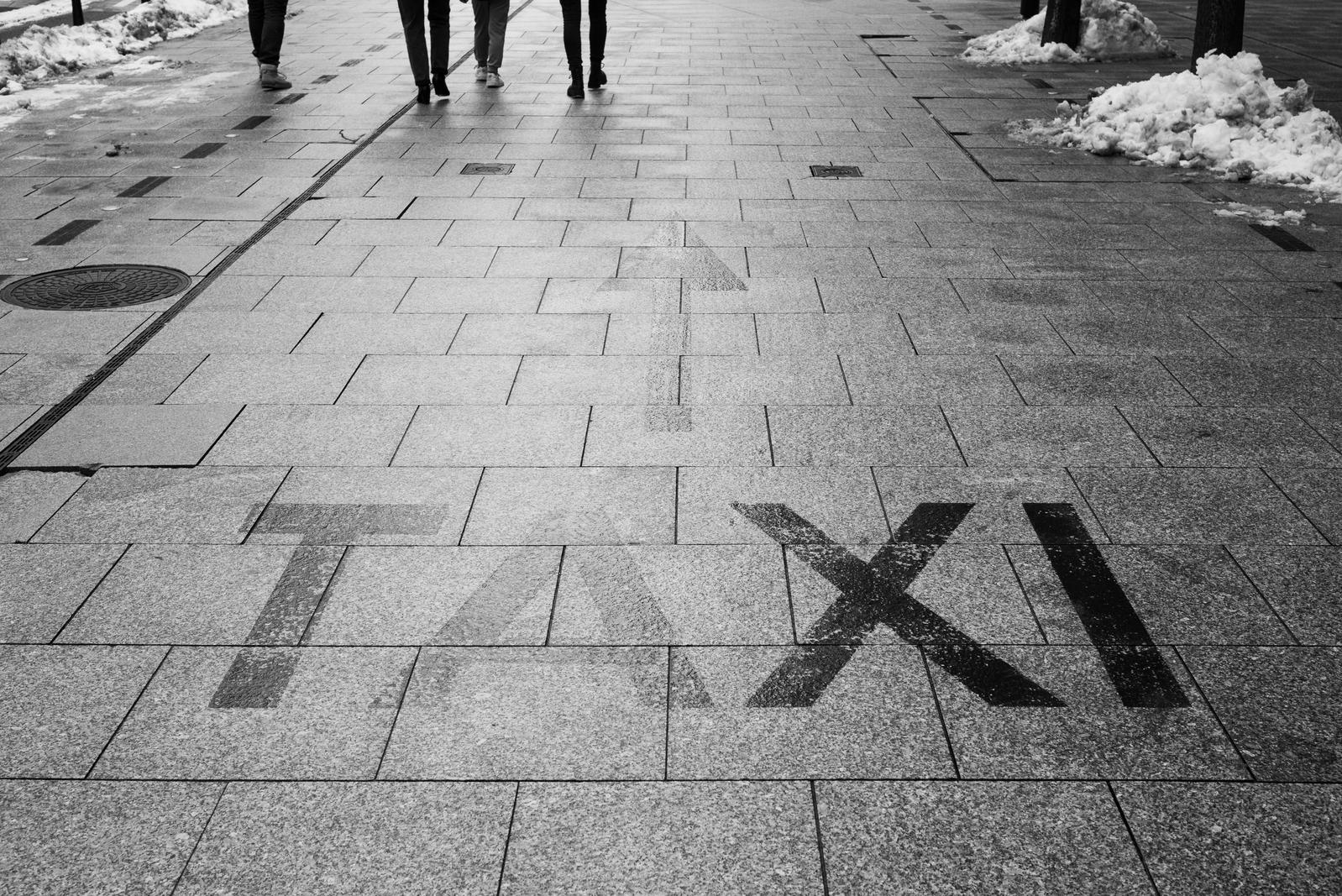
You’ve seen the graphic potential well: the bold TAXI lettering, the arrow, and the receding pavement give you a strong backbone for a street photograph. Your intention to combine symmetry with a hint of narrative (walkers heading “towards the taxi”) is clear. This sits comfortably in street photography, where form and timing must meet. The feet at the top provide a human note, but because they’re small and cropped mid‑calf, the idea feels more like a study of patterns than a lived moment. With a touch more precision in framing and a stronger human cue, this could speak much louder.
TECHNICAL EXECUTION ★★★★
The file looks clean and sharp from edge to edge, which suits the crisp geometry of the paving. Your monochrome treatment is sensible for texture and avoids any colour distractions from the snow. Tonally it leans a little mid‑grey; the TAXI letters and arrow don’t quite pop against the pavement, so local contrast could be pushed. No visible artefacts or heavy processing, and exposure is well managed given the reflective wet stone. A touch more micro‑contrast and selective dodging/burning would give this the bite it deserves.
COMPOSITION ★★★
The TAXI text anchors the lower right nicely and the arrow gives you a ready‑made leading line. However, the large empty slab of pavement between the letters and the feet weakens the link between idea and subject. The people are small, bunched together, and cropped at the calves—so they read as background texture rather than the payoff to the arrow’s direction. Symmetry is hinted at but not fully committed: the manhole cover on the left and the snow mounds on both sides break the formal balance. A lower viewpoint and tighter vertical centring would make the geometry feel deliberate rather than approximate.
LIGHTING ★★★
Flat, overcast light keeps detail in the paving and avoids glare—good for pattern. But the scene lacks a tonal gradient that would guide the eye from TAXI to the walkers. The wet stone gives a faint sheen you could exploit with a slightly lower angle to catch subtle reflections. Consider shaping the light in post: darken the lower edges to hold attention in the text and lift the arrow midtones so it reads more clearly. As it stands, the light is competent but not helping the story.
STORY ★★
The ingredients suggest a narrative—direction, choice, movement—but the decisive element is missing. Without a taxi, a suitcase, someone hailing, or a clear gesture at the arrow’s tip, the walkers feel generic. The crop at the calves also removes personality; we don’t get posture, stride, or expression to connect with. This reads more as a graphic exercise than a moment in the city. What exact behaviour did you hope to show: people choosing to walk instead of taking a taxi, or the promise of one ahead?
IMPACT ★★
It’s tidy and readable, but not memorable. Many urban graphics shots do the “word on pavement + feet” idea; to stand out you need either ruthless geometry or a telling human moment. Right now it sits in the middle—neither perfectly formal nor narratively strong. Push one direction hard: either make it a razor‑clean graphic statement or wait for a specific action that locks the story.
CONSTRUCTIVE NEXT STEPS
- Commit to geometry: take a lower position and centre the arrow precisely on the frame’s vertical axis; fill more of the foreground with the TAXI letters to reduce the empty mid‑zone.
- Wait for the moment: hold the frame until a single figure with a suitcase, someone hailing, or a taxi nose enters the top of the frame at the arrow tip—one clear subject beats several anonymous calves.
- Clean the frame: either crop slightly from the left to remove the manhole cover or clone it out; consider trimming a little from both sides to minimise the messy snow piles that break symmetry.
- Post‑processing: add selective contrast—burn gently around the frame edges, dodge the arrow and the “X/I” strokes, and add subtle clarity to the letters so they read as the undeniable focal point.
AI Version 2.12