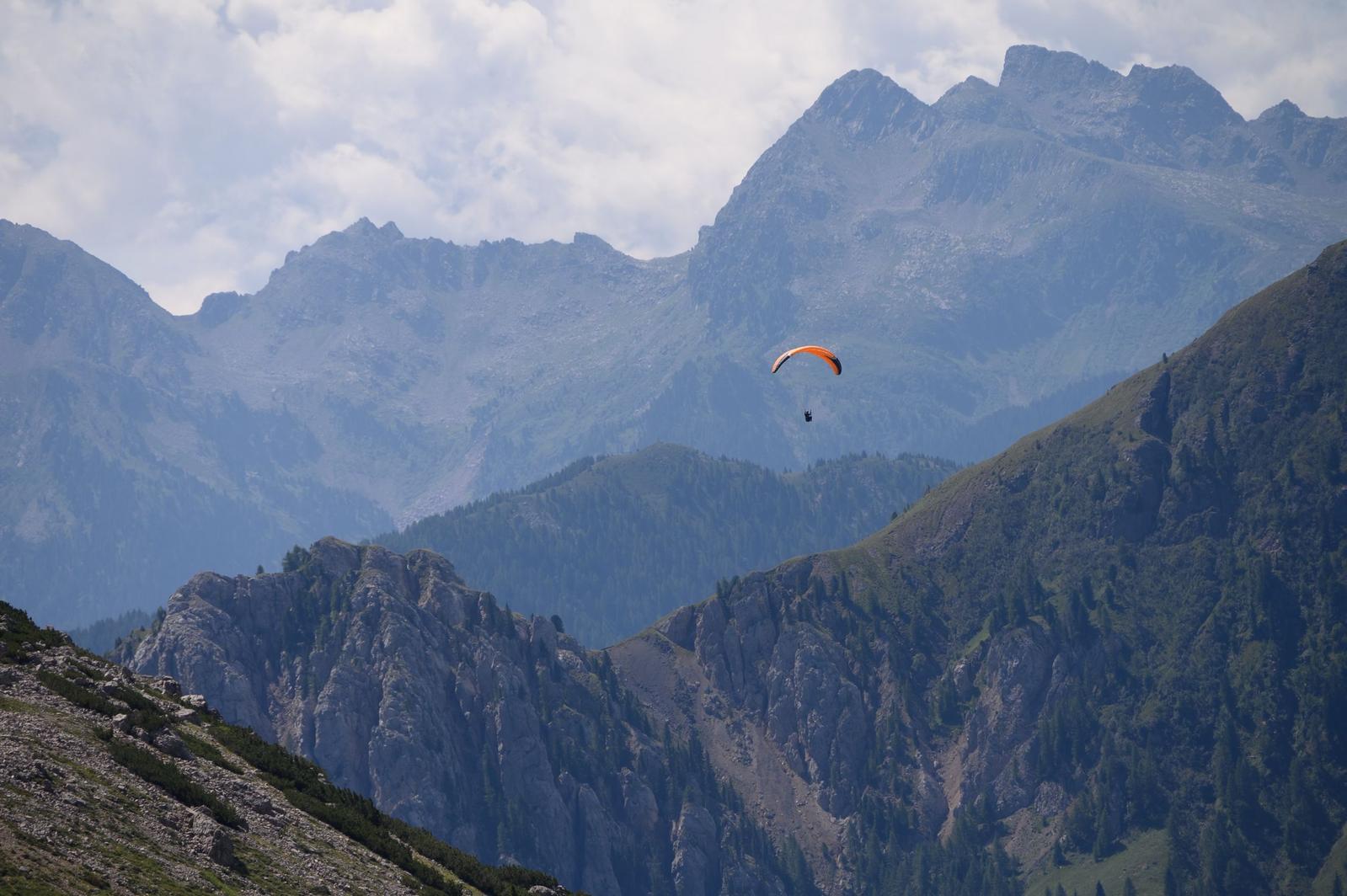
A calm, airy frame where a tiny splash of orange makes the mountains feel enormous.
Short answer: yes—tightening in on the wing would shift this from a sense‑of‑scale mountain scene to a small sports action shot. Here the orange canopy works as a scale marker against the layered peaks, so keeping it small preserves the “big country, small human” message. If you want the thrill of flight, zoom in; if you want immensity, stay wide. The layered ridges, the diagonal right‑hand slope, and the little figure under the wing say “freedom in a vast place,” which is classic landscape with an adventure accent. What reaction do you want first in the viewer: the vastness or the adrenaline? That decision should drive how much you crop.
TECHNICAL EXECUTION ★★★★
Exposure is well handled; the clouds hold tone and the darker ridges aren’t crushed. Detail is decent given the distance, with atmospheric haze softening the far peaks naturally rather than through heavy processing. The paraglider is sharp enough to act as a clean anchor, suggesting a shutter around 1/800–1/1000s or good timing. Colours are restrained and believable; the orange wing pops without looking oversaturated. A touch more micro‑contrast in the mid‑distance could add bite, but there are no obvious artefacts or halos. To hit five stars you’d need a bit more crisp separation in the layers and slightly cleaner micro‑contrast on the nearer rock faces.
COMPOSITION ★★★★
The glider sits nicely in the upper‑right quadrant against darker hillside, which helps visibility. The staggered ridgelines build depth from the bottom‑left foreground across to the right massif and back to the distant peaks. That dark, rocky wedge bottom‑left adds layering, though it also drags the eye out of the frame a little. A modest crop—trim 5–8% from the left and a sliver from the top—would tighten the flow without losing the spacious feel or the mountain scale. Consider whether you waited for clean air around the wing; its placement against a uniform tone is strong. For five stars I’d want either a cleaner foreground edge or a more deliberate use of that slope as a leading line.
LIGHTING ★★★
The light is midday‑soft through high cloud—gentle and perfectly usable, but not dramatic. Haze lifts contrast off the distant peaks, which supports depth but mutes texture. There are no problematic hotspots or blocked shadows, which keeps the image calm. However, the scene would gain a lot from lower sun—side light carving the ridges and giving the canopy a stronger glow. A subtle local contrast boost could partially compensate. To reach five stars the light needs to sculpt the forms more decisively.
STORY ★★★★
The narrative is clear: a lone pilot suspended over huge terrain—solitude and scale. The small size of the glider is the point, and that choice communicates well. The diagonal of the right‑hand ridge adds direction, implying the path of flight. It’s not a peak action moment, but it doesn’t need to be; the stillness carries the mood. Would waiting for the pilot to be slightly higher over the saddle, or nearer a contrasting sky patch, intensify the story? A minor positional tweak could elevate the tension a notch.
IMPACT ★★★
The picture is pleasing and calm, with a solid sense of place, but the flat light tempers its punch. The orange wing gives a quick hook, yet the scene doesn’t quite cross into unforgettable. A stronger weather moment—raking light, a clearing cloud bank, or a more graphic alignment—would lift memorability. Still, it’s a good blend of landscape scale and human presence. With more dramatic light or a slightly tighter, cleaner frame, this could step up a level.
CONSTRUCTIVE NEXT STEPS
- Keep the wide master for scale, but make a second frame tighter (or a second crop) where the wing fills 5–10% of the frame—two distinct stories from one moment.
- Refine the frame edge: crop 5–8% off the left to reduce the heavy foreground wedge, and a little from the top to concentrate attention on the glider and the middle ridges.
- Post‑processing: apply a gentle local Dehaze/clarity to the mid‑distance ridges and slightly lower highlights in the clouds so the eye lands first on the wing.
- Field craft for next time: aim for 1/1000s, AF‑C with single point on the canopy, and wait for the pilot to cross a clean, darker backdrop for maximum colour contrast.
AI Version 2.12