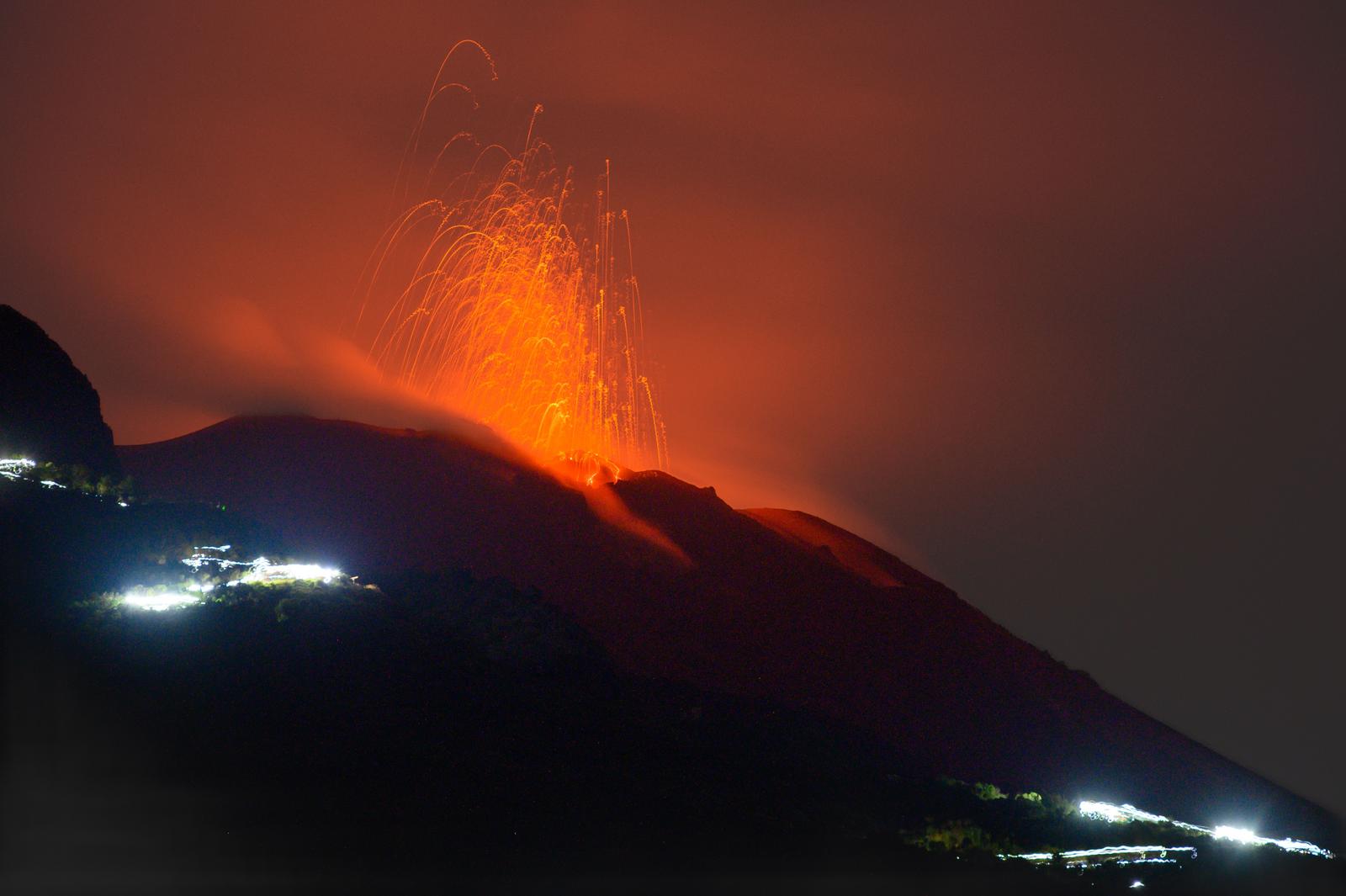
The eruption is thrilling, but the head‑lamp ribbons are stealing attention they haven’t earned.
You’re right to question those bright trails—they pull the eye away from the crater. Two practical routes: in-camera and post. In-camera, shorten the shutter and collect many frames (e.g., 1–2 s at ISO 200–400, around f/4–f/5.6) during bursts; later, stack the frames—use “Lighten” blending on a masked area over the crater to build the lava arcs while keeping the foreground dark, or use a median stack for the lower slopes to suppress moving headlamps. If you want to keep a single long exposure, use the black‑card technique: during a 15–20 s exposure, hold a card just in front of the lens to cover the lower third for most of the time, removing it for the last 3–5 s—this lets the eruption accumulate while starving the hikers’ lamps of exposure. In post, darken only the bottom bands with a linear gradient and a luminance/colour-range mask that targets the cool white lamps, then clone any remaining hotspots. This sits squarely in the landscape/travel space, and the best qualities here are the elegant diagonal of the cone and the clean arc of glowing ejecta against the night.
TECHNICAL EXECUTION ★★★
Exposure on the crater and ejecta is well judged, with good separation in the orange plume. The issue is the clipped, pure‑white headlamps along the lower edges, which feel hard and draw the eye; they’re beyond recovery in a single RAW frame. The land is largely a deep silhouette, which is fine at night, but some shadows look a touch muddy rather than rich. There’s the expected long‑exposure softness in wind‑blown smoke, which works for mood. To push this to five stars, control those bright trails at capture (shorter frames and stacking or black‑carding) and keep the shadow tonality clean and deliberate.
COMPOSITION ★★★
The diagonal ridge guiding up to the vent is strong, and the eruption sits near a good third. However, the bright strings of lights bottom left and right act as accidental leading lines out of the frame, competing with the crater. There’s also a lot of uniform sky above; the upper third doesn’t add much once the glow is established. A tighter crop from the bottom to remove the brightest road lights and a small trim from the top would concentrate the energy around the vent. Ask yourself: do you want human presence to be read at all, or do you want a pure, elemental study of fire and rock? Your answer should dictate how much of that lower slope you include.
LIGHTING ★★★★
The volcanic glow paints the plume and low cloud beautifully, giving the scene its drama. The colour contrast between warm lava and the cooler, neutral land works nicely. The artificial lights introduce a jarring, clinical white that doesn’t harmonise with the natural palette. White balance looks believable; if anything, a tiny reduction in saturation around the glow could keep it from feeling heavy. For five stars, eliminate or greatly suppress the man‑made light sources so the glow is the only sculptor.
STORY ★★★★
There’s a clear narrative of scale and awe—the earth spitting fire while tiny humans trace the slopes. The motion of the ejecta gives a sense of time and danger. Right now the headlamps read louder than “scale” and start to become the subject, which dilutes the core story. If you choose to keep a hint of people, one faint cluster is enough; otherwise, minimise them and let the mountain own the frame. A single additional element—moonlit texture on the cone or a subtle foreground silhouette—could deepen the mood further.
IMPACT ★★★★
The eruption has undeniable punch and will stop viewers, but the bright roadside threads drain some of that power. Tightening the frame and suppressing those lights would turn this from “dramatic” to “commanding.” The restrained palette elsewhere is a strength and keeps things natural. To hit five stars, present a cleaner, more singular statement: the cone and the fire, with nothing else shouting for attention.
CONSTRUCTIVE NEXT STEPS
- Shoot a burst of short exposures (1–2 s, ISO 200–400, f/4–f/5.6). Median-stack the lower third to erase moving headlamps, and “Lighten” blend only the crater area from selected frames to rebuild long lava arcs.
- Single‑frame option: use the black‑card method on a 15–20 s exposure—cover the bottom third for ~80% of the exposure, then remove the card for the final seconds to record the eruption without accumulating the hikers’ lights.
- Reframe: crop 10–15% from the bottom to lose the brightest road, and 10% from the top to compress the sky; consider a slightly longer focal length on location to exclude tourist paths entirely.
- Post: apply a bottom linear gradient at −1 to −2 EV with Whites −40/−60, constrained by a luminance or colour‑range mask that excludes the orange glow; clone any remaining hotspots along the path.
AI Version 2.12