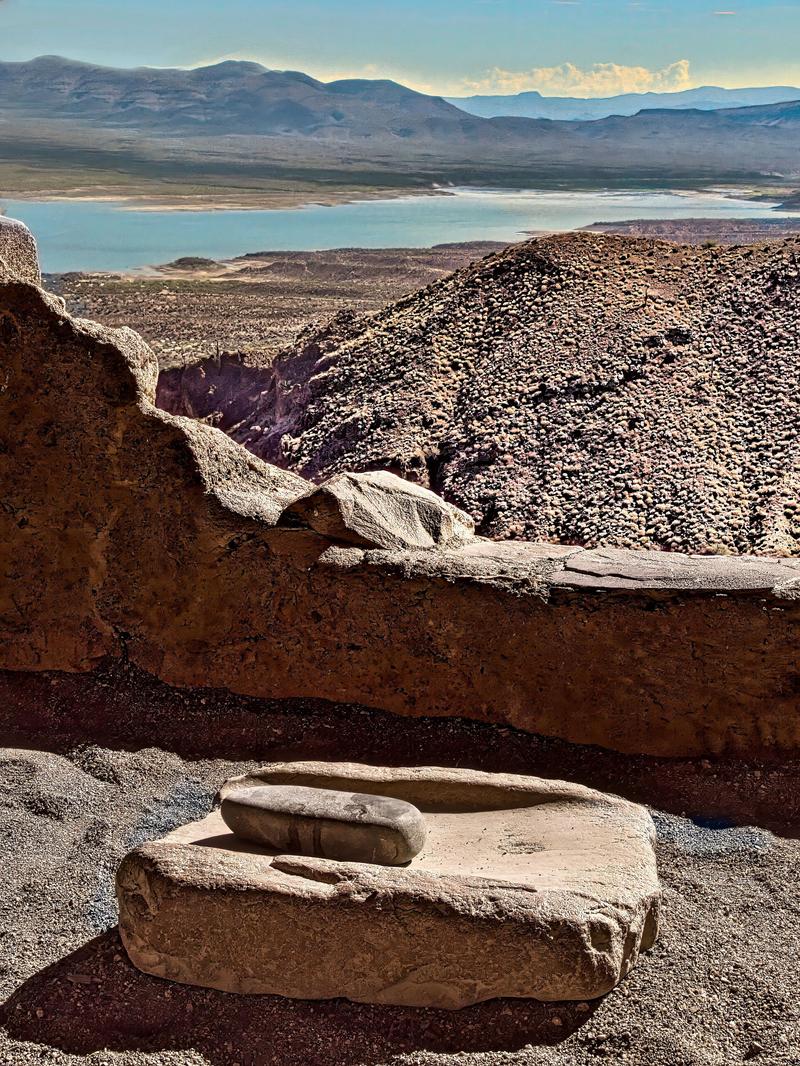
A strong sense of place from a rare vantage, anchored by the metate against a sweeping desert and lake.
Richard, you’ve made a travel/documentary landscape that uses the dwelling as a frame and the grinding stone as a cultural anchor. Shooting from shade into bright desert is a gutsy choice and the textures on the metate are well rendered. The very fast shutter wasn’t necessary for a static scene, but it didn’t hurt; f/13 ensures depth front to back. The big win here is the relationship between the ancient tool in the foreground and the timeless landscape beyond — that’s the story. As you refine this, ask yourself: is the photo about the metate, the view, or the connection between them — and how can your framing and light make that answer unmistakable?
TECHNICAL EXECUTION ★★★★
The file looks clean at ISO 200 with good detail on rock textures and distant ridges. Exposure is handled decently despite a tough dynamic range; highlights on the lake approach hot but remain recoverable, and shadows in the alcove keep structure. Colour is natural and not overcooked, though contrast is a bit crunchy in the mid‑tones, likely from high clarity or strong micro‑contrast. The choice of 1/2000 at f/13 is overkill for motion control and risks slight diffraction softness; a slower shutter and lower aperture would have yielded equal sharpness with more dynamic range latitude. To reach five stars, I’d want subtler micro‑contrast, gentler sharpening halos on the ridge line, and a tonal curve that breathes a little more in the shadows.
COMPOSITION ★★★★
The metate and mano provide a solid foreground anchor and the rock wall works as a natural frame, giving clear layers: tool, alcove, desert mound, lake, mountains. The eye moves well from the stone up the sloping ridge to the water. However, the heavy left wall and the thick band of rock mid‑frame feel a touch dominant and static, slightly boxing the scene. A step right and lower would reduce the left mass, align the metate more decisively with the water, and open the window shape. Would including a little more of the top arch — or committing to a tighter crop on the metate — better state your priority?
LIGHTING ★★★
This is hard midday sun outside versus deep shade inside. The shade gives you workable detail on the stone, but the exterior reads somewhat flat and contrasty at once — bright lake, muted land, short shadows with little shape. There’s potential for gorgeous cross‑light here in early or late day to carve the metate and warm the rock tones while softening the distant haze. A subtler interior highlight on the mano (via reflectance from the cave floor or dodging) would help it pop without looking lit. Five stars would need more intentional timing or shaping of light so the interior and vista feel unified rather than competing exposures.
STORY ★★★
The elements imply a clear idea: daily life here once faced this view. That said, it remains descriptive rather than a lived moment — an artefact and a landscape with no additional beat of tension or discovery. A slight gesture — footprints in dust, a shaft of sun kissing the mano, or a human scale reference such as a silhouetted visitor framed in the opening (if site rules allow) — would deepen the narrative. What single detail could you emphasise to make the connection between labour and land feel inevitable? Right now, the scene informs more than it moves.
IMPACT ★★★
The rare viewpoint and cultural anchor give this image presence beyond a standard vista. Still, the midday look and slightly heavy framing temper the wow factor, making it good rather than unforgettable. With more intentional light and a bolder, cleaner window shape, this could sing. Consider what you want the viewer to remember first — the tool, the lake, or the union of both — and design the frame around that single idea for greater punch.
CONSTRUCTIVE NEXT STEPS
- Return at golden hour; place the metate on a lower third and shoot slightly lower/right to reduce the left wall mass and align the stone visually with the blue water. This will add depth and a clearer subject hierarchy.
- Manage dynamic range with a tripod and two-frame manual blend (one for the exterior highlights, one for the interior stone). Keep the blend subtle; avoid HDR looks by masking only the bright lake and sky.
- Post-process: ease global clarity/sharpening; lift interior mid‑tones with a gentle curve; add a soft dodge on the mano to separate it; and cool the distant blues slightly to increase atmospheric depth.
- Try f/8–f/11 at ISO 100 with a slower shutter (e.g., 1/60–1/125 on tripod) for optimal sharpness and cleaner tonal range; use a remote or 2‑sec timer to avoid vibration.
AI Version 2.12