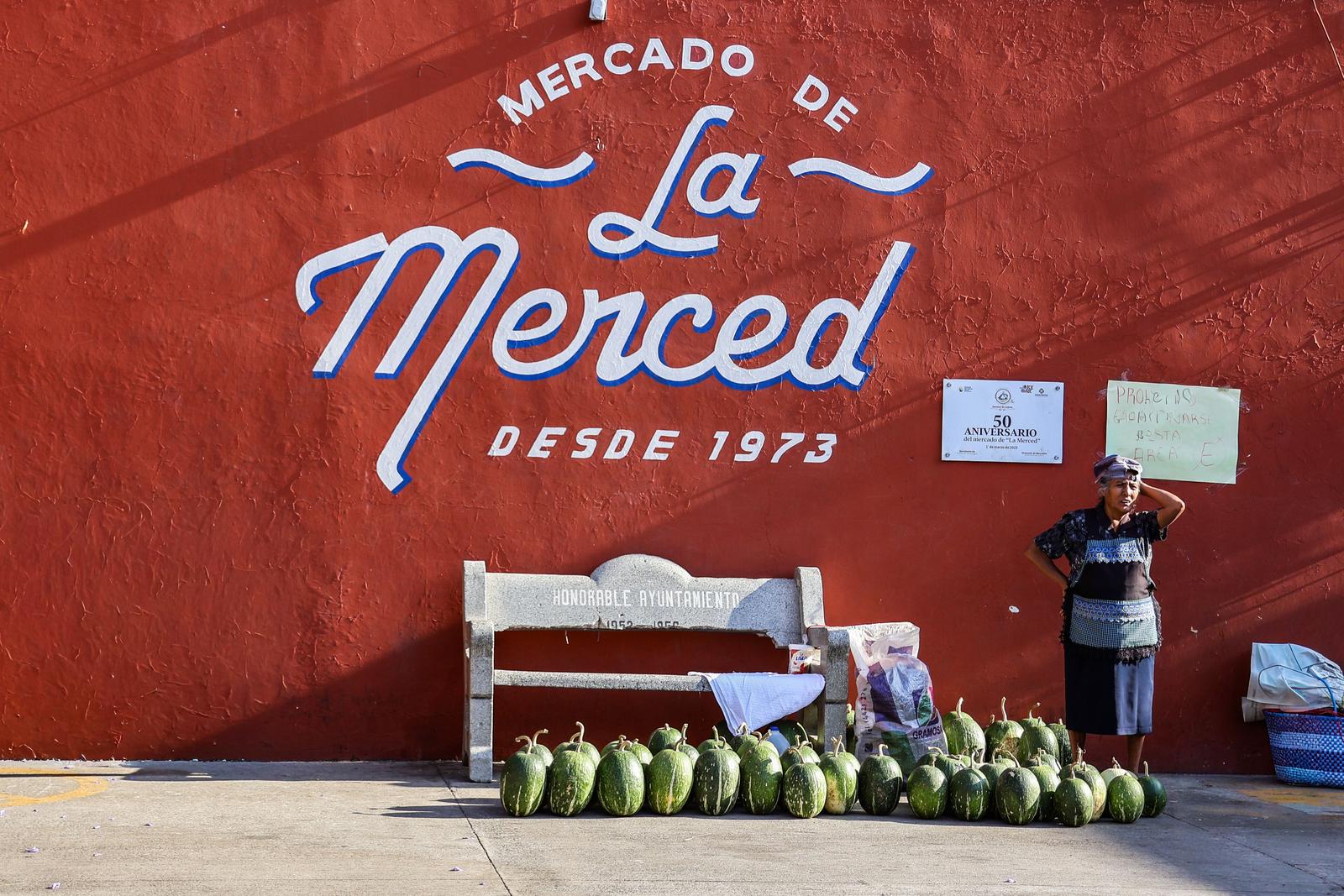
Bold sign, humble stall, and a quiet gesture give this scene a strong sense of place.
You’re right to question the framing — it’s close but not quite landing. This sits between travel and street: the story is the market identity on the wall, the neat row of squashes, and the vendor’s hand-to-head gesture. The strongest elements are all here, but the subject is crowded to the right edge while there’s a lot of unused wall on the left; the produce also kisses the bottom border. A small shift to your right or a tighter crop from the left would have given the vendor breathing room and strengthened the relationship with the painted “La Merced.” Did you intend the bench to be a co‑star, or was the mural–vendor pairing your priority?
TECHNICAL EXECUTION ★★★★
Focus and detail are solid across the frame — the texture of the stucco wall, the bench, and the squashes all read cleanly. Exposure is handled well in punchy daylight; shadows are deep but not blocked and there’s no heavy clipping. Colours feel honest for Oaxaca: a saturated red wall balanced by natural greens, and no heavy-handed processing. There are a few bright hotspots (the white plaque and the handwritten green sign) that pull the eye, but they’re manageable in post. Overall this is easily print‑worthy technically, with small tonal tweaks needed to control the brightest distractions.
COMPOSITION ★★★
The idea is strong: big typographic mural as place marker, human subject as counterpoint, produce as foreground rhythm. However, the vendor is pressed against the right edge while the left side holds a lot of empty wall, so the frame feels lopsided. The bench sits centrally without a clear role — it neither anchors symmetry nor leads to the subject — and the neat line of squashes is clipped tightly along the bottom edge, reducing their weight. A 15–25% crop from the left (and a sliver from the top) would move the “La Merced” text off‑centre and give the woman more breathing room; alternatively, stepping a half‑metre to your right on the day would place her under or just beside “La,” tying the words to the person. Ask yourself: is the bench essential to your story, or would omitting it simplify and strengthen the scene?
LIGHTING ★★★
This is hard, high sun — crisp shadows and strong contrast. It doesn’t ruin the image, but it flattens subtleties and puts small hotspots on the plaque and pavement. The vendor is lit side‑on, which gives her form, but the overall light doesn’t add mood. Early morning or late afternoon would have given warmer tone and gentler texture to the wall, though waiting isn’t always possible in street work. A modest local lift on the vendor and produce with a slight burn on the bright signs would help the eye land where you want it.
STORY ★★★
The frame clearly says where we are and what’s happening: a market, a lone vendor, a tidy harvest laid out for sale. The hand-to-head gesture gives a small human moment — perhaps a pause or a thought — which is good. What’s missing is an interaction or extra layer: a passer-by, a sale, or a look that connects us more deeply to her day. The mural does heavy lifting for context, but the scene remains descriptive more than moment‑driven. What micro‑story were you hoping to catch here — the graphic sign against daily life, or the vendor herself?
IMPACT ★★★
The bold wall text and the row of green squashes make an immediate visual statement, so the image is easy to read and place. The near‑miss in framing and the midday light hold it back from being memorable. With cleaner balance and one added human element, this could move from solid record to standout travel image. Right now it’s engaging, but it doesn’t quite stick.
CONSTRUCTIVE NEXT STEPS
- On location, step a half‑metre to your right and lower your viewpoint slightly so the squashes form a stronger leading line to the vendor; leave a little more space on the right edge to avoid crowding.
- Alternatively, commit to the graphic: centre the bench under the mural and wait for the vendor to step into that space for a cleaner, symmetrical version — two clear options rather than a compromise.
- Post‑processing: burn down the white plaque and the green handwritten sign by about 0.3–0.5 stops, and gently dodge the vendor and produce to guide the eye; consider a small left‑side crop (15–25%) to rebalance the frame.
- Wait for a beat of interaction — a customer’s hand reaching in, an exchange of coins, or even a passer‑by crossing the foreground — to lift the scene from descriptive to a lived moment.
AI Version 2.12