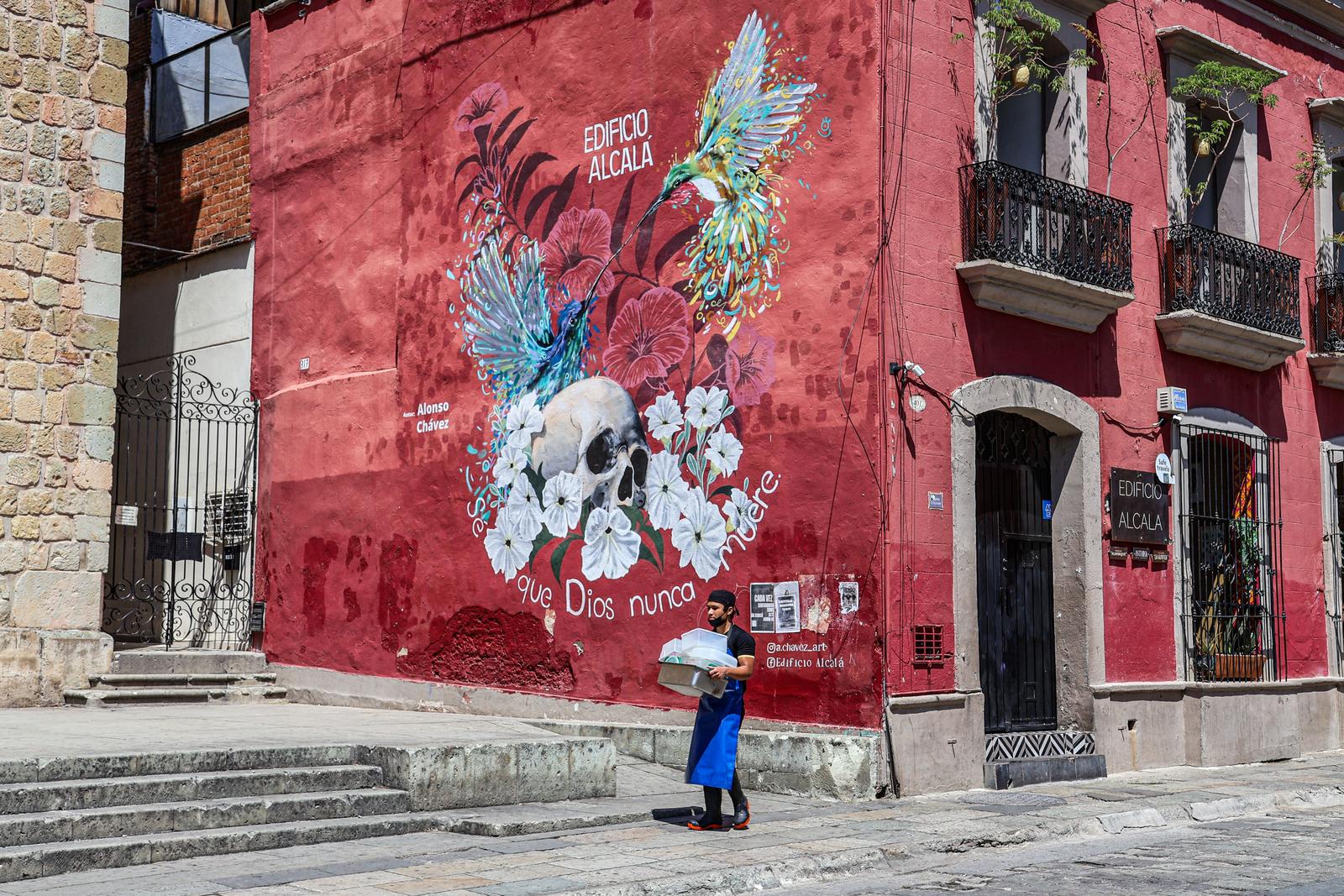
Bold colour and a slice of daily life — strong bones that need better light and a tighter moment.
Short answer: yes in terms of colour and texture, not quite in terms of energy. The saturated red wall and intricate mural read as lively and unmistakably local, which supports a travel/street frame. The passer-by in a blue apron carrying boxes is a good human anchor that hints at work and routine. Where the image falls short of “vibrant” is the midday light and an in‑between gesture; the scene feels observed rather than alive. With a more considered moment or kinder light this corner could sing. Which feeling were you chasing here — the mural’s colour blast, or the rhythm of people moving through the space?
TECHNICAL EXECUTION ★★★★
Focus is crisp across the frame and the mural’s brushwork holds detail — well handled. Exposure is respectable given the high-contrast sun; the deep balcony shadows retain enough detail and the highlights on the wall aren’t clipping badly. Colour looks natural for a sunlit red facade, without cartoonish saturation or HDR halos. There’s no visible noise or JPEG artefacts that distract at this size. The main technical compromise is the hard, specular sheen on the painted wall and the shadowed face of the man — both realities of shooting at noon rather than processing flaws. A polariser could have tamed some glare, but the base file is solid.
COMPOSITION ★★★
The mural is the clear anchor and the corner line sensibly divides the frame. The man is placed low-right and walking into space, which is good, but he’s small relative to the wall and competes with busy elements like wires, posters and two dark doorways. There’s a lot of pavement foregound and extra facade on the right that doesn’t add much, diluting attention from the human moment. A step left to square up more to the mural (or a tighter crop that trims the right-hand building) would streamline the story. Consider a lower viewpoint so the walker sits against the clean red paint rather than merging with doorways and shadow. How would this feel if the frame ended just past the corner stonework, making the mural and person the whole conversation?
LIGHTING ★★
This is harsh midday sun: high contrast, shiny wall, and a cap shadow across the subject’s face. The light flattens colour depth and robs the scene of the dimensionality that early or late sun would give. Side light in the morning would rake across the texture of the plaster and give the hummingbirds and flowers more shape. Open shade would also even out exposure, revealing the worker’s expression and the box details. As it stands, the light documents but doesn’t flatter or add mood. Timing the same corner for kinder light would lift the whole frame.
STORY ★★★
There’s a nice everyday thread: a worker hauling boxes beneath an ornate memento‑mori mural and Spanish text — strong sense of place. However, it’s a “passing by a mural” moment rather than a decisive beat. If he glanced up, adjusted the stack, or if his stride aligned with the painted curve of the flowers or text, the frame would feel more intentional. Waiting half a second longer might have placed him in the sun patch with a cleaner backdrop, or positioned under the hummingbird beak for a playful visual rhyme. Think about whether you want juxtaposition (human vs art) or interaction (human engaging with art) and time accordingly.
IMPACT ★★★
The wall’s colour and the skull-with-hummingbirds mural grab attention immediately, so the image reads fast. Beyond that initial hit, the familiar trope of a person walking past a mural limits memorability. Stronger light or a more telling gesture would push it beyond “nice corner in town” to something that sticks. Still, it communicates location and culture cleanly and would sit well in a travel set. To reach “stop-and-stare”, you’ll need either a tighter human moment or a more refined, graphic composition.
CONSTRUCTIVE NEXT STEPS
- Return when the light is lower: early morning side light or open shade will reduce glare on the red wall and reveal the subject’s face; consider −0.3 to −0.7 EV to protect the reds.
- Refine framing: step left and crop to end the frame at the building corner, removing the right-hand doorways/wires; or go lower to place the person fully against the clean red paint, minimising pavement.
- Work the moment: wait for a gesture that connects to the mural (a glance up, a pause to adjust boxes, someone in matching blue or carrying flowers) and fire a short burst as they hit the sweet spot.
- Post-process lightly: lift shadows selectively on the walker’s face, tame wall sheen with a gentle highlights reduction, and clone the small posters/wire tails near the mural edge to simplify.
AI Version 2.12