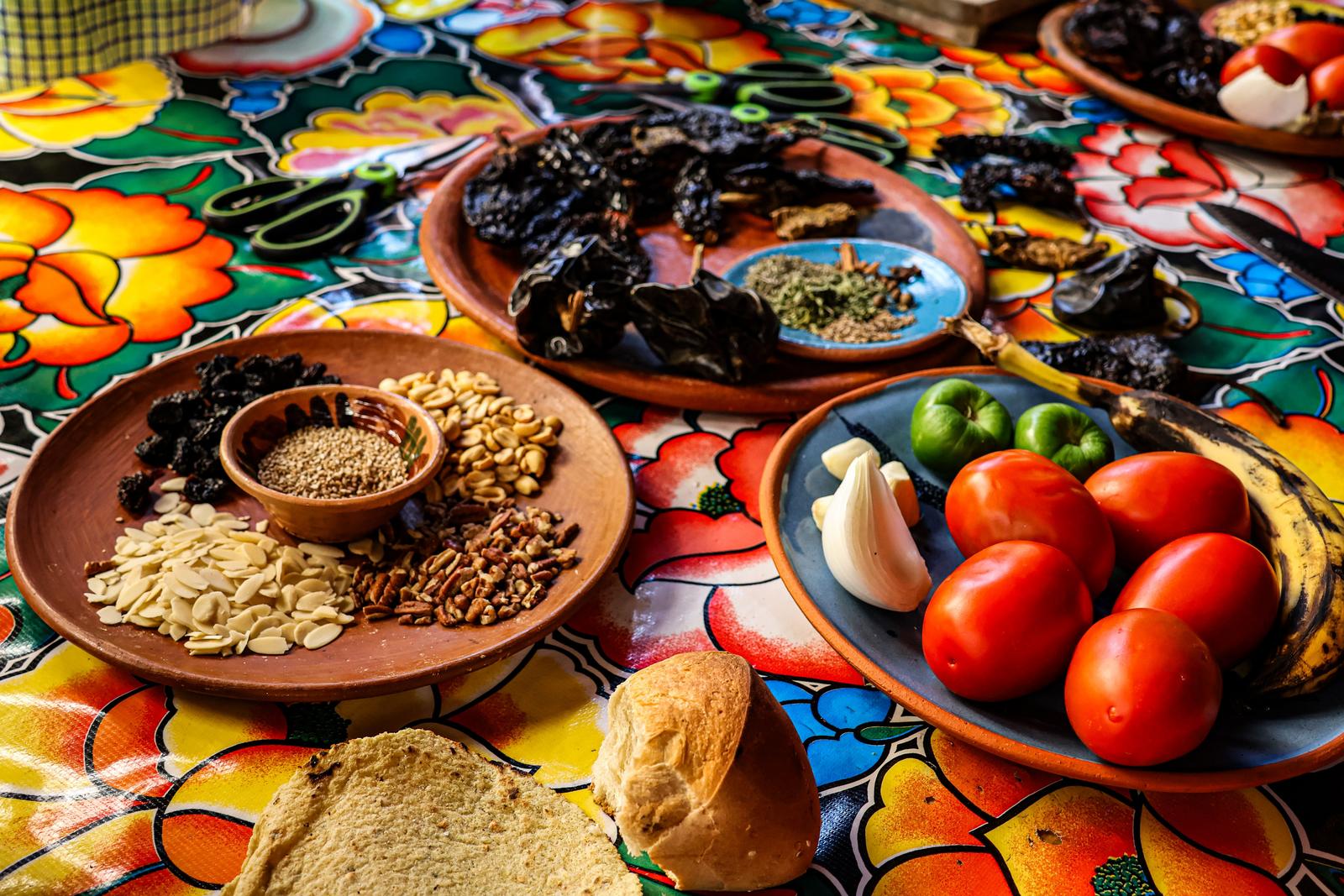
A vibrant, sensory table that celebrates Oaxaca, but the scene is fighting itself for attention.
You’re clearly building a cultural food still life — travel‑flavoured food photography. The clay plates, dried chiles and nuts read beautifully and the abundance suits the spirit of mole. The challenge is that the hyper‑colourful oilcloth and scattered utensils compete so strongly that the ingredients don’t quite become the “hero”. What flavour do you most want us to taste first — smoke of the chiles, sweetness of the tomatoes, or the nuttiness of the seeds? Choosing that single anchor would help the rest of the frame support, rather than shout over, the story.
TECHNICAL EXECUTION ★★★★
Focus is crisp across the foreground plate of seeds and the tomatoes, with plenty of detail in textures like sesame and pecans. Exposure is well handled considering the mixed tones; nothing critical is blown, and shadows hold enough detail to read the chiles. Colour feels mostly natural, though the oilcloth pushes saturation to the edge and risks stealing the eye. There’s a touch of specular glare on the tomatoes that could be tamed with diffusion or angle. I don’t see distracting artefacts or noise. For five stars I’d want subtler colour control and cleaner specular highlights, especially on glossy produce.
COMPOSITION ★★
The frame is busy and lacks a clear focal hierarchy. My eye ping‑pongs between the red tomatoes, the bright flower pattern, and background objects like the scissors and knife; none sits confidently as the hero. Several elements sit awkwardly on edges — the tortilla at bottom, the plantain curving to the right edge, and partial plates at the top — which adds visual noise rather than useful tension. The three main plates could form a strong triangle, but they’re not aligned to guide the eye. How might this scene change if you committed to one hero plate and allowed the others to recede or leave the frame entirely? A tighter, cleaner crop and removal of non‑story items would transform the composition.
LIGHTING ★★★
Natural light gives appealing colour and reveals texture on nuts and seeds; that’s working well. However, the glossy tomatoes carry small hotspots and the dark chiles sink a little, suggesting the light is slightly hard and directional without enough fill. A larger diffuser on the window side would soften reflections, and a white card opposite would lift the chiles. Consider a black flag near the edge of the oilcloth to keep the background from bouncing too much colour back into the scene. With more shape and control — highlights placed on the heroes, shadows gently opened elsewhere — the ingredients would feel richer and more dimensional.
STORY ★★★
The set speaks of Oaxaca through material culture — clay plates, dried chiles, sesame, tomatillos — so the premise is clear. What’s missing is the craft: there’s no sense of process yet, just an inventory. One human cue — a hand toasting chiles, a molcajete mid‑grind, steam from a pot — would add immediacy and aroma to the frame. Alternatively, a more curated still life that elevates one component (e.g., a “chile trio” with supporting spices) would clarify the message without introducing people. As it stands, it informs more than it transports.
IMPACT ★★★
The colour blast grabs immediate attention, and the abundance is joyful. After that first hit, the eye tires a little because there’s no visual rest and no hero to reward the gaze. The cultural cues are strong but diluted by modern, non‑story props (scissors/knife) and edge clutter. Dialling back the background dominance and sharpening the narrative would lift memorability significantly. Aim for either a refined still life with a single star, or a lived moment showing the making of mole.
CONSTRUCTIVE NEXT STEPS
- Establish a hero. Build the scene around one plate (e.g., the dried chiles) and remove the rest or push them soft and distant. Keep edges clean; crop out the scissors/knife and the partial plates at the top.
- Shape the light. Shoot by a window with a large diffuser; add a white foam‑core bounce to lift the chiles and a small black card to control spill on the oilcloth. Rotate tomatoes to avoid hotspots; a circular polariser can further tame glare on glossy skins.
- Control the background. If you want the Oaxacan cloth, use less of it and blur it by stepping back and shooting around f/2.8–f/4 with a longer focal length; otherwise swap to a neutral textile that lets the food sing.
- Post‑process with intent: use HSL to reduce saturation of the background reds/yellows by 15–30, dodge the chiles and spices about +0.3 EV for presence, add a subtle vignette centred on the hero, and clone out stray crumbs and the scissors.
AI Version 2.12