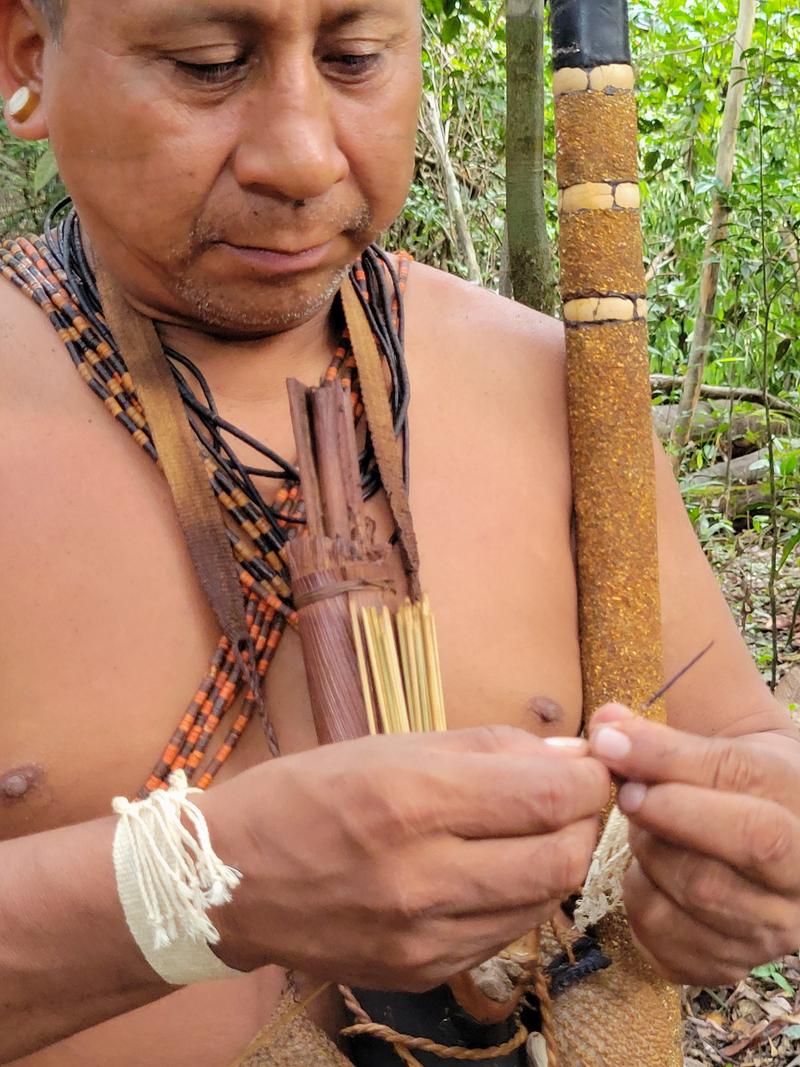
A quiet, concentrated moment that invites us into the skill of preparation.
You were right to move in close; this is a travel/documentary detail portrait where the hands are the story. Including a slice of his face and the quiver adds humanity and context. Where the frame stumbles is legibility: the tiny dart and wrap are small and a touch soft, so without your caption the action isn’t immediately clear. Consider whether going even tighter on the hands/dart or stepping back slightly to include the full blowgun would tell the story more cleanly. What did you try in the moment—did you make a second frame where the cotton touches the dart tip, or where his hands pause sharply for focus?
TECHNICAL EXECUTION ★★★
Colour and white balance feel natural, with earthy skin tones and greens that don’t look overworked. Exposure is well controlled; no harsh blown highlights on skin despite the bright wrist tie. The critical detail—the dart and fingertips—looks slightly soft, likely from small hand movement and a modest shutter speed; that’s the one place you most need crispness. Background detail is a bit busy but not noisy. To reach five stars you’d need decisive sharpness on the working fingers/dart and cleaner isolation of that area, ideally via a faster shutter and precise focus point.
COMPOSITION ★★★
Your intent is clear: the hands doing delicate work. The partial face at top left gives dignity, and the quiver of darts centred in the chest is a strong anchor. However, the blowgun is sliced at the right edge and the bright white wrist tie fights for attention, which dilutes focus on the tiny task. The hands ride low and close to the border, making the frame feel cramped. Five stars would come from committing to one approach—either a vertical that fully includes face, hands, and the entire blowgun as a bold line, or a tighter crop that eliminates the face and right edge so the hands and dart dominate.
LIGHTING ★★★★
Soft forest shade gives you gentle contrast and respectful skin texture. There are no harsh shadows cutting across the working area, which keeps the moment readable. The light is a touch flat on the fingers, so they don’t pop against the busy background as much as they could. A small local lift on the hands or slight darkening of the surroundings would guide the eye better. For five stars, aim for a tiny bit of directional light or a post‑processing dodge that subtly spotlights the action.
STORY ★★★
We sense concentration and craft, and the gear—the quiver and blowgun—grounds the scene in place. Yet the core action is miniaturised and not crystal clear; the viewer works to decode what exactly is happening. A frame where the fibre clearly wraps the dart point, or a second image in a short sequence, would strengthen comprehension. Including the full blowgun or a stronger gesture (a pinch, a twist) would add tension. To reach top marks, deliver a single, unmistakable micro‑moment that reads instantly.
IMPACT ★★★
The cultural specificity and calm focus hold attention, and the natural palette suits the subject. Impact is tempered by the edge cut of the blowgun and the slight softness on the key detail. It’s a good, honest slice of preparation rather than a frame that stops you cold. With cleaner edges and crisper action on the dart, this could step up a level. What single element would you want a viewer to remember—the man’s concentration, the tool, or the wrapping—and how can the frame make that one thing unmistakable?
CONSTRUCTIVE NEXT STEPS
- Prioritise sharpness on the action: shoot at 1/250–1/500s, AF‑C with a small single point on the fingers/dart; raise ISO if you’re in shade (ISO 800–1600 is fine on modern cameras).
- Resolve the edge tension: either go vertical and include the blowgun fully as a strong right‑hand line, or crop it out and move in tighter so the hands and dart fill the lower two‑thirds.
- Control distractions in post: subtly darken/desaturate the white wrist tie and pale bands on the blowgun; add a gentle radial dodge and a touch of micro‑contrast on the fingertips/dart to guide the eye.
- Consider a lower, more oblique angle so the dart runs diagonally across the frame with the face behind it; this can align hands and expression on a single visual path and clarify the task.
AI Version 2.12