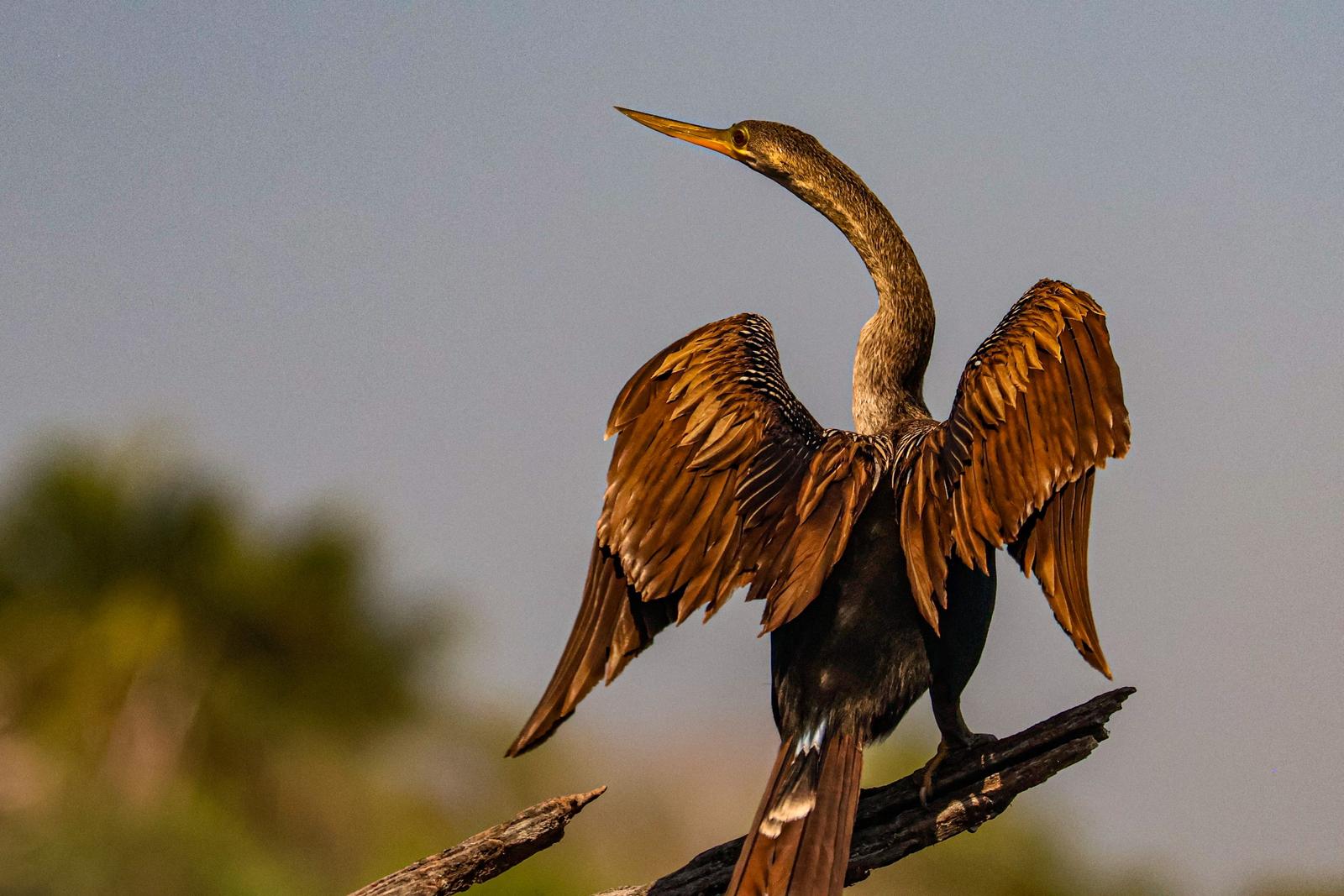
Golden-hour bronze on wings with a classic drying pose that holds the frame.
Thanks Susan. This reads as a wildlife portrait focused on behaviour—the anhinga spread to dry after a dive. The warm, backlit feathers are the hero here; the copper tones and the S-curve of the neck give the image elegance. You’ve kept the background simple so the bird sits cleanly against sky with just a whisper of habitat. I’ll frame my critique with that intent in mind and look at how the technicals, composition and light support the moment.
TECHNICAL EXECUTION ★★★★
Feather detail on the open wings is crisp and the exposure is well judged for strong backlight—highlights hold and the blacks aren’t crushed. The head and eye appear a touch softer than the wings, which slightly weakens the connection; a single AF point locked to the eye and a step down to f/7.1–f/8 would increase depth on head and neck without sacrificing the background blur. Noise looks controlled and colour is tastefully handled—no heavy saturation or halos. Processing feels restrained; you could gently lift micro‑contrast on midtones to emphasise the barred plumage. With tack‑sharp focus on the eye this would be publication‑ready.
COMPOSITION ★★★★
The pose is strong—wings open, neck sweeping, and the diagonal perch adds direction. Placing the bird slightly right gives it room to “look” into the left-hand space, which works. The right wingtip feels a touch cramped against the frame and the tail almost kisses the lower edge; 5–10% more canvas on the right and bottom would let the posture breathe. The small broken twig on the lower perch and the pale patch near the tail pull the eye—minor, but noticeable against an otherwise clean field. Did you consider committing to full symmetry by centring the bird, or do you prefer the dynamic offset created by the perch?
LIGHTING ★★★★
Lovely low sun from behind sculpts those bronze primaries and separates the bird from the sky. The trade‑off is a shaded face; the eye lacks the small sparkle that glues us to the subject. A slight shift in your position (or waiting for a head turn) to catch a rim or catchlight on the eye would add life without killing the rim glow. You could also locally lift the neck and eye by about a third of a stop to reveal texture while keeping the dramatic backlight. With that extra catch of light in the eye, this would jump a level.
STORY ★★★★
The frame tells a clear behaviour story—anhinga drying after a dive—made readable by the outstretched wings and aquatic perch. It’s honest and natural, not staged, and gives a hint of place with the soft greenery in the background. What’s missing is a small beat of action or character: a shake sending droplets, a preen, or a head tilt toward light to reveal the eye. Those micro‑gestures turn a strong record into a memorable moment. Were you waiting for additional behaviour, or was the goal a clean, archetypal pose?
IMPACT ★★★★
The warm palette, grand wing span, and tidy background give the image presence. It’s the kind of photograph that would sit well in a nature feature or print. Familiarity of the pose keeps it shy of iconic; a sharper eye highlight and a little more breathing room would increase its staying power. Still, it sticks due to colour and shape harmony. One more layer of moment or precision would push this to a five.
CONSTRUCTIVE NEXT STEPS
- Prioritise the eye: single-point AF on the eye, f/7.1–f/8, and 1/1600–1/2000s with Auto ISO to hold micro‑sharpness on perched birds that still twitch.
- Work the angle to catch light in the eye—move 30–60 cm so the sun is 20–40° off your shoulder, or simply wait for a slight head turn; fire a short burst when it happens.
- Give the pose room: zoom out a notch or step back to keep the wingtip and tail clear of the edges; in post, consider a small canvas extension on the right/bottom if needed.
- Post‑process cleanly: mask the head/neck and lift shadows +0.3–0.5 EV, add subtle midtone contrast to the wings, and clone the bright tail patch and little broken twig on the perch to reduce eye‑catching distractions.
AI Version 2.12