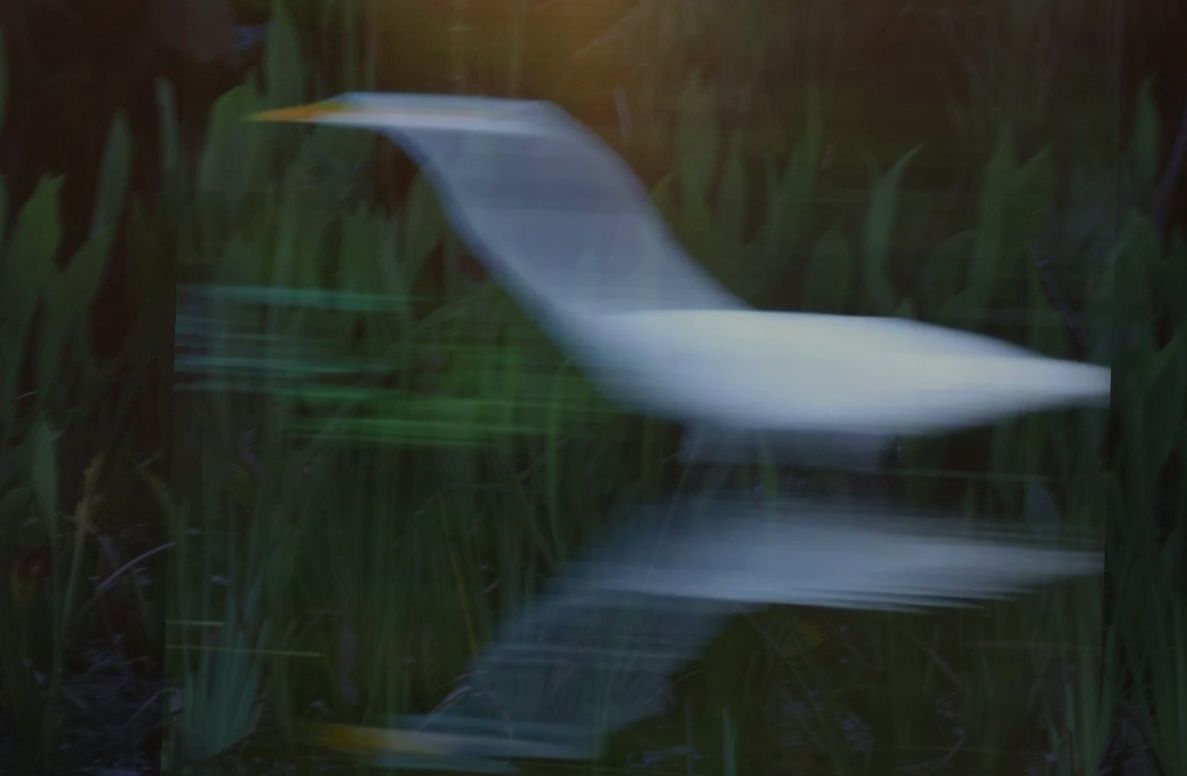
A lyrical, abstract sweep of a bird in motion that lives or dies by print choices and tonal control.
Your frame sits between fine art and wildlife: a panned, long‑exposure white bird cutting across dark reeds with a mirrored echo below. For a museum print, materials matter as much as pixels. With soft motion and deep, subdued greens, you have two strong directions: a matte, cotton‑rag treatment that feels painterly and quiet; or a baryta/gloss presentation that intensifies the luminous white streak and reflection. I’ll outline specific stocks below, then critique what’s on screen so you know what will actually hold up when scaled.
TECHNICAL EXECUTION ★★★
There’s clear intentional motion blur from a pan, which suits the concept, and exposure holds the white body without obvious clipping. Blacks feel a bit muddy and green‑shifted; the reeds never quite settle into a clean low‑key tonality. I’m also seeing faint vertical seams/bands near the left and right edges that look like processing or stitch artefacts—these will be very noticeable in a big print. Noise isn’t a problem here, but local contrast is low around the reflection. To reach five stars you’d need to remove artefacts, deepen D‑max cleanly, and refine colour so the whites stay neutral while the greens sit natural and restrained.
COMPOSITION ★★★
The arrow‑like body and its reflection create a strong horizontal vector that carries the eye left to right; that’s the picture’s backbone. However, the bird’s rightmost edge is uncomfortably close to the frame, making the “flight path” feel cramped. The band of bright green streaks behind the head competes a little with the subject and breaks the otherwise simple shapes. Negative space on the left is better managed and gives some breathing room. Would a wider capture (or a crop adding space on the right if available) strengthen the sense of glide?
LIGHTING ★★★
Low light suits the mood, letting the white form glow against darker reeds. The reflection carries a nice, cooler tone but lacks separation in the mid‑shadows, so the lower half reads a bit flat. A touch more tonal structure in the dark greens would help the white streak sit in a richer field without becoming harsh. Consider whether a slight warm/cool split (cool in the shadows, neutral in the bird) would anchor the palette more convincingly.
STORY ★★★
The idea is movement distilled to shape: a fleeting pass over water, doubled by its own wake. It’s not about species or behaviour; it’s about the feeling of a white brushstroke through dusk. The concept is clear, though it could carry more tension with cleaner edges or a more deliberate relationship between subject and reflection (for instance, a stronger S‑curve or more space to “fly into”). What emotion are you aiming for—calm, velocity, or mystery—and how might shutter length or pan speed push that further next time?
IMPACT ★★★
On a wall this could be striking, especially large, because the graphic white form reads from distance. Right now the slight artefacts and murky blacks blunt the punch and the near‑crop on the right saps elegance. Cleaned up and printed on the right surface, it can cross from “interesting” to “quietly commanding.” To hit five stars you’d want flawless edges, richer darks, and a presentation choice that amplifies the glide rather than fighting it.
CONSTRUCTIVE NEXT STEPS
- File prep for print: remove the faint vertical seam/banding at the left and right edges; set a true black point around RGB 5–8 and lift lower midtones slightly to keep reed detail; keep the brightest whites under about RGB 245 to avoid paper clipping on matte stocks.
- Colour management: neutralise the bird’s whites (target Temp/Tint so they’re slightly cool-neutral) while letting the greens stay muted; soft‑proof with the paper ICC profile and adjust using a Perceptual rendering intent.
- Local shaping: a gentle dodge along the top edge of the bird and a mirror dodge in the reflection to create a clean “spine” of light; burn down the bright green band behind the head so the subject reads first.
- Presentation: if you have extra canvas, add 3–5% space to the right side before print to avoid edge tension; otherwise consider a slightly tighter panoramic crop that commits to the streak as a graphic mark.
For the museum print itself:
– Painterly route (my first choice for this image): Hahnemühle Photo Rag 308gsm or Canson Rag Photographique 310gsm. Soft, non‑reflective surface that flatters the motion blur, with excellent archival stability. Deckled edges on a float mount can look superb for this quiet piece.
– Deeper blacks with subtle sheen: Hahnemühle Photo Rag Baryta 315gsm, Canson Platine Fibre Rag 310gsm, or Ilford Gold Fibre Silk. Higher D‑max will make the dark greens richer and the white streak pop without the glassy look of full gloss.
– Contemporary gloss/face‑mount (only if you want maximum luminosity): Fuji Crystal Archive Maxima or Fujiflex SuperGloss, face‑mounted to acrylic. Stunning punch but will emphasise any artefacts and every speck of dust—perfect files and immaculate finishing required.
– Experimental/poetic option: Awagami Kozo/Bizan washi (inkjet‑coated). The slight fibre texture suits the brushstroke feel; expect softer blacks, so adjust accordingly.
Practical notes:
– Deliver a 16‑bit TIFF in Adobe RGB at the intended size, 240–300 ppi. Run A3 test strips of the bird’s brightest whites and the darkest reeds on your top two papers before committing.
– Mounting: museum‑grade cotton rag mat, hinged with Japanese paper and wheat starch, or a float mount in a deep, non‑glare glazed frame. Keep glazing non‑reflective (Optium Museum Acrylic) if you choose matte papers.
– Consider scale: this reads well large. A long side of 36–48 inches (or 90–120 cm) works; go bigger only once artefacts are fully resolved.
What feeling do you most want the viewer to carry away—serenity or speed—and does that point you towards a softer rag surface or a punchier baryta finish?
AI Version 2.12