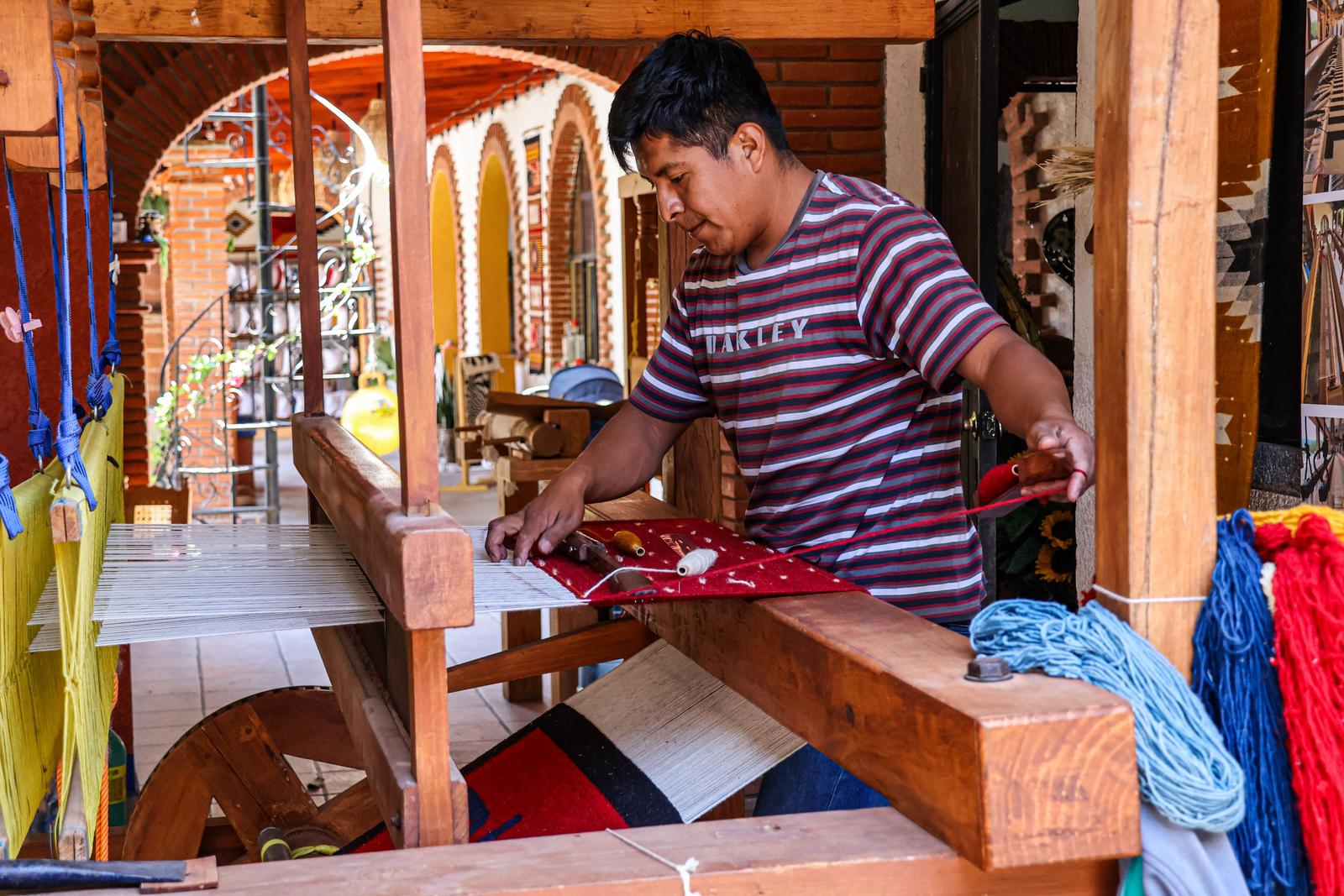
A respectful, workmanlike portrait of craft slowed by clutter and a missed peak moment.
You’ve clearly shown a craftsman engaged at his loom, which hits your aim. The large wooden frame and warp threads give immediate context, and his concentrated gaze feels genuine — this sits comfortably in travel/documentary with an environmental portrait flavour. What holds it back is that my eye bounces between the bright blue yarn on the right, the spiral stair in the background, and the brand text on his shirt before settling on his hands. What single action did you most want the viewer to notice first — the shuttle, the hands, or his expression? Deciding that would help you choose framing, depth of field and timing more decisively.
TECHNICAL EXECUTION ★★★★
Focus and exposure look solid: his face and hands are crisp, and the tonal range across the wood and fabric is well handled without crushed shadows or blown highlights. Colour is natural, with warm brick and timber tones that suit the subject. There’s no obvious noise or artefacts, and processing appears restrained. Minor issues are the slightly mixed warmth between foreground shade and the brighter corridor, and the strong saturation of the blue yarn that pulls attention. A touch more control over white balance and local colour would elevate it to publication‑ready perfection.
COMPOSITION ★★★
The loom creates a helpful frame, but the scene is busy: the spiral staircase, arches, and the bright bundle of blue yarn on the right compete with the main action. The bottom wheel is partially cut and the right hand is close to the edge, which feels cramped. A lower, slightly leftward viewpoint could have aligned the warp as leading lines into his hands and kept the background simpler. Consider whether you want the workshop context or the craft moment to dominate; right now it’s half‑and‑half. How might the frame change if you stepped left 50–80 cm and used the loom posts to block the corridor clutter?
LIGHTING ★★★
The open shade is kind to skin and wood, giving even illumination without harsh contrast. However, the light doesn’t shape the subject much; it’s functional rather than expressive. A slight side angle to catch a soft highlight on the hands and shuttle would add depth and texture to the threads. Watch the brighter corridor in the background — it becomes the brightest area and steals attention. Subtle dodging on the hands and a small burn on the corridor would help guide the eye.
STORY ★★★
We understand what’s happening — a person weaving — and the tools, yarn and loom support that. What’s missing is a decisive gesture: the shuttle in motion, a tightened thread, or a foot on the treadle to show action. His look of concentration is good, but the moment feels mid‑process rather than peak. Including both hands actively engaged or timing for the shuttle pass would add urgency and rhythm. Could you have asked for one more pass of the shuttle or waited for a repeatable motion to capture a clear “now”?
IMPACT ★★★
The image is pleasant and respectful, but the competing elements dilute its punch. A cleaner background and a stronger gesture would make it stick. As it stands, it’s a solid record of place and craft rather than a memorable, story‑driven frame. With a tighter focus on hands and action — or a bold compositional decision using the loom as a full frame — this could rise a level.
CONSTRUCTIVE NEXT STEPS
- Shift position lower and 50–80 cm to your left so the warp threads lead directly towards his hands; use the loom posts to hide the corridor and keep the wheel and shuttle fully inside the frame.
- Decide on motion: to freeze, aim around 1/250–1/320 sec and catch the shuttle mid‑pass; to show craft in action, try 1/30–1/60 sec for a slight blur of the shuttle and fingers while keeping the face steady.
- Soften distractions in post: crop a little from the right to reduce the bright blue yarn, lower blue/yellow luminance selectively, burn the corridor by about −0.3 to −0.5 EV, and dodge the hands/shuttle slightly to make them the brightest point.
- Use a wider aperture (around f/2.8–f/4) or a longer focal length to compress and blur the background while keeping the hands and face within the depth of field; this keeps context but reduces clutter.
AI Version 2.12