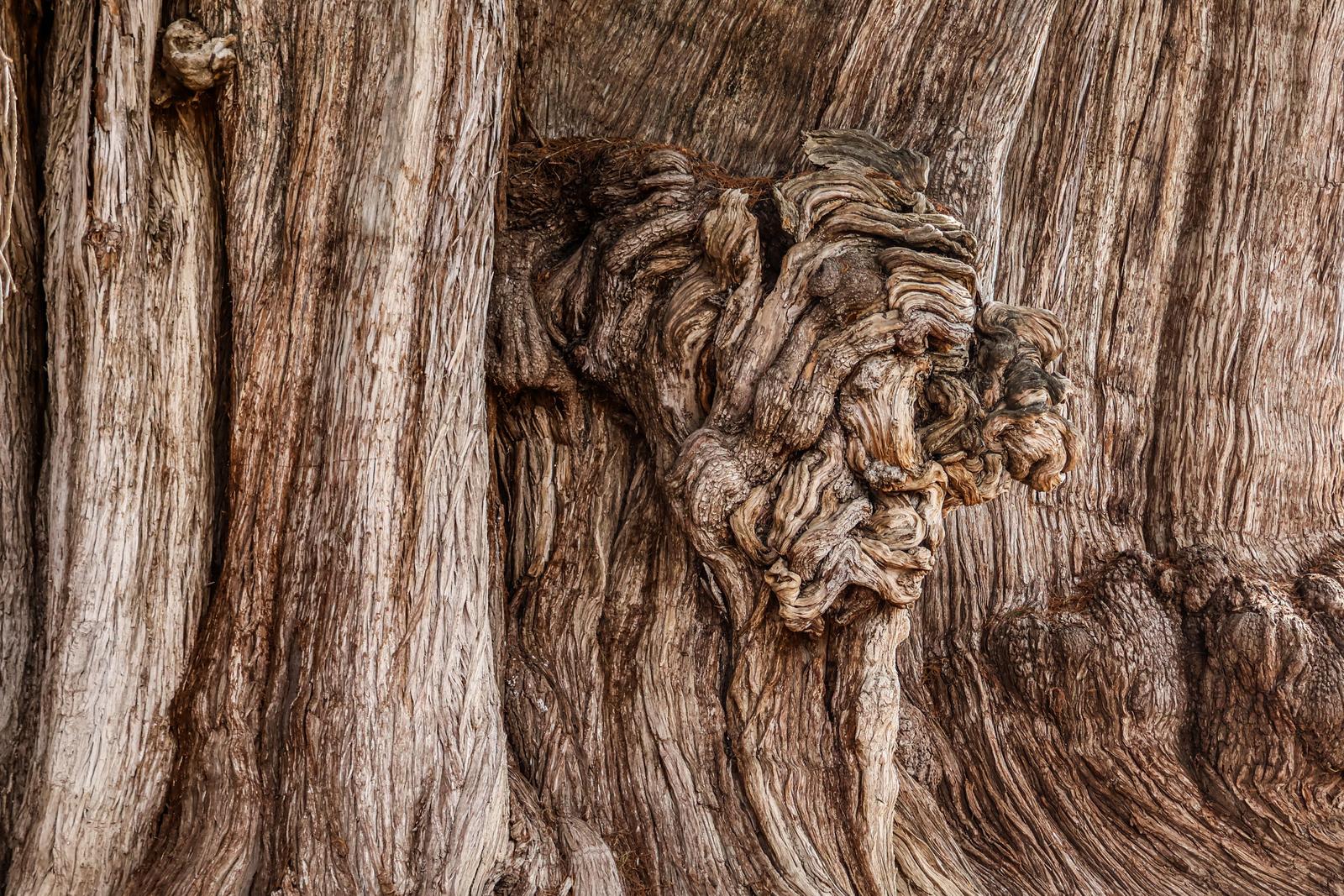
Tactile, well-seen bark with a surprising “lion” hiding in the grain.
You’ve nailed the texture, Susan—the fibres, ridges and age lines are crisp and readable. What elevates this beyond a simple record is the knotted burl on the right that reads like a lion’s head in profile; that visual surprise gives the frame a hook. I’d treat this as an abstract nature/fine‑art close‑up rather than a pure macro study, leaning into that face-like form. Do you want the viewer to see “texture” first or “the hidden animal” first? Your answer to that will guide both framing and post work.
TECHNICAL EXECUTION ★★★★
Detail is strong across the frame—fibres and growth rings are sharp and free of obvious noise, suggesting a stable shutter and modest ISO. Colour is natural and nicely muted; there’s no heavy-handed saturation or HDR sheen. Exposure is well judged with gentle roll-off in the shadows and no clipped highlights in the pale bark. If anything, midtone contrast is a touch even, which flattens the deepest folds slightly. A subtle, selective micro-contrast boost on the “mane” could push this to publication-grade polish.
COMPOSITION ★★★★
The burl “head” sits just right of centre and faces right, giving the image a readable subject with the surrounding grain acting as flowing hair. The vertical panels on the left create rhythm but the bright, pale strip at the far left pulls the eye a bit too strongly from the main form. The small nub near the top-left edge is another minor pull. A slightly tighter crop from the left—and a sliver from the top—would concentrate attention on the face-like knot without losing the sweeping lines. How would a square crop, anchored on the “lion,” change the clarity of your intent?
LIGHTING ★★★★
The light is soft and even, which keeps colours honest and reveals surface detail cleanly. There is some directionality—enough shadow in the folds to suggest depth—yet it stops short of strong modelling. A touch more raking side-light would carve the relief further and separate the “snout” from the body. Specular glare is nicely controlled, so you’ve avoided the plasticky shine that often spoils bark studies. Consider revisiting when the sun skims across the trunk, or use a diffuser plus a small white card to lift the shadowed recesses selectively.
STORY ★★★
Your comment frames this as a texture study, and on that front it succeeds; however, texture alone offers limited narrative. The accidental “lion” gives the frame a moment of discovery, which is the most engaging element here. If that reading is intentional, the image could communicate “nature’s hidden forms” more clearly with framing and tonal shaping that prioritise the head. As it stands, the story sits between pure pattern and discovered subject. What emotion or idea did you want viewers to leave with—calm observation, or the delight of spotting a face in the wood?
IMPACT ★★★★
The piece is memorable because of the pareidolia effect; once seen, the “lion” is hard to unsee. Earthy tones and honest processing keep it tasteful and print-friendly. Small edge distractions and slightly even tonality hold it back from a true “stop-you-in-your-tracks” moment. Refined framing and targeted tonal guidance would add bite without betraying the natural feel. This is close to gallery-wall material with a few deliberate choices to emphasise the central shape.
CONSTRUCTIVE NEXT STEPS
- Reframe tighter around the burl: trim ~10–12% from the left to remove the bright pale strip, and a small slice from the top to drop the eye straight onto the “mane”.
- Return in low raking light (early/late) or angle yourself so light crosses the trunk; use a polariser to tame any sheen and add micro-contrast to the folds.
- In post, use gentle dodge/burn: lift the “snout” ridge and front curls by about +0.2–0.3 stops; burn the left panel and far-right background by −0.2 to create a subtle vignette that doesn’t look added.
- Shoot from a position square to the main surface, tripod-mounted at roughly f/8–f/11 and ISO 100–200, to maximise uniform sharpness across the bark plane.
AI Version 2.12