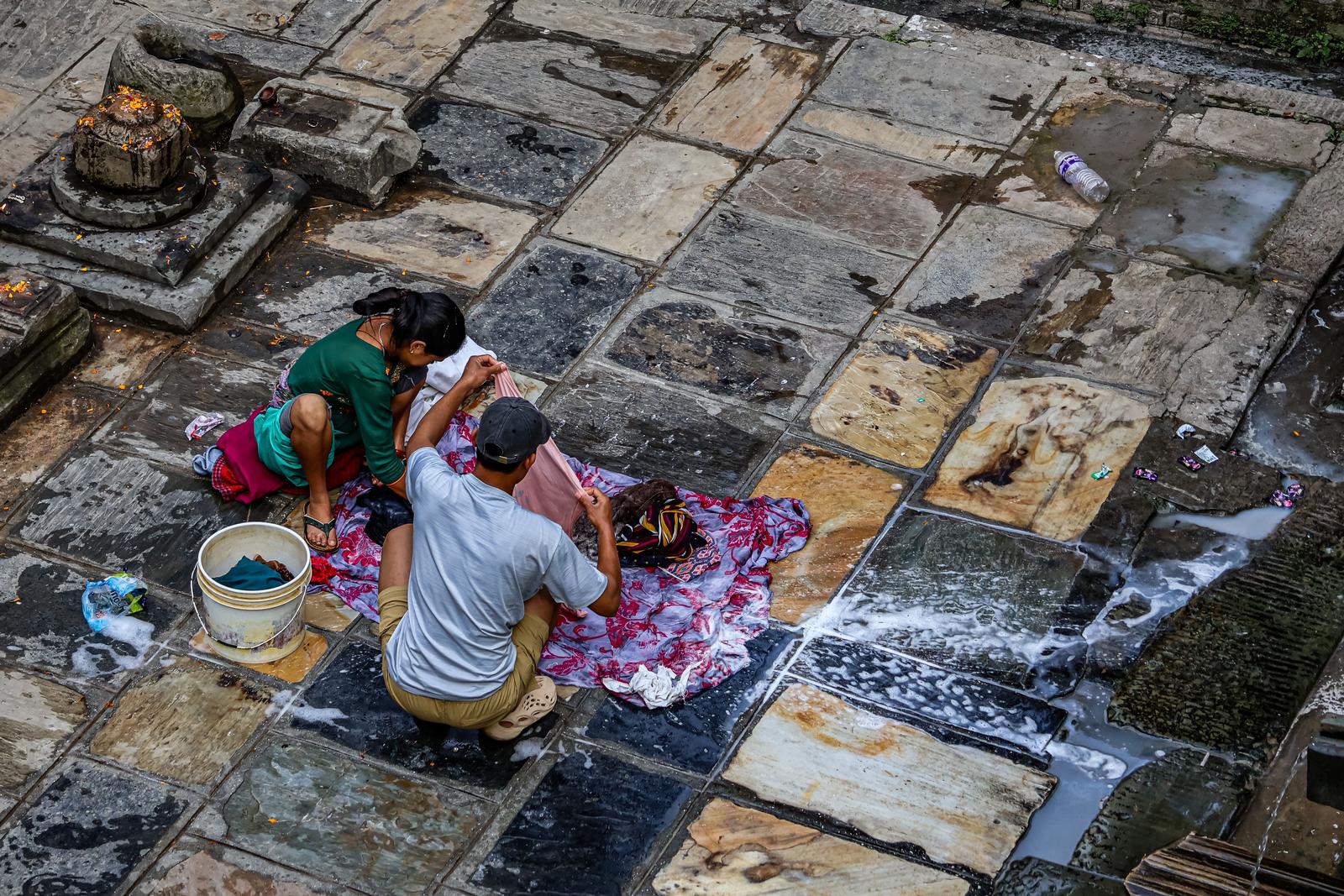
A genuine slice of everyday life with strong textures and a clear task at its centre.
Thanks Susan. Your frame reads as candid travel/documentary: two people working together over patterned cloth, with soap and water running across the stone slabs. The high viewpoint gives context—the shrine on the left, the bucket and suds, and the worn paving all speak of place and routine. The moment of both hands pulling the garment adds action. My notes below focus on tightening the frame and deepening the connection; what drew you to the overhead angle, and how might a lower, closer position have changed the feeling of participation versus observation?
TECHNICAL EXECUTION ★★★★
File quality looks strong: crisp detail in the stone textures and fabrics, and no obvious noise or artefacts. Exposure is well judged; the midtones in the paving hold texture and the whites in the soap aren’t excessively clipped. Colour feels natural and restrained, which suits the subject. There’s no distracting sharpening haloing. If anything, the scene could benefit from a touch more local contrast or clarity around the hands and fabric to emphasise the action, but the base capture is solid and publishable.
COMPOSITION ★★★
The overhead diagonal works, and the red patterned sheet anchors the eye. However, the frame carries a lot of empty paving that dilutes the subject’s importance; the family sits low-left while the top-right quadrant is dominated by blank slabs. Bright distractions compete for attention—the plastic bottle near the top-right edge and small wrappers on the right pull the eye away from the hands. The shrine at top-left is interesting but feels half-in, half-out of the story. A tighter crop from the right and top, or a closer shooting position to include more faces and hands, would concentrate the narrative and remove visual noise.
LIGHTING ★★★
Soft, likely overcast light keeps colours honest and prevents harsh shadows on skin—good for a candid moment. That said, it’s quite flat; the scene lacks a defined highlight to pull us straight to the action. A bit of directional contrast—the kind you can get by waiting for a brighter patch or stepping so the light rakes across the stones—would add depth and texture. In post, gentle dodging on the joined hands and the pale garment, with slight burning of the surrounding slabs, could subtly shape the viewer’s path without looking manipulated.
STORY ★★★
The image communicates labour and cooperation clearly: two people wringing cloth, soap flowing into the drain, bucket at the ready. The setting hints at a public washing area and the ritual of daily chores. What’s missing is a more personal read—faces are largely obscured, so we read action more than relationship. Waiting for a split-second gesture—a laugh, eye contact, or a stronger splash—could lift it from descriptive to affecting. How close could you have worked, with permission, to bring a human expression into the centre of the frame?
IMPACT ★★★
The textures and authenticity hold attention, and the diagonals of soap lend movement. Still, the image doesn’t fully stick because the subject is small within a busy field and competing bright litter steals focus. A cleaner edge and a more decisive moment would add bite. This is a strong foundation; with tighter control of frame and moment, it could be memorable.
CONSTRUCTIVE NEXT STEPS
- Reframe tighter in camera or crop now: remove the top-right quadrant to eliminate the plastic bottle and much of the bright foam; keep the red cloth, hands, bucket, and a slice of shrine for context.
- Work slightly lower and closer (after seeking consent) to include at least one face with the working hands; a 35–50mm view at knee height would balance intimacy with context.
- Wait for a stronger gesture—water pouring, cloth snapping, or shared glance—to add a clear peak moment.
- Post-process: subtle dodge on the hands and pale garment; burn down bright litter and stray foam; consider cloning the most distracting wrappers if your documentary intent allows.
AI Version 2.12