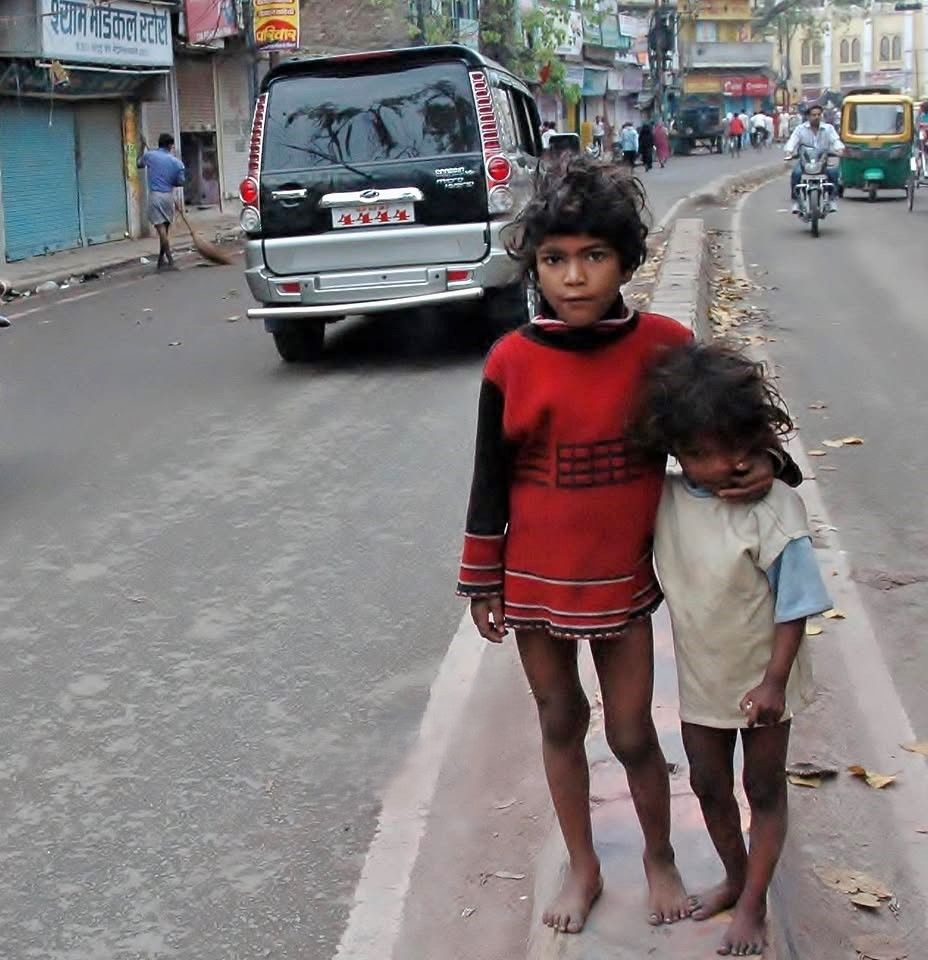
A tender moment is here, but the frame lets clutter shout over it.
You’re right to be bothered by the van—it competes hard with the two children, who are the heart of this street/documentary scene. Yes, you can de‑emphasise it in post: a left‑side linear burn of around 0.7–1 stop, plus a touch of desaturation and reduced clarity on the van will push it back; a subtle radial lift on the children (exposure and contrast) will pull the eye where it belongs. But the cleaner solution is in‑camera: shift a step or two to your right and/or lower your viewpoint so the kids sit against the road rather than the bright van; or wait three seconds for traffic to clear. Your intent—contrasting modern traffic with the children—makes sense, yet here the van is so large, bright and central that it turns from context into a distraction. The protective arm and the bare feet on the curb are strong story anchors; lean into those. How might this picture feel if you’d framed vertically and let the street recede behind them while keeping the older child’s gaze as the focal point?
TECHNICAL EXECUTION ★★★
Exposure is broadly sound and colours are natural; nothing looks over‑processed. The children appear acceptably sharp for a candid, though I’d like crisper focus around the older child’s eyes. Background detail is busy but handled without obvious artefacts or halos. There’s a bit of motion softness in the scene (look at the people sweeping and riding) that’s fine for the genre but it leaves the frame without a crisp anchor. A faster shutter (around 1/250–1/500) and focus priority on the older child would strengthen the file. To hit five stars, I’d want pinpoint eye focus, cleaner micro‑contrast on the subjects and deliberate control of background sharpness via aperture choice.
COMPOSITION ★★
The siblings are placed near centre‑right, which could work, but the large silver van sits directly behind them and dominates the left half. Its bright tonality and size drag the eye away from the bond between the kids; this undermines your “new/old” idea by sheer visual weight. The pavement curb gives a useful leading line, yet the wide empty road to the left becomes dead space rather than breathing space. A vertical frame from the same spot—or a one‑step move right to separate the kids from the van and place them against the roadway—would simplify the story. Be alert to mergers; here, the taller child’s head and the van’s tail form a heavy cluster. For a five‑star composition, every background element would either support the story or be excluded.
LIGHTING ★★★
Soft, overcast light is kind to skin and gives a gentle mood that suits the tenderness between the children. However, the light is flat across the whole scene, meaning the background competes tonally with the subjects. A slight directional lift (in post) to the children’s faces—dodging midtones and adding a hint of local contrast—would create separation without looking forced. Shooting a touch earlier or later in the day could have offered shape and shadow to carve them from the street. To reach five stars, I’d want either intentional sculpting from available light (shadow/highlight play) or stronger tonal separation on the subjects.
STORY ★★★★
The narrative is clear: an older child steadying a younger one, both barefoot on a busy road. That protective arm and the direct gaze are powerful and humane; they carry the picture. The surrounding street gives context—sweeper, rickshaw, closed shops—so place and circumstance read immediately. The van weakens, rather than enriches, the contrast you wanted by visually overshadowing their relationship. Did you interact with them before/after the frame—could a beat more connection or a closer step have deepened that moment? A cleaner background or a tighter, vertical framing would lift this to the next tier.
IMPACT ★★★
The children’s bond stays with you, but the image doesn’t fully land because attention keeps bouncing to the van. The scene feels authentic and respectful, and the muted tones help. With stronger subject isolation and a more decisive background choice, this could be a memorable frame in a travel/documentary set. Right now it’s a good picture with a clear heart, diluted by competing elements. Reduce those and the emotional punch will increase noticeably.
CONSTRUCTIVE NEXT STEPS
- In post: add a left‑side linear gradient (‑0.7 to ‑1 EV), lower saturation and clarity on the van, and apply a subtle radial lift (+0.3 EV, +10–15 contrast) on the children to guide the eye while keeping it natural.
- On location: step 1–2 metres right and drop your viewpoint to chest or waist height; shoot a vertical 4:5 frame so the kids sit cleanly against the road, not the van, and keep both sets of feet fully in.
- Use shallow depth of field to separate subject from background: target f/2–f/2.8 (or your lens’ widest clean aperture), 1/250–1/500s, ISO as needed; focus on the older child’s eye.
- If your aim is documentary integrity, avoid cloning out big elements; instead, wait for the background to clear or reframe. Reserve cloning/healing for tiny distractions only.
AI Version 2.12