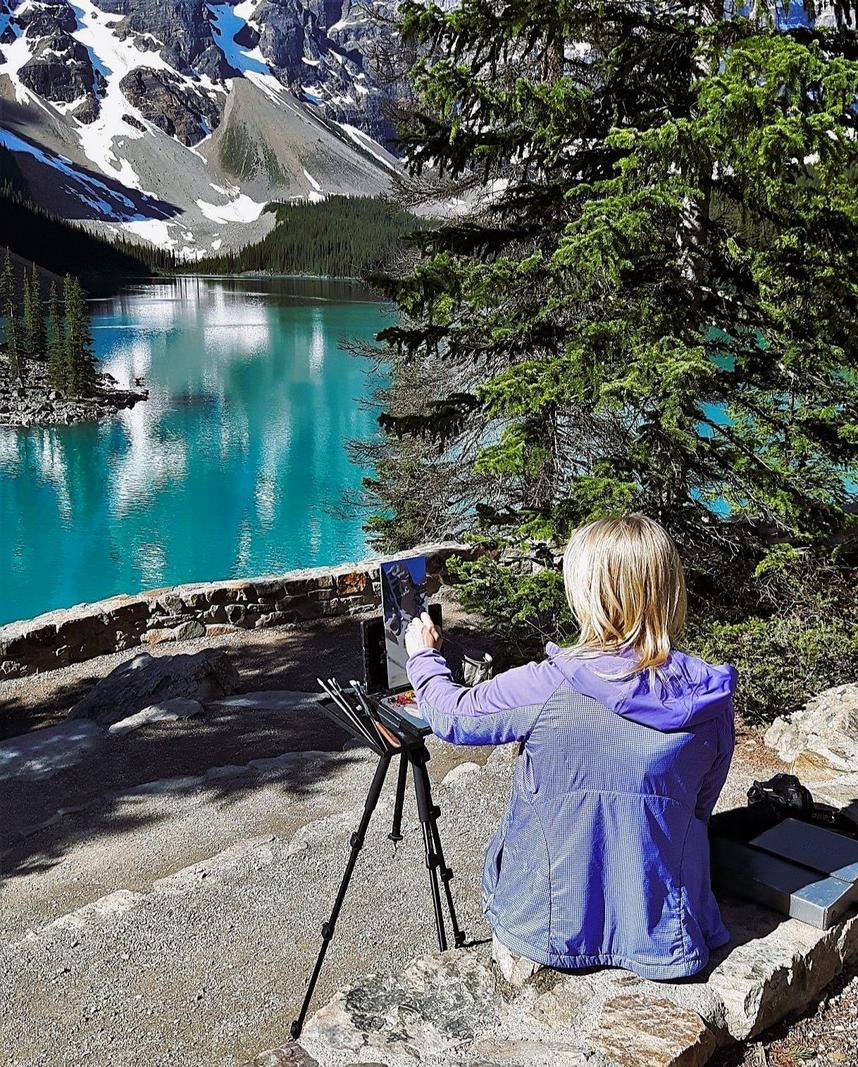
A lovely “artist at work” scene in a world‑class setting, held back by harsh midday contrast and a busy right side.
You’re right to question exposure, but the core problem isn’t overall brightness—it’s the wide contrast range. Pulling global exposure down makes the shaded rocks and the painter go dull while the bright snow and turquoise water still feel hot. This is a travel photograph with a strong human element: the painter on the rock, the easel and tripod, and that striking blue lake framed by pines and snowy peaks. The moment is good; you’ve caught a real activity rather than just a postcard view. To fix the balance, think selective adjustments rather than a blanket exposure drop: recover highlights in the lake and snow, open the painter a touch, and tame saturation in the aquas. Looking back at the capture, could you have taken two steps left or a little higher to separate the painter from the heavy evergreen and give her a cleaner backdrop of water?
TECHNICAL EXECUTION ★★★
Focus looks solid across the mid‑frame and the detail in the rocks and trees holds up well. The issue is dynamic range: bright snow patches and reflective lake areas are close to clipping, while the painter sits in comparatively dull light. Colour feels a touch pushed—especially the cyan water—which starts to look digital rather than natural. A global exposure reduction won’t solve this; use highlight recovery and local dodging/burning on separate masks. If you shot RAW, you should be able to pull back half to one stop in the highlights and still lift the painter slightly without noise problems. Next time, a circular polariser at a modest rotation would help manage glare on the water and deepen tones without going garish—did you have one on?
COMPOSITION ★★★
The core idea—showing the painter against the famous lake—is strong and gives the scene a reason to exist. However, the large conifer on the right dominates and partially blocks the water, competing with your subject. There’s also a lot of empty gravel foreground that doesn’t add story; it dilutes the impact of the beautiful mid‑ground. A step or two left would place the painter more cleanly against the blue water and reduce the branch clutter, while a slightly higher viewpoint could use the stone wall as a leading arc rather than a barrier. Consider a tighter crop from the right and bottom to remove some gravel and the box/bag, bringing the eye faster to the painter and lake. How would the image feel if the easel and painting were given more breathing space with the tree acting as a partial frame rather than a block?
LIGHTING ★★★
This looks shot in hard midday sun: crisp highlights on the hair and wall, deep shade on the ground, and strong specular glare on the lake. It makes the place pop but flattens the painter and exaggerates the contrast you’re wrestling with. Waiting for a thin cloud or shooting earlier/later would give softer modelling on the subject and richer texture in the mountains. If time didn’t allow, placing the painter fully in open shade (or simply moving a metre to put her against the water’s reflected light) would have balanced tones better. In post, use a gentle highlights pull and a soft, warm tone curve to calm the harshness while keeping the scene believable.
STORY ★★★★
The narrative is clear and appealing: a traveller taking time to paint an extraordinary view. The inclusion of the easel, palette, and tripod roots us in the act of creation and gives the landscape a human scale. The back‑turned subject avoids cheesiness and keeps attention on the act, though a slight profile showing hand and brush more clearly might strengthen the gesture. The stone wall suggests a lookout, adding context to place. With cleaner separation from the tree and gentler light on the painter, this story would read even stronger.
IMPACT ★★★
The location has undeniable wow factor and the painter lifts it above a standard vista. Still, the busy right side and high contrast mute the punch you could get from this scene. A tighter, more deliberate frame and calmer colour would move this from “nice moment” to a memorable travel image. Subtlety will help here—less saturation, more balance, and a clearer subject‑to‑background relationship. Aim for a frame where the first read is the painter and canvas, and the second read is the sweeping turquoise bay and peaks.
CONSTRUCTIVE NEXT STEPS
- In post: work locally. Pull highlights in the lake/snow (−0.5 to −1 EV), lift the painter by +0.3 to +0.5 EV with a soft brush, and reduce Aqua/Blue saturation by 10–20% to keep the water believable.
- Reframe on location: step 1–2 metres left and slightly higher to place the painter against open water, reduce the dominance of the right‑hand tree, and use the curved stone wall as a leading line.
- Carry a circular polariser and use it lightly to cut glare on the water; expose for the brightest snow/water and lift shadows later to protect detail.
- Crop a little from the right and bottom to remove the box/bag and excess gravel; keep the tripod and easel comfortably inside the frame with breathing space.
AI Version 2.12