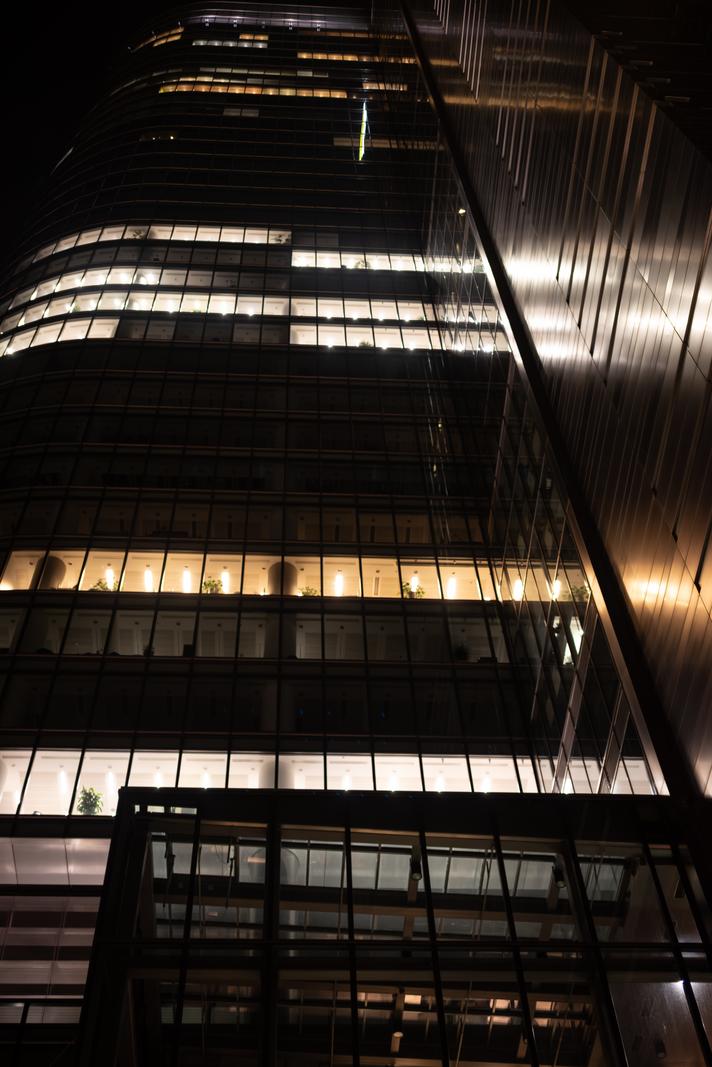
Strong night-time geometry with a moody corporate feel, but the frame needs stricter control.
You’ve gone for a dramatic, upward-looking study of glass and light, which suits architectural work at night. The glowing bands of offices read well and the diagonal split with the metal façade on the right adds texture contrast. What drew you to include so much of that metal plane—were you aiming for a materials contrast or a leading line? The idea is sound; the execution just needs more discipline in perspective and framing to elevate it from record to statement.
TECHNICAL EXECUTION ★★
Exposure is handled reasonably well given the bright windows and dark exterior; highlights aren’t egregiously blown. However, the heavy keystoning from pointing the camera upward makes the structure feel like it’s falling back, which is a technical issue in this genre unless used with a very clear purpose. The file reads slightly murky in the deepest shadows, suggesting underexposure or lifted blacks without enough detail. Edge-to-edge sharpness looks acceptable, but the overall legibility suffers because of the dark top and the cluttered lower section. To reach five stars you’d need corrected verticals (in-camera with a tilt–shift or in post using perspective transform), lower ISO on a tripod, and a cleaner tonal range—ideally from a base ISO exposure or a careful bracket and blend.
COMPOSITION ★★★
The upward angle creates energy, and the repeating lit floors give a nice rhythm. The right-hand metal wall brings a bold diagonal but dominates a third of the frame, competing with the real subject—the gridded glass façade. The bottom section with the canopy/atrium structure is busy and pulls the eye away from the stronger mid-frame patterns. A tighter crop excluding most of the canopy and part of the right metal plane would simplify and strengthen the graphic intent. How might the scene read if you stepped back and kept the camera level, allowing more of the pure grid and less of the competing elements?
LIGHTING ★★★
The interior office lighting creates an appealing pattern and warm/cool contrast against the night. That said, the surrounding exterior is very dark, flattening the building’s shape and losing separation at the top. Shooting at blue hour would keep a deep cobalt sky, revealing edges and adding depth without killing the window glow. A slightly darker base exposure to protect the window detail, with a second exposure to lift exterior structure, would provide a richer tonal map. Right now the light supports pattern, but not form.
STORY ★★
There’s a hint of narrative—after-hours offices with plants glowing on the sills—but it stops short of a real moment. Without a human presence or a clear design statement, it becomes mainly a pattern study. A lone cleaner, security guard, or even a single occupied window would shift it from “building surface” to “place where life continues at night.” Consider what feeling about corporate life you want to communicate and wait for an element that anchors that mood.
IMPACT ★★★
The scale and angle give a first hit of drama, and the illuminated bands are pleasing. Impact is muted by the perspective distortion and by visual clutter at the bottom and right edges. With straighter verticals, a cleaner frame, and a touch of sky for separation, this could become a striking night study. As it stands, it’s interesting but not memorable.
CONSTRUCTIVE NEXT STEPS
✓ Level the camera on a tripod and correct perspective: keep verticals parallel in-camera (tilt–shift if available) or in post (Lightroom Transform: Vertical + Guided).
✓ Shoot at blue hour, ISO 100, around f/8–f/11; bracket ±1 to ±1.5 EV to hold window highlights and reveal exterior structure, then blend subtly.
✓ Simplify the frame: step left and exclude most of the right metal wall and the lower canopy, or commit to the metal/glass split but align that diagonal precisely.
✓ Wait for a human element in one lit window or the lobby to give the eye a single hook and a clearer after-hours story; time your exposure for that one lit frame.
AI Version 2.1