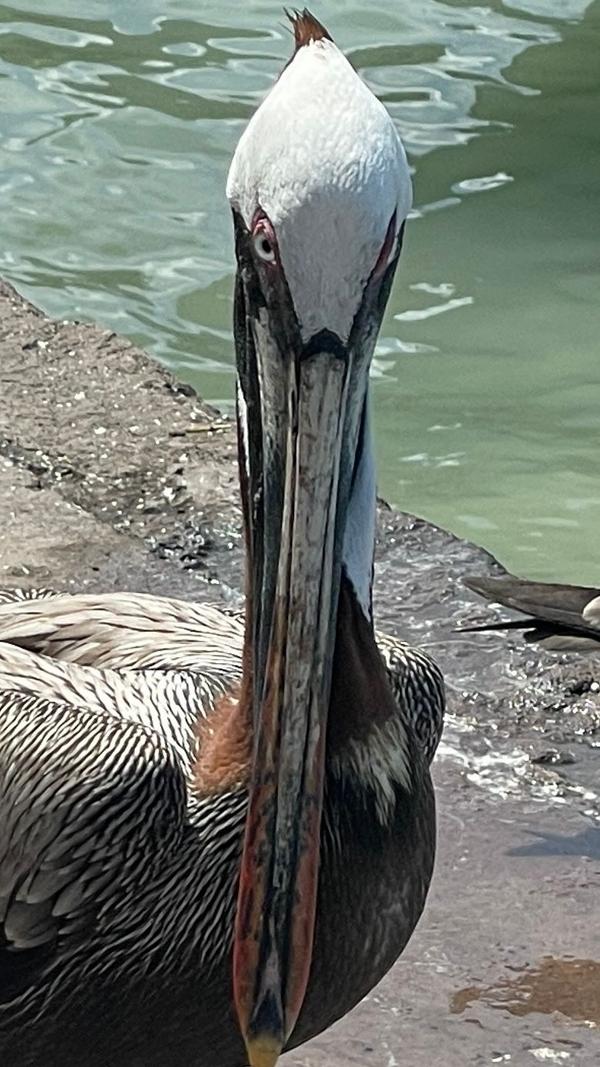
A commanding, face‑to‑face pelican portrait with real presence, held back by tight framing and busy edges.
Thanks Ismar. This is a wildlife portrait, and the straight-on stare with that monumental bill is the picture’s strongest asset. The symmetry of the head and the patterned feathers give you great raw material. What stops it short is how cramped the beak is against the bottom edge and the clutter around it (the concrete ledge on the left and the other bird’s tail on the right). Did you consider taking a small step to your left or lowering your angle to place the bird cleanly against the water?
TECHNICAL EXECUTION ★★★★
Focus looks solid on the eye and upper bill, with fine feather detail holding up well. Exposure is broadly controlled, though the bright white crown is flirting with highlight clipping and the mid-day contrast is a touch harsh on the bill. Colour feels natural—greens in the water and the warm browns of the plumage are believable. There’s no obvious noise or artefacts to distract. To push this to five stars, a touch more highlight headroom and a cleaner, smoother background rendition would help—easy to nudge in RAW with careful highlight recovery and gentle colour noise reduction.
COMPOSITION ★★
The straight-on symmetry is a good idea, but the framing is too tight at the bottom—the bill almost kisses the frame, which makes the bird feel squeezed. The concrete slab on the left and the partial bird on the right pull the eye away from your subject; they don’t add context, only distraction. Cropping tighter into a vertical, symmetrical head-and-bill portrait could work, but you’d need space below the tip. Alternatively, stepping left to eliminate the right-hand intruder and using the water as a clean backdrop would simplify the scene. When you were shooting, what stopped you from giving the beak more breathing room?
LIGHTING ★★
This looks like hard mid-day sun. It flattens the face and creates bright hotspots on the white head while pushing the body into deeper contrast. It’s not disastrous, but it’s not flattering either; pelicans sing in soft, low-angle light where texture and colour come alive and a catchlight pops in the eye. If timing’s fixed, open shade or a slight change of angle to avoid specular glare on the bill would help. Could you revisit early or late in the day for gentler light?
STORY ★★★
As a character study, the direct stare gives a clear connection and the species’ personality comes through. Beyond that, there’s little behaviour or sense of place—Galápagos can’t be inferred from what’s visible. A yawn, a preen, or the pouch stretching would add that extra beat of “why this moment.” The partial second bird hints at a colony but reads more like a mistake than context. What behaviour could you have waited for to turn this from a portrait into a moment?
IMPACT ★★★
The massive, centred bill creates instant punch and the eye contact holds attention. Impact drops as the frame edges start to fight the subject and the light feels clinical. Clean edges and a calmer background would let the pelican’s presence dominate. A touch more room and a better moment would lift this to something you’d remember long after scrolling.
CONSTRUCTIVE NEXT STEPS
- Give the beak breathing room: compose with at least 1–2 cm of space below the tip; if needed, take half a step back or zoom out slightly, then crop for symmetry later.
- Simplify the background in-camera: shift left and lower to place the head entirely against water, excluding the concrete and the partial bird; aim for a parallel camera to keep the bill straight.
- Work the light: return early/late or use open shade; if handheld, try around 1/1000s, f/5.6–f/7.1, ISO as needed to keep the eye tack sharp and the background soft.
- Post-process with restraint: clone out the right-edge bird, recover highlights on the white crown, and add a subtle radial dodge on the eye to enhance connection without overcooking.
AI Version 2.12