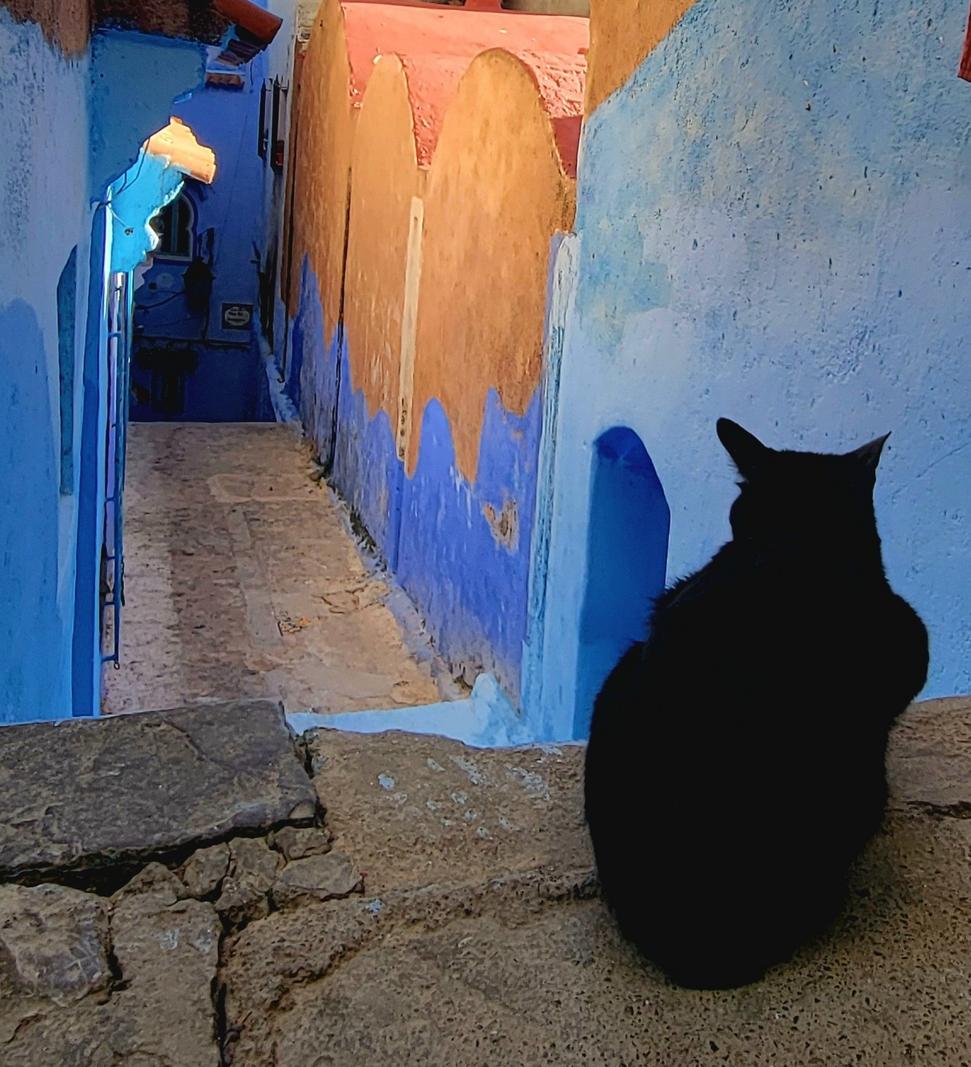
A charming stage of blue walls and a watchful cat, but the promised second character never quite enters the scene.
I believe you, Kit — but in the photo the second cat isn’t legible, and that’s the linchpin of the story you’re hinting at. What we do have is a bold foreground silhouette and a beautiful painted alley, which puts this comfortably between travel and street. The warm ochres against the blues are lovely and the alley draws the eye forward nicely. For the “two‑cat” narrative to work, the distant cat needs to be visible enough — larger in the frame, separated from clutter, or sitting in light — so the viewer doesn’t have to be told it’s there.
TECHNICAL EXECUTION ★★★
The file looks clean with decent sharpness and natural colour; no heavy processing artefacts jump out. The black cat, however, is clipped to a featureless silhouette, losing any texture that might anchor it as the main subject. Midtones down the alley feel a touch thin, suggesting exposure was biased to protect the bright walls. There’s minor compression in the blue paint but nothing fatal. Shooting RAW and lifting the blacks slightly would let you recover a hint of fur or rim detail without making it look forced. Would a small positive exposure compensation have helped you avoid crushing the foreground?
COMPOSITION ★★★
Placing the cat on the right with the alley leading away is a solid idea and the curve of the blue wall adds rhythm. Yet the cat sits very tight to the right and bottom edges, which feels cramped and a little accidental. The red roof fragments at the top nibble at the frame and don’t add much. Most importantly, the distant subject you mention isn’t readable; the leading line arrives at an empty payoff. A small shift left and lower would give the cat breathing space and set a cleaner line of sight to the alley’s end. How might the frame change if the second cat were positioned in one of the brighter patches?
LIGHTING ★★★
The mix of cool shade and warm reflected light suits the place and gives depth to the walls. Back/side light turns the foreground cat into a pure silhouette, which can be strong, but here it also erases character. A slight reposition to catch a thin rim along the cat’s back or ear would separate it from the wall without losing mood. The brightest section of the path nicely pulls the eye, but it outshines the subject. Waiting for a shaft of light to hit the far end — or for the second cat to step into it — would have strengthened the visual hierarchy.
STORY ★★
The posture of the cat suggests a lookout, which hints at a moment, but the narrative stops there. Because the second cat isn’t visible, the viewer can’t connect the lookout with a reason, so we’re left with a static scene rather than a beat of interaction. If the far cat were clearly seen — or if the foreground cat offered a stronger gesture (ears pricked, head turn into light) — the frame would move from “nice place with a cat” to a small story. Consider whether you wanted a quiet sentinel or an encounter; your framing suggests the latter but doesn’t deliver it. What would you have been willing to change — position, time, or patience — to make that interaction undeniable?
IMPACT ★★★
The blue alley is instantly attractive and the cat silhouette gives a clear focal anchor, so the image holds attention at first glance. It conveys a sense of place effectively. However, without the second subject the surprise fades and the frame settles into a pleasant postcard rather than a memorable moment. A readable connection between the two animals, or a more decisive gesture from the foreground cat, would lift it a level.
CONSTRUCTIVE NEXT STEPS
- Reframe from half a metre to the left and lower to give the cat space from the right edge and a clean sightline down the alley; aim to place the cat on a lower-third with negative space in front of its gaze.
- Make the distant cat legible: step forward a few paces or zoom so it occupies at least 3–5% of the frame, and wait for it to sit in a lit patch or clean background; use around f/8 (or your phone’s default deep DoF) to keep both cats readable.
- Expose for the foreground cat if you want texture: dial +0.7 to +1 EV or spot‑meter on the fur, then pull back the bright walls in RAW using a gentle curve; add a subtle dodge along the cat’s rim to separate it from the wall.
- In post, tidy the frame: reduce blue saturation by 10–15% for a more natural palette, clone out the bright flecks on the foreground stone, and crop a sliver off the top to remove the stray red roof pieces.
AI Version 2.12