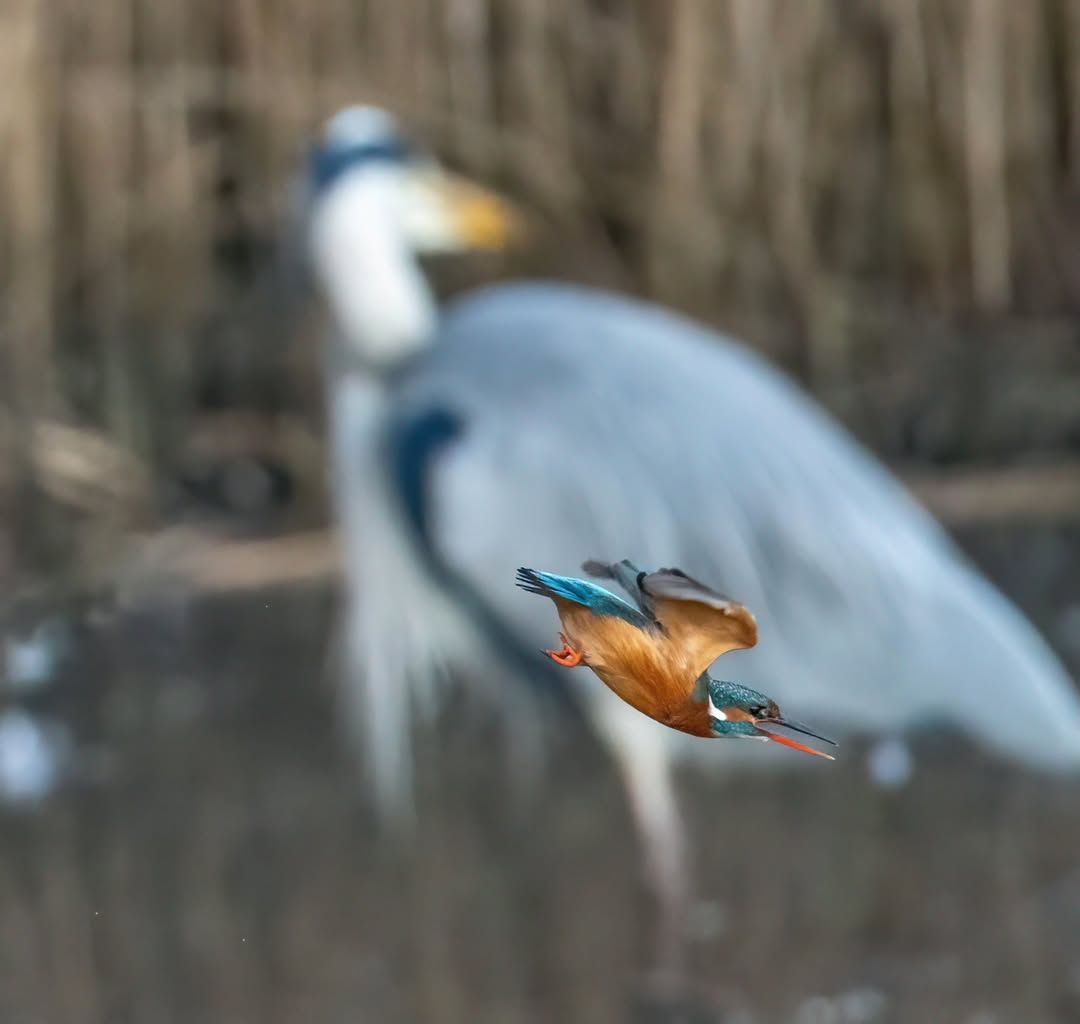
A thrilling split‑second of a kingfisher knifing past a hulking, out‑of‑focus heron — great timing, messy frame.
Unfortunately where we see this Kingfisher is in a limited area
The Heron makes this picture look awful
You did well to freeze a very difficult subject in flight — the kingfisher is sharp and looks alive. This sits squarely in wildlife photography, and your instinct is right: the huge, pale heron dominates and pulls attention from the kingfisher. I wouldn’t call it awful, though; the big soft shape can be useful as context and scale, but in this frame it’s too large and bright. To improve, you need cleaner separation or a crop that gives the kingfisher more presence while pushing the heron further into the background visually. Could you shift your position a metre or so or pre‑select a flight lane where the kingfisher passes over dark water rather than the heron? If you truly can’t move, timing, pre‑focus and thoughtful post will be your best tools.
TECHNICAL EXECUTION ★★★★
Focus on the kingfisher is commendably crisp for such a fast bird, suggesting solid AF‑C tracking and a fast shutter. Noise looks controlled and colours feel natural, with no heavy processing artefacts. If anything, a touch more micro‑contrast on the bird would help it stand out from the soft background. For future attempts, 1/2500–1/3200s at f/4–f/5.6 with Auto ISO is a good baseline for these passes, and keep bursts short to maximise the tack‑sharp frames. Five stars would require critically sharp eye detail plus pristine micro‑contrast on feathers.
COMPOSITION ★★
The kingfisher is relatively small in the frame while the heron occupies most of the background as a bright, high‑contrast mass; it competes for attention. The bird is flying toward the right edge with limited breathing space ahead, reducing the sense of speed and direction. A tighter crop that places the kingfisher lower‑right with more space in front would help, or better yet, capture it against a darker, cleaner patch of water. Even a small lateral shift or lower stance could have separated bird and heron so they don’t merge. Ask yourself: where can you stand so the kingfisher’s usual flight path crosses an uncluttered background?
LIGHTING ★★★
Soft, even light keeps colours honest and avoids harsh shadows on the bird — good for feather detail. The issue is tonal hierarchy: the pale grey heron is the brightest, largest shape, so it steals the eye first. Slightly underexposing the background or post‑burning the heron would restore focus to the kingfisher. Catchlight on the kingfisher’s eye is faint; shooting when the sun is fractionally behind you can add that sparkle. To reach five stars, aim for warm, low‑angle light that models the bird and gives clear separation from a darker background.
STORY ★★★
There’s a built‑in tension: a tiny missile of colour blasting past a giant, ghostly heron. That contrast hints at territory and scale, which is interesting. The merger, however, muddles the story because the heron reads as an overpowering blob rather than a deliberate supporting character. A frame where the kingfisher either clears the heron entirely, or is shown diving/splashing, would raise the narrative stakes. Consider whether you want the heron as context or not, then shoot decisively for one version.
IMPACT ★★★
The sharp kingfisher and unusual backdrop make me pause, but the dominance of the background keeps it from being memorable. A cleaner frame or stronger placement would let the excellent timing shine. With better subject prominence and tonal control, this could be a standout image from a tough location. Right now it feels like a strong near‑miss rather than a signature shot.
CONSTRUCTIVE NEXT STEPS
✓ Fieldcraft: watch a few passes and map the kingfisher’s favourite flight lane; pre‑focus and wait for a section of dark water or reeds, not the heron, as the backdrop. Even a one‑metre shift or lower angle can change the background completely.
✓ Camera setup: AF‑C with a small expanded zone, 1/2500–1/3200s, f/4–f/5.6, Auto ISO; shoot short bursts while gently panning to keep the bird centred and give it space to fly into.
✓ Alternative approach if the heron is unavoidable: try a controlled pan at 1/125–1/250s to blur the background further into streaks, turning the heron into tone rather than a shape while keeping the kingfisher’s head sharp.
✓ Post‑processing: crop tighter around the kingfisher with extra room in front; use a mask to darken and desaturate the heron by ~0.5–0.8 stops and reduce clarity/texture there, while adding a subtle dodge and extra micro‑contrast on the kingfisher. Clone out the small white specks near the lower edge.
AI Version 2.0