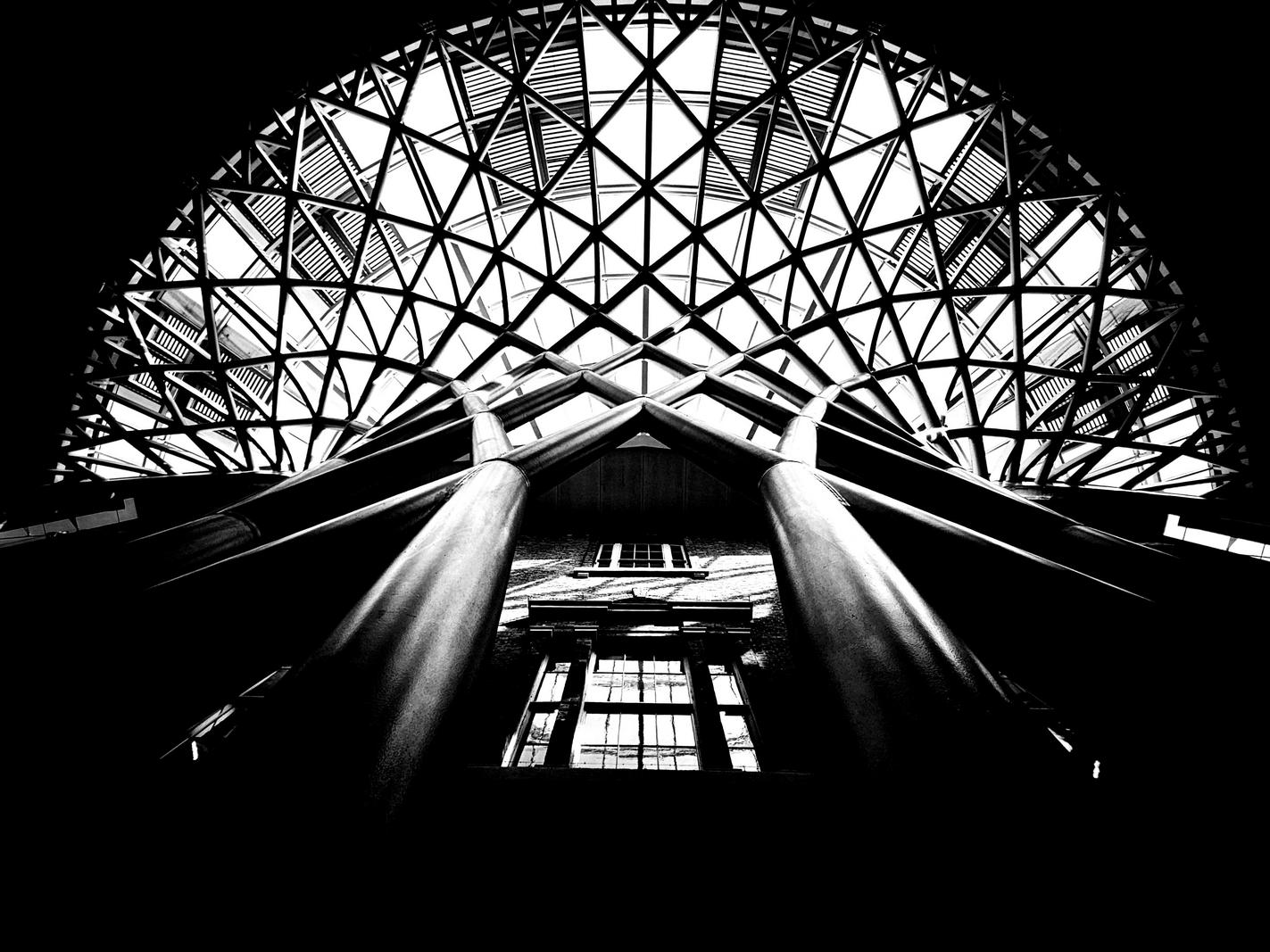
Bold geometry and deep blacks deliver a dramatic, almost cathedral-like study of structure.
Your description matches what’s on screen: a deliberate low‑key treatment that pushes the station’s lattice roof and branching columns into an abstract graphic. As an architectural/fine‑art take, the upward viewpoint and hard contrast make the steelwork feel monumental. The central “trunk” of columns drawing into the webbed roof is the strongest feature, and the choice of black and white keeps attention on shape and rhythm. There’s real intent here, though the extremity of the contrast sacrifices some structural detail near the base. Did you prioritise a pure graphic read over legibility, and if so, how far did you want to push that trade‑off?
TECHNICAL EXECUTION ★★★★
The file looks clean and sharp; the repeating lattice is crisp with no obvious fringing or moiré, which is vital in a subject like this. Exposure is intentionally aggressive: highlights in the roof are close to clipping and the lower frame falls to solid black. That suits a low‑key approach, though it costs texture in the brickwork and the lower support surfaces. Perspective is strongly controlled for symmetry, and any remaining distortion reads as an intentional, dramatic convergence rather than a mistake. To reach five stars, retain just a hint more shadow detail at the base and tame the brightest roof panes with subtle highlight recovery.
COMPOSITION ★★★★
The centred, upward composition works because those branching columns act as powerful leading lines into the dome. The symmetry is nearly perfect and gives the structure real authority. However, the bottom window area feels abruptly cut, and a bright sliver on the right edge pulls the eye out of the frame. A fractionally wider or lower vantage point could have included the full base or given the central “trunk” more breathing room. Ask yourself: would a step left or right to nail perfect bilateral symmetry tighten the design even further?
LIGHTING ★★★★
Natural light pouring through the roof creates bold contrast and pleasant specular runs along the columns. The directional highlights carve shape nicely, particularly on the leftmost pillar. The issue is balance: the roof panels at the top centre are significantly brighter than the flanks, which can overpower the rest. A little dodging and burning could equalise the dome and keep attention on the converging structure. Holding a touch more detail in the lower shadows would add depth without losing the low‑key mood.
STORY ★★★
This is primarily a study in form and scale rather than a narrative moment. It communicates “engineering as sculpture,” which is valid, yet it stops short of telling us something about the station’s life or human flow beneath it. Including a small human figure or a hint of the concourse could have added scale and a sense of purpose without diluting the abstraction. As it stands, it’s a striking diagram of a place rather than a scene happening in it. What balance between pure design and lived space were you aiming for?
IMPACT ★★★★
The graphic punch is strong—the dome and radiating lines grab attention immediately, and the monochrome treatment suits the subject. It’s memorable for its boldness, though the clipped base and hotspot roof stop it from feeling completely resolved. With slightly cleaner edges and better tonal balance, this could be a portfolio anchor. The vision is clear; it just needs a touch more refinement to become unforgettable.
CONSTRUCTIVE NEXT STEPS
✓ Revisit the raw file: pull highlights by about 0.3–0.5 stops and apply selective burning to the brightest roof panes; lift shadows +10–20 only in the lower columns/brick to reclaim minimal texture while staying low‑key.
✓ Crop or clone the small bright fragment on the right edge and consider a 4:5 or slightly taller aspect to avoid the cramped cut across the lower windows.
✓ On location, use a tripod and centre the camera precisely on the structure’s axis (live‑view grid and a hot‑shoe level help) to lock perfect symmetry; a step back or a slightly wider focal length would keep the base intact without distorting lines.
✓ For a second version, include a single passer‑by or small figure at the base to add scale and a hint of life while keeping the architecture dominant.
AI Version 2.0