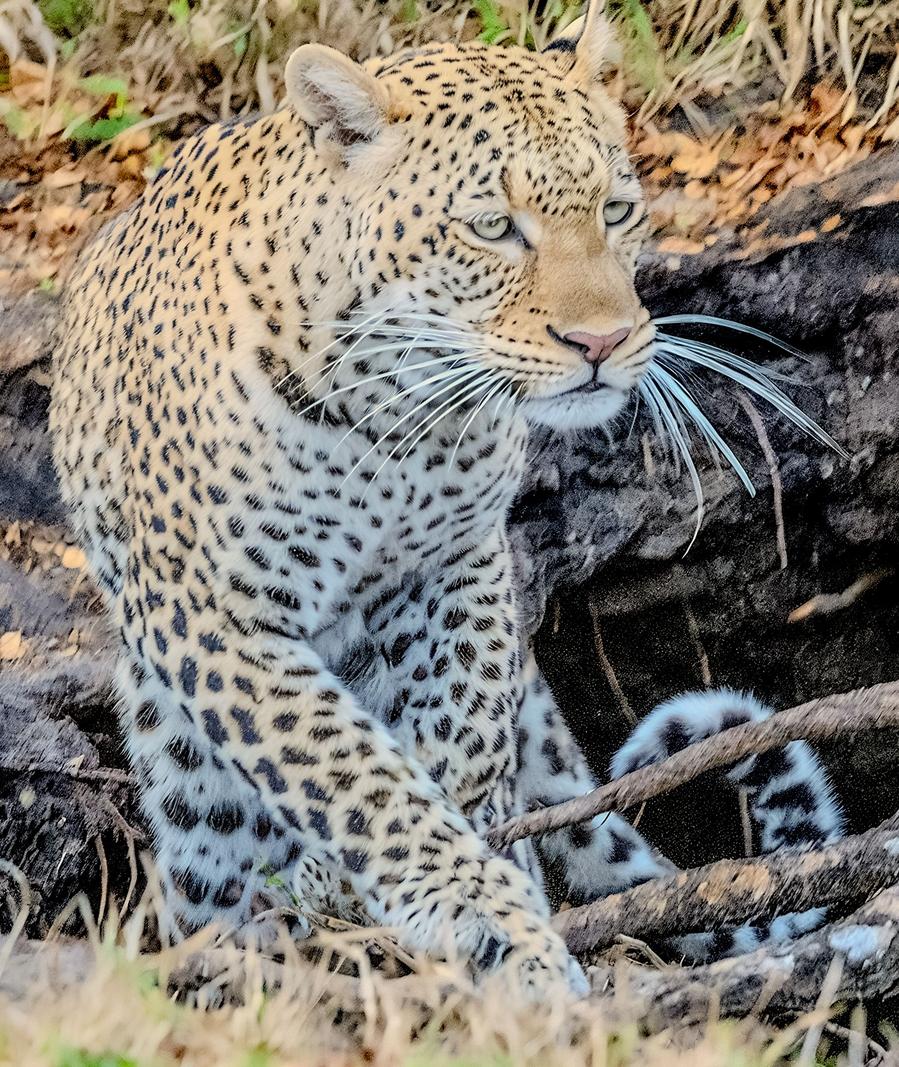
A strong encounter with a magnificent cat, held back by busy framing and heavy-handed processing.
Short answer: yes, more separation would help. You’ve captured a compelling moment of a leopard emerging from a den — classic wildlife territory. The pale coat against the dark burrow already gives you some contrast, but the rosettes and the tangle of branches merge with the surroundings, so the head and foreleg don’t stand out as cleanly as they could. A lower, cleaner angle or shallower depth of field would simplify the scene and put the emphasis where it belongs: those eyes and whiskers. How intentional was your choice to keep the branch across the paws and the tail curling in the shadows — were you aiming to show habitat, or was this the only angle available?
TECHNICAL EXECUTION ★★★
The file looks sharp overall, but critical focus doesn’t appear locked on the eye — the whiskers draw more attention than the pupils. Processing feels heavy: micro-contrast and sharpening have accentuated halos around the whiskers and spots, and the fur texture starts to look a little crunchy/plastic in places, likely from combined sharpening and noise reduction. Exposure is broadly fine, with detail in both coat and shadows, though the bright whiskers and cyan fringing on them distract. A cleaner, more natural edit would elevate this considerably. For five stars I’d expect tack-sharp eyes, subtle processing with no halos or colour fringing, and crisp but natural fur detail.
COMPOSITION ★★★
The cat is well placed and angled, but the environment competes hard for attention. The thick branch cutting across the forelegs, the busy root tangle, and the partially hidden tail create visual noise rather than context. The near‑centred head works, yet the frame feels cramped at the bottom while the most expressive area — the face — doesn’t get clean background separation. A small step left or right to place the head entirely against the dark burrow, or a lower viewpoint to replace the roots with soft grass, would simplify the read. To reach five stars, aim for a cleaner field of view with no strong lines intersecting the limbs or muzzle.
LIGHTING ★★★
Soft, even light keeps contrast manageable and preserves coat detail, but it’s a bit flat on the face. There’s a faint catchlight, yet the eyes don’t sing; a slight turn into the light or waiting for a brighter patch on the head would add shape. The darker den behind helps, but side light to carve the cheek and brow would provide more three‑dimensionality. Five-star lighting here would show gentle directionality, a livelier catchlight, and a touch more modelling on the muzzle without blowing the whiskers.
STORY ★★★
There’s a clear narrative: a leopard emerging, alert and intent. However, the gesture isn’t at a peak — no stride mid‑step, no decisive glance, no interaction. The habitat elements are there, but because they clutter the frame they dilute the sense of stealth you’re hinting at. A fraction later, with the paw lifting free of the branch or the head fully clear against the burrow, would strengthen the moment’s clarity. To reach higher, look for behaviour — a yawn, stretch, or focused stare that telegraphs intent.
IMPACT ★★★
The subject itself has undeniable charisma, and the proximity is impressive. Impact softens due to the busy frame and processing artefacts, which pull the eye from the cat’s face. Cleaner separation and subtler editing would turn this into a print‑worthy image. For five stars I’d want a decisive gesture, immaculate eyes, and an uncluttered, natural-looking background that lets the animal dominate.
CONSTRUCTIVE NEXT STEPS
✓ In the field, open your aperture one stop (e.g., f/5.6 instead of f/8) and shift a step to place the leopard’s head entirely against the dark burrow; this will blur the roots and give you natural separation without losing habitat.
✓ Wait for a cleaner gesture — paw lifted clear of the branch or the cat a half-step forward — to avoid mergers over the forelegs and to add intent to the pose.
✓ In post, reduce global sharpening/clarity; instead, mask the face and add a subtle, local midtone contrast while defringing cyan/purple on the whiskers (use the Defringe tool or targeted HSL). Slightly burn the background roots to push them back.
✓ Aim focus priority on the nearest eye and shoot short bursts around the moment; with a shutter around 1/1000s and Auto‑ISO, you’ll maximise the chance of tack-sharp eyes without motion blur.
AI Version 2.0