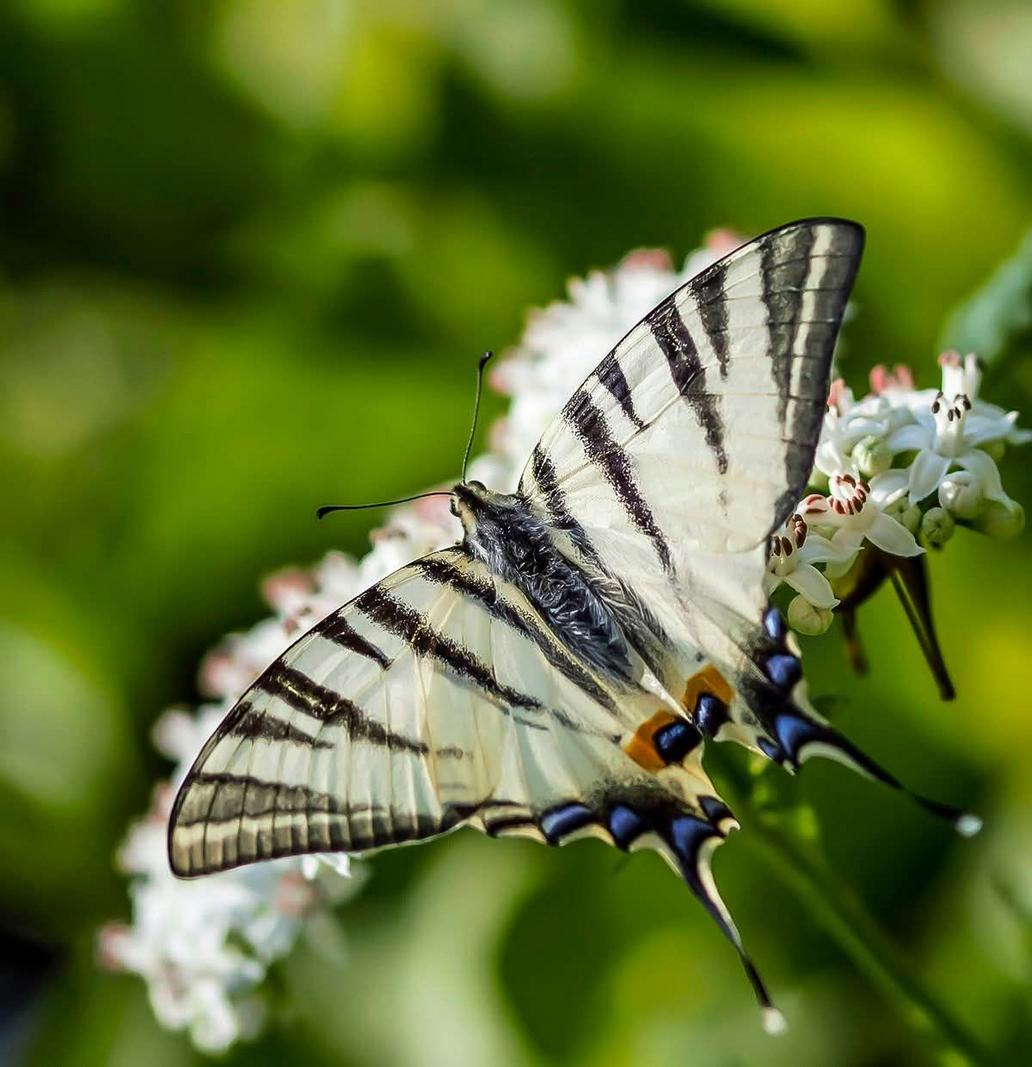
Elegant, crisp butterfly portrait with a clean, painterly background and a strong diagonal pose.
You largely achieved that goal. The butterfly’s thorax and much of the wings are nicely sharp, and the soft green bokeh keeps attention on the subject — this sits between macro and wildlife. If I’m picky, the absolute tack point seems to be on the body rather than the eye/antennae, so the head doesn’t quite have that “bite” that makes the image sing at large sizes. That’s a common trade-off in the field where depth of field is razor thin and the subject is moving. Did you purposely choose the thorax as your focus point, or did the autofocus settle there while you composed? With a touch more depth or a slightly different plane of focus, this could be print‑ready.
TECHNICAL EXECUTION ★★★★
Detail across the wings is strong, and the background is smooth with no distracting noise or artefacts. Focus appears a fraction forward of the eye, leaving the antennae tips a little soft, but the body texture is excellent. Exposure is well controlled on the butterfly; the white blossoms have a few hot spots that pull the eye but are not blown beyond recovery. Colours look natural and not over-processed, which suits the subject. To reach five stars, I’d want pin‑sharp eyes/antennae, flawless highlight control on the flowers, and a masked sharpening pass targeted at the head only.
COMPOSITION ★★★★
The butterfly forms a pleasing diagonal from lower left to upper right, giving the frame energy. The curve of the tails and the blue/orange markings add a rhythm that keeps us looking. The wing tip at the top right sits very close to the edge, creating slight tension that feels more accidental than intentional, and the bright flower cluster competes a little on the right side. Background separation is otherwise clean, and nothing essential is cut off. For a five‑star composition, I’d like a touch more breathing room around the top and right edges or, alternatively, a tighter crop that embraces a deliberate close view. How might stepping a half pace left or lower have simplified the flower shapes behind the head?
LIGHTING ★★★★
Soft natural light flatters the wing texture and avoids harsh shadows, giving gentle colour to the cream tones. There’s a clean catchlight on the eye area, though it’s subtle. The main drawback is the bright, specular highlights on the white blossoms which are a touch hotter than ideal and compete with the subject. A small diffuser or choosing a cloud‑covered moment would have tamed these. With slightly more direction or softer top light to sculpt the body and reduce the flower glare, this would reach five stars.
STORY ★★★
This is a strong natural portrait that celebrates pattern and form. The moment is calm — the butterfly appears settled rather than actively feeding, so the frame leans towards beauty over behaviour. Showing the proboscis extended into a bloom, or interaction with another insect, would add a clearer narrative. Consider whether you were waiting for an action cue or prioritising clean geometry; both are valid choices. To reach higher, aim for a behavioural beat that adds life beyond the static pose.
IMPACT ★★★★
The striking zebra stripes, blue accents and long tail streamers give immediate visual punch, and the tidy background helps it stand out. It’s a polished, pleasing image that many viewers will enjoy. What holds it back from “unforgettable” is the slightly soft head and the near‑miss crop on the right, plus the lack of a distinctive action. Nail those elements and this would be competition‑ready.
CONSTRUCTIVE NEXT STEPS
- Shift the focus priority to the head: use a single small AF point and place it on the eye; shoot at f/7.1–f/9 with ISO raised as needed, and keep shutter at 1/500–1/1000s to counter wing twitch and wind.
- Align the sensor plane with the wings by moving a step left/right so the head and both antennae fall within the same focus slice; fire a short burst to catch the stillest micro‑moment.
- Tame bright flowers: wait for a passing cloud, use a pocket diffuser/reflector, or in post pull highlights down on the white blossoms and clone a few pink specks that attract the eye.
- Give the subject breathing room on the right/top during capture; if that’s impossible, commit to a tighter crop that avoids the “almost touching the edge” tension.
AI Version 2.12