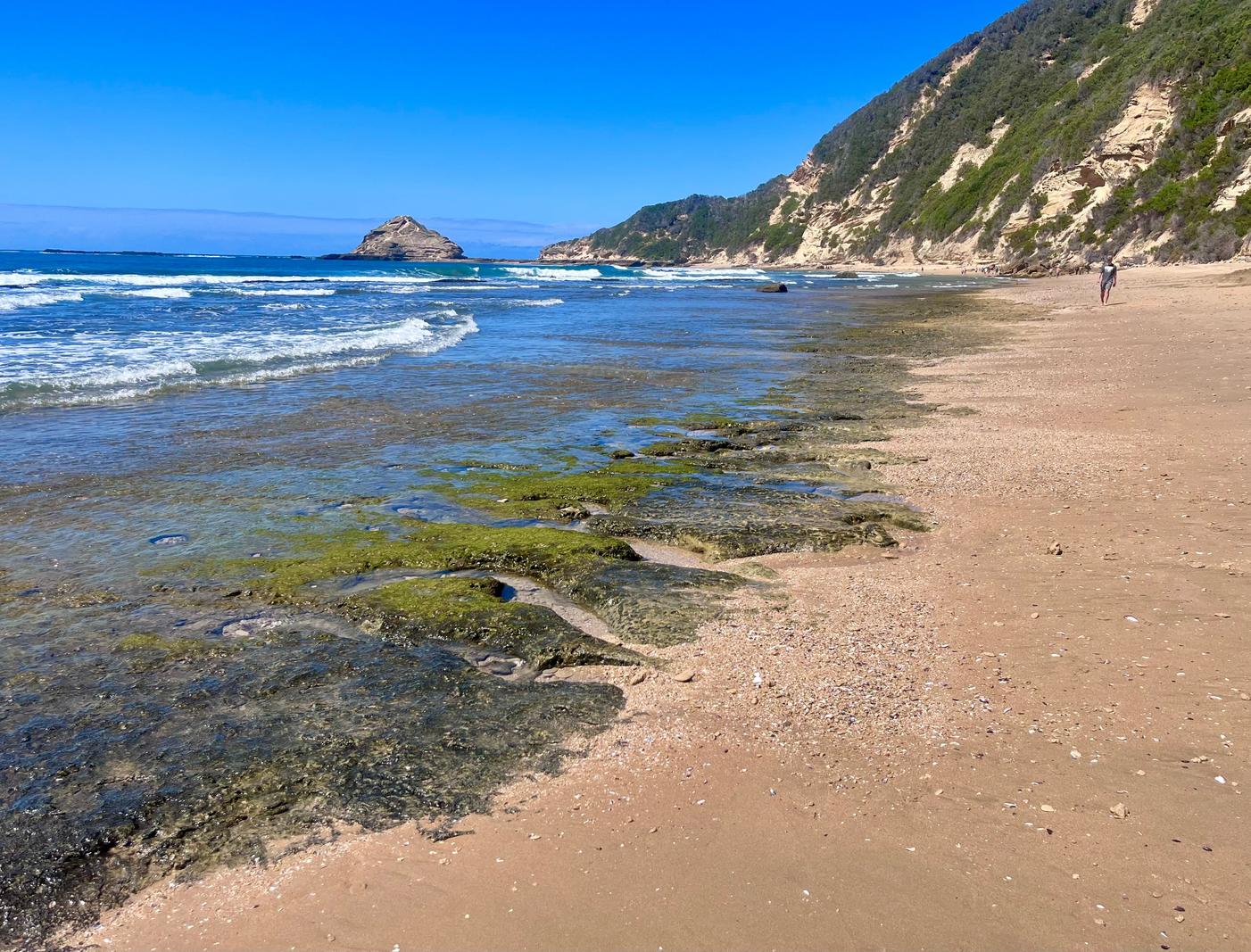
A calm coastal scene with pleasing diagonals, but it needs subtler colour and a stronger moment.
Short answer: you’re close, but it’s a bit too punchy in the blues and greens. In bright midday sun, seaweed and sky already run saturated; here the algae in the foreground looks a touch neon and the sky leans into deep cobalt. I’d nudge the white balance slightly warmer and pull back colour selectively rather than globally. Think of this as a clean coastal landscape: the sweeping shoreline forms a nice lead to the rocky islet, while the green tide pools provide texture. What did you want the viewer to notice first—the vivid algae, the island, or the long bay? Your answer should drive the colour choices and the composition.
TECHNICAL EXECUTION ★★★★
Exposure is well judged for harsh sun; highlights in the surf are held and detail remains in the darker rock. Sharpness looks good front to back for a handheld coastal scene, and the horizon is acceptably level. The colour is believable but a fraction over-saturated—particularly the blues and greens—which pushes it towards a postcard look. A slight cool bias is present; warming the white balance by around +200–400 K and adding a hint of magenta (+2 to +4) will neutralise the cyan cast in the water. In HSL, try Blue −10/−15, Aqua −8/−12 and Green −8/−12, with a small shift of Green hue toward yellow to tame the fluorescent feel. Keep processing gentle; the file already has plenty of contrast from the midday sun.
COMPOSITION ★★★
The diagonal shoreline guides the eye well from the lower right towards the island, and the cliffed headland balances the left-hand rock. The foreground tide shelf and green streaks offer a usable anchor. However, there’s a lot of empty tan sand on the right that doesn’t add much, and the dark slab of weed at bottom left is heavy and pulls attention. The lone walker on the far right could give scale, but they’re too small and close to the edge to read clearly; they become a distraction rather than a character. A lower, leftward stance—using the green channels as leading lines aimed at the island—and a tighter crop off the right would create a stronger flow.
LIGHTING ★★★
This is hard midday light: clean and bright but flat on form, so the seaweed textures and cliff contours don’t pop. Side light at the bookends of the day would carve the rock and reveal ripples in the water, adding depth without needing heavy contrast in post. A thin veil of cloud or shooting just after sunrise would soften the scene and produce truer, less electric colour. As captured, the light is serviceable, but it’s not doing any heavy lifting for mood.
STORY ★★
Right now this reads as a “nice place” record rather than a moment. The distant walker hints at human presence, but they’re too small to matter and don’t interact with the environment in a meaningful way. Consider waiting for a closer figure, a dog splashing through the shallows, or a single wave crashing over the green shelf—something to give the scene a heartbeat. Ask yourself: what emotion or activity defines this beach for you, and how could you frame for that?
IMPACT ★★
Pleasant and calm, but easily overlooked among countless bright beach views. The slight over-saturation and midday flatness keep it from feeling distinctive. With more purposeful foreground use, a clearer subject, and gentler colour, this could move from descriptive to compelling. To reach the top tier, it needs either special light or a decisive human/nature moment that makes the frame memorable.
CONSTRUCTIVE NEXT STEPS
- Colour: in post, warm WB by +200–400 K and reduce Blue, Aqua and Green saturation by roughly 10–15; shift Green hue a few points toward yellow to avoid the “neon” algae look. Consider using a local mask to slightly lift midtones on the seaweed (+0.2–0.3 EV) for gentle texture without extra saturation.
- Refine the frame: crop 10–15% from the right to remove the blank sand, or, on location, step left and lower to turn the green channels into leading lines that point directly to the islet.
- Timing and light: return at golden hour with the tide mid‑to‑low so the rock shelf is exposed. Side light will carve texture and reduce the need for punchy colour.
- Add a moment: wait for a person to enter the shallows nearer the foreground, or a wave to break over the shelf; place them on a third so they read clearly and give scale.
AI Version 2.12