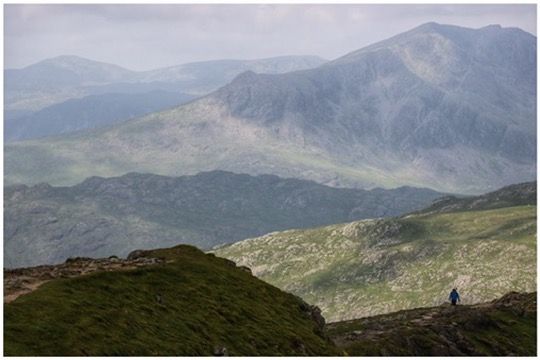
Layered hills and a lone walker give a calm sense of scale, but the frame needs a clearer anchor.
Thanks for sharing this, Andrew. You’ve made a quiet landscape with muted tones and good restraint in the edit — no gaudy colours or HDR, which suits the Lake District mood. The tiny figure in blue at the lower right hints at your intent: to show the vastness of the mountains from Old Man of Coniston. This sits squarely in the landscape genre with a human for scale. The image’s strength is the stacked ridgelines and dappled light on the mid-ground slopes; the weakness is that the person is almost lost at the edge and the dark foreground mass doesn’t lead the eye. What did you want the photograph to be about — the human against the mountains, or the layered geology and light? Deciding that in the field would guide where you stand and how you time the shot.
TECHNICAL EXECUTION ★★★★
The exposure is nicely handled — no blown highlights and the greens feel natural. Detail looks solid for the 90D/kit lens combo, with only the distant layers softening in atmospheric haze, which is expected at this distance. Colour is restrained and believable; there’s no heavy processing or obvious artefacts. If anything, the file could use a touch more mid‑tone contrast in the mid-ground to give it bite without killing the depth cues of the far mountains. A polariser or a small selective dehaze on the middle ridge would help separation.
COMPOSITION ★★★
The layering works, but the frame doesn’t decide on a clear subject. The large dark wedge of grass and rock at the lower left is heavy without guiding lines; it anchors the frame but doesn’t invite the eye forward. The walker in blue is a smart inclusion for scale, yet they’re tiny and pressed against the lower-right edge, so they read as an afterthought rather than a deliberate counterpoint. A step or two left and slightly lower could have turned that foreground into a leading line, or you could have waited until the walker was further into the frame against a lighter patch of ground. Consider a tighter crop from the left and a touch from the bottom to rebalance the weight.
LIGHTING ★★★
The light is soft, with pockets of sun picking out textures on the mid-ground hills — pleasant and true to the place. It’s not dramatic light, so the frame relies on structure and separation to carry it. Because the sky is flat and minimal, the mountains must do the heavy lifting; a slightly stronger micro-contrast on the lit areas would emphasise the gentle rhythms. Returning for lower-angled light or a clearer day could add shape to those ridges, but this subdued treatment can work if the composition is more assertive.
STORY ★★★
There is a quiet story of scale and solitude: one person hiking through big country. However, because the person is so small and near the edge, that story doesn’t immediately register; it feels more like a scenic view that happens to include a walker. If the human presence is your narrative hook, they need more breathing room or a clearer silhouette. Alternatively, remove the person and build the story purely around the rhythm of landforms and light. Which story were you aiming for at the time?
IMPACT ★★★
The scene is pleasing and true to the Lakes, but it doesn’t linger. The restraint in colour helps, yet the lack of a decisive focal point limits the “wow”. Stronger placement of the walker or a more purposeful foreground would push it higher. As it stands, it’s a good record with hints of something more compelling just out of reach.
CONSTRUCTIVE NEXT STEPS
✓ If including a person for scale, give them space: wait until they’re a third into the frame against a lighter patch, or zoom in slightly to make them read at first glance.
✓ Rework the foreground: from this spot, drop a little lower and step left to turn that grassy edge into a diagonal lead-in; or crop ~10–15% from the left/bottom to reduce the dark mass.
✓ In post, add selective mid‑ground presence: a gentle local Dehaze/Clarity and a small dodge on the sunlit slopes, keeping the far mountains softer to preserve depth.
✓ Consider a circular polariser (used lightly) on hazy days to separate layers and tame glare on the greens; aim for f/8–f/11 and base ISO, tripod if possible, to maximise micro‑contrast from the 90D/kit lens.
AI Version 2.0