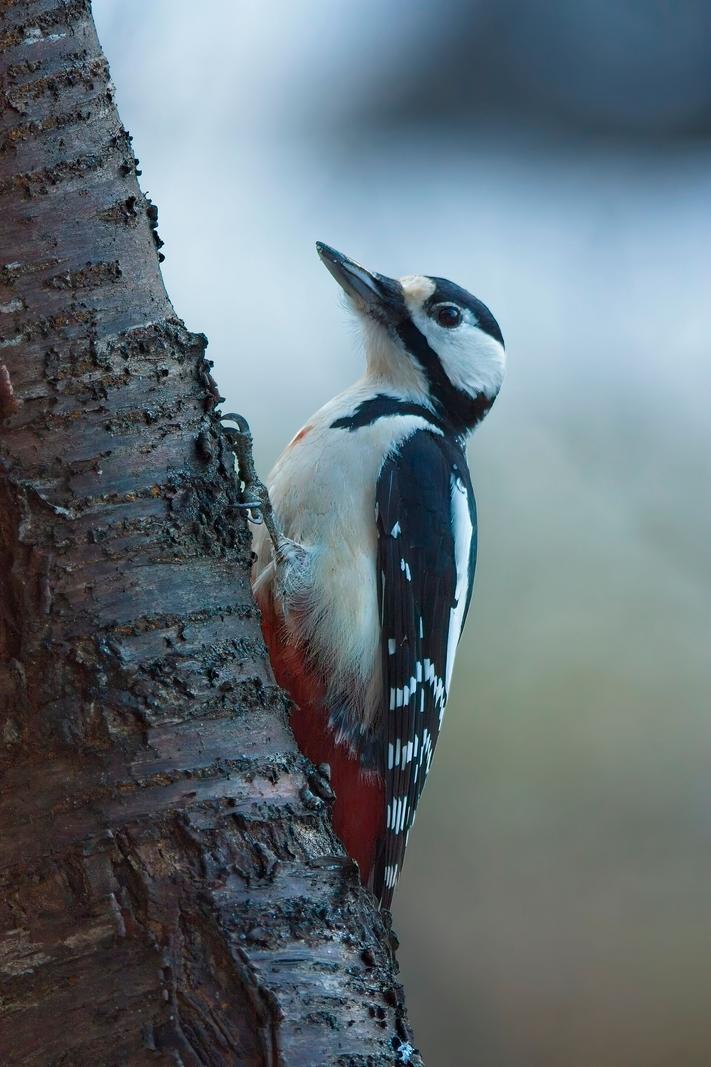
A clean, elegant woodpecker portrait with strong craft and a calm mood.
Thanks for sharing this, Ingel. This sits squarely in wildlife portraiture: a great spotted woodpecker pressed to a textured trunk with a soft, creamy background. You’ve handled exposure and focus well, and the earthy palette suits the subject. I’ll break down what’s working and where you could push it further, then suggest concrete next steps. In short: technically strong, compositionally tidy, but the moment is quiet — consider chasing behaviour or refining the frame to reduce small distractions. As you review this image yourself, what story about the woodpecker did you want a viewer to take away — a calm perch, or the vigorous drumming and feeding this species is known for?
TECHNICAL EXECUTION ★★★★
Feather detail on the head and mantle is crisp, and the eye is acceptably sharp, which anchors the portrait. Exposure is controlled nicely in tricky black‑and‑white plumage; the white cheek is close to the edge but not blown, and blacks hold texture. The background is smooth and free from artefacts, suggesting a wide aperture and good subject separation. Colours feel natural and not over‑pushed, which keeps the file believable. Minor points: the beak tip looks a touch softer than the eye, and the eye could use a subtle lift to read more clearly. A small amount of targeted sharpening and dodging on the eye would finish it nicely.
COMPOSITION ★★★★
The vertical trunk on the left acts as a strong anchor, with the bird forming a parallel line — a tidy, graphic arrangement. Negative space to the right gives the woodpecker somewhere to “look,” which is good. However, the trunk occupies a lot of visual weight and includes a small metal loop near the feet that pulls attention. The tail and lower belly feel slightly crowded near the bottom edge. A modest crop from the left to reduce trunk dominance, or a step half a pace right when shooting, would emphasise the bird without losing habitat context. Do you want the bark texture to share billing with the subject, or should the bird be the clear star?
LIGHTING ★★★★
Soft, overcast light flatters the plumage and keeps contrast manageable between black and white feathers. There’s gentle modelling along the flank and wing, and the background tones sit nicely muted. The trade‑off is a slightly subdued face and a faint catchlight; a tiny dodge on the eye and cheek would add life. Waiting for a brighter window through the clouds or repositioning a few degrees so ambient light skims the face could add more shape without harshness. Overall the light is kind and even, just short of dramatic.
STORY ★★★
This is a solid portrait that shows the species clearly on a natural perch. The moment is quiet: no drumming, flaking bark, prey item, or interaction, so the frame doesn’t move beyond identification into behaviour. That’s not a failure, but it caps the narrative potential. A fractionally lower or more frontal angle to catch an intent gaze, or timing a burst as the bird strikes the bark, would add the tension and character that lingers. Consider what behaviour you’re willing to wait for — drumming, feeding young, or courtship — to elevate the story next time.
IMPACT ★★★★
The clean background, restrained colour and strong subject make this immediately pleasing. It’s publication‑worthy as a field‑guide style portrait. Its limitation is familiarity — many similar woodpecker images exist, so it doesn’t quite stand apart. Removing small distractions (the metal loop) and landing a lively eye highlight would boost presence. Capturing a behavioural moment would push this towards a five.
CONSTRUCTIVE NEXT STEPS
- Refine the frame: clone/heal the small metal loop and a few bright flecks on the bark; crop 5–10% from the left to lessen trunk dominance while keeping the bird’s full tail clear of the bottom edge.
- Bring the eye to life: a subtle dodge on the iris and a touch of local contrast/clarity on the face; keep it gentle to avoid a “processed” look.
- Chase behaviour: use continuous AF, 1/1000–1/2000s, and short bursts to catch a peck with wood chips flying or the bird extracting prey. Pre‑focus on the strike spot and wait for the movement.
- Micro‑reposition: if possible, shift a step right and slightly lower to give the head more separation from the trunk and increase negative space in the bird’s looking direction.
AI Version 2.12