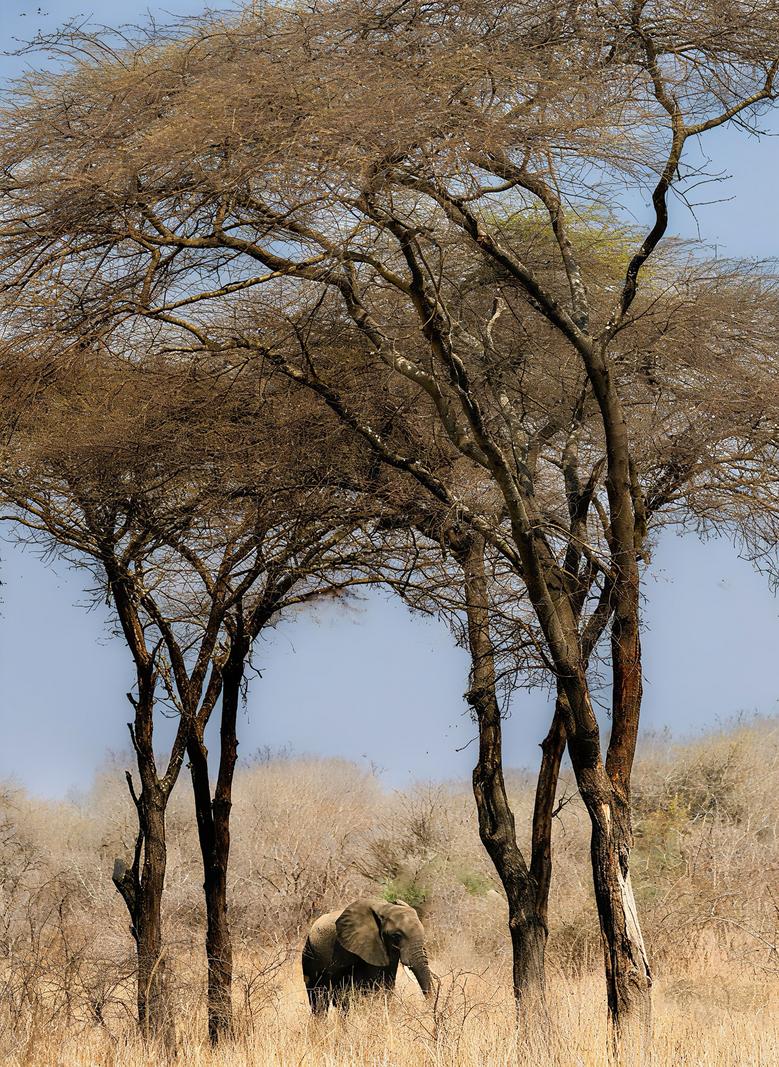
A gentle, habitat‑first wildlife frame where the trees do most of the talking.
Short answer: it’s not critical here. The sky is a small, calm part of the scene and heavy masking around these fine acacia branches risks halos and crunchy edges that would hurt the picture more than help it. If you still want control, in Lightroom use Select Sky, then Add > Colour Range (sample the blue) or Add > Luminance Range to pull in the sky showing through the canopy; refine with a 2–5px feather and keep adjustments subtle (think -0.2 to -0.4 EV, a touch of dehaze). Alternatively, skip a sky mask and nudge the Blue HSL luminance down a touch globally; the trees won’t be affected much. Broadly, this reads as wildlife with a landscape sensibility—the small elephant under the high canopy gives scale, which is the picture’s strongest idea.
TECHNICAL EXECUTION ★★★★
Exposure is well judged; the elephant retains detail without the grass blocking up, and the sky isn’t blown. Focus looks solid for the subject distance, with enough definition on the elephant’s head and ears. Colour is natural and pleasantly muted, avoiding the over‑saturated safari cliché. There are no obvious artefacts or haloing, which is why I’d be cautious about aggressive sky masking. To reach five stars, aim for a touch more micro‑contrast and crispness on the elephant’s face (either via a small local clarity/texture pass or by ensuring a slightly faster shutter/steadier stance in capture).
COMPOSITION ★★★
The grove frames the elephant nicely and gives a strong sense of scale—good choice to back up and let the habitat breathe. However, the elephant is small and merges with similarly toned brush, so the eye wanders among the busy branches before settling. A small lateral move left and lower would likely have placed the elephant more cleanly in the gap between the right-hand trunks and separated the head from the pale shrub behind. Consider a very slight crop from the top to reduce the dominance of the canopy while keeping the arching lines that shelter the animal. What was your thought in giving the canopy nearly two‑thirds of the frame—scale, or a way to simplify the bright sky?
LIGHTING ★★★
The light feels like late morning: workable but a bit flat and contrasty. It renders the elephant evenly, but the scene lacks the shape and subtle shadows you’d get at first or last light. The pale sky and dry grasses keep the palette gentle, which suits the mood, yet the mid‑day hardness gives the branches a scratchy, busy look. A touch of local dodging on the elephant’s face would pull attention without looking artificial. Shooting earlier or later would add warmer tone and cleaner separation through rim light on the ears.
STORY ★★★
The story is scale and habitat: a lone elephant dwarfed by acacias. It’s an honest, quiet moment, but the animal isn’t doing much—no lifted trunk, stride, or interaction that would elevate it. Waiting for a clearer gesture (ear flare, step forward, trunk reach to the foliage) would add life and intention. The composition hints at a corridor between the trees; catching the elephant mid‑walk through that “gateway” would strengthen the narrative. What behaviour were you hoping to catch as you framed this wider scene?
IMPACT ★★★
The image is pleasant and believable, with a calm, earthy palette. Its impact sits in the idea of smallness within a big landscape, rather than a dramatic wildlife moment. Because the subject is visually busy against similar tones, it doesn’t immediately grab the viewer. Cleaner separation and a micro‑gesture from the elephant would push this much higher. As it stands, it’s a solid, habitat‑centric frame that rewards a slower look.
CONSTRUCTIVE NEXT STEPS
✓ If masking the sky, use Select Sky then Add > Colour Range (sample multiple blues) and a 2–5px feather; keep the adjustment subtle to avoid halos around the twiggy canopy.
✓ On location, shift a step or two left and drop your stance to place the elephant cleanly in the gap between the right trunks; aim for the moment the trunk lifts or the front leg steps forward.
✓ Use a gentle local adjustment on the elephant’s head (small exposure +0.2, texture +10, clarity +5) to guide the eye without making it look “burned in.”
✓ Consider a modest top crop (about 8–12%) to reduce canopy dominance, or alternatively wait for golden hour to add rim light and warmer tone that naturally separates subject from background.
AI Version 2.0