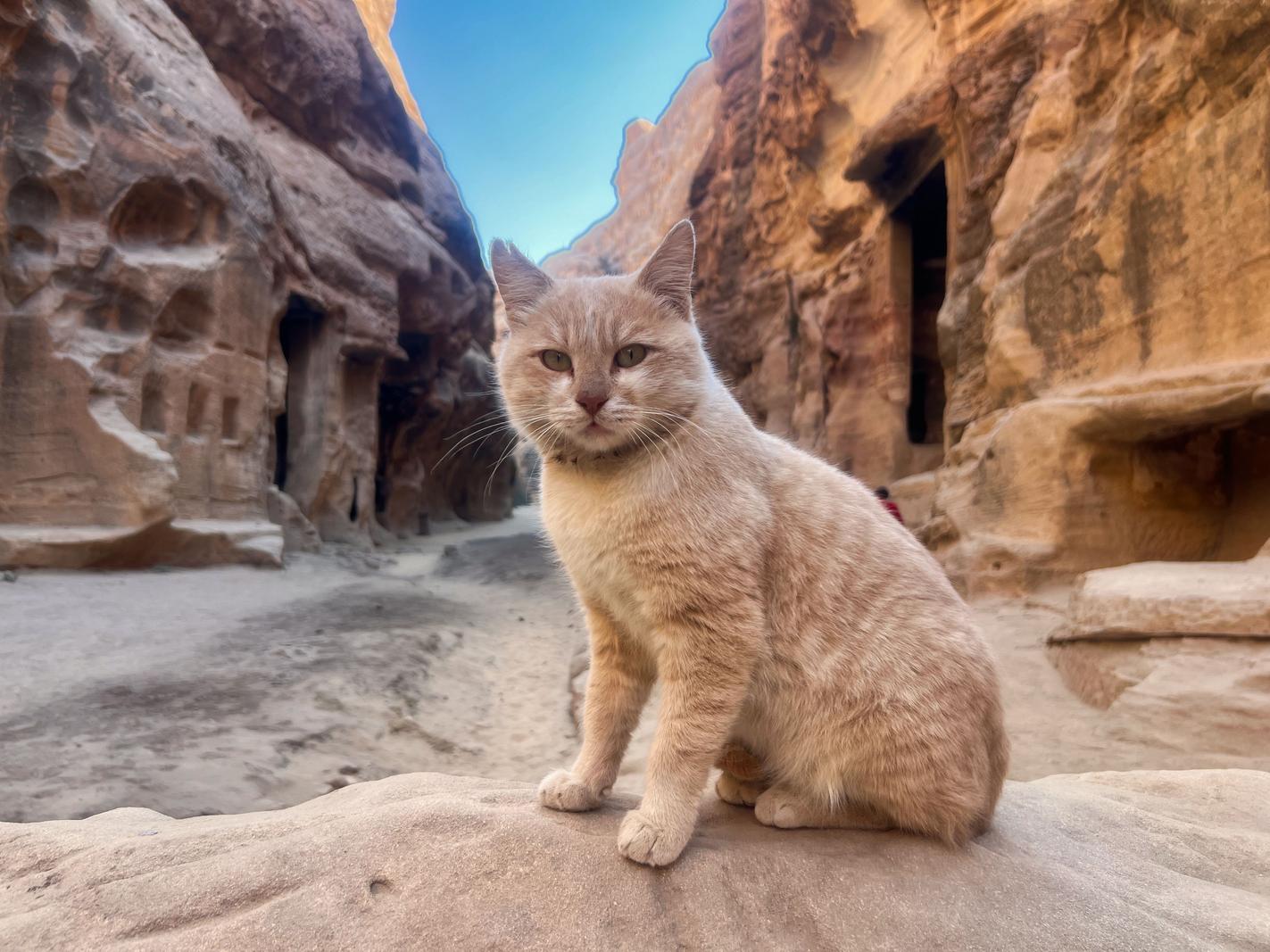
A calm, confident cat holds the centre of a grand sandstone corridor — simple and strong.
Short answer: a little fill could help, but I wouldn’t use obvious flash here. The open-shade light is already kind to the cat and keeps the scene natural; the thin slice of blue sky isn’t the hero. If you did add light, make it subtle: expose for the background as you have, then add a low-power, warm-gelled fill (around −1 to −2 flash exposure compensation) to lift the eyes and chest without shouting “flash”. Off a small diffuser or bounced off pale rock would be ideal. This is essentially a wildlife/travel portrait — a local animal owning its space — and the environmental context is the photograph’s strength.
TECHNICAL EXECUTION ★★★★
Focus looks good on the cat’s face with readable fur detail; if anything, the eyes are a touch shy of razor‑sharp, but still serviceable at normal viewing sizes. Exposure is well judged: no clipped highlights in the pale rock and no muddy shadows in the cat’s coat. Colour is natural and pleasantly muted, which suits the location. I can’t see problematic noise or artefacts, suggesting a sensible ISO and clean processing. A tiny figure in red on the right introduces a minor, fixable distraction that slightly reduces polish. To reach ★★★★★ I’d want tack‑sharp eyes, a faint catchlight, and a cleaned background.
COMPOSITION ★★★★
Centred placement works because the rock walls form a natural corridor that funnels attention straight to the cat. The low viewpoint gives the animal stature and lets the textures of the canyon frame it. However, the cat’s sandy coat blends tonally with the rock, so separation is more about shape than colour; a sliver more sky behind the ears would help carve the outline. The small figure in red and a few bright ledges on the right pull the eye off subject. A vertical 4:5 crop placing the cat slightly lower in frame could emphasise the height of the walls while trimming distractions. How would the shot feel from a step lower to lift the ears cleanly against the blue?
LIGHTING ★★★
The light is soft and even — flattering, but a little flat across the face with modest shadow in the eye sockets. A gentle catchlight would add life. Using flash is optional: if attempted, keep it subtle with a small diffuser and −1.3 FEC, ideally gelled warm to match the rock; this would not “dull” the sky if you keep ambient exposure the same, it would simply lift the subject. Personally, I’d first try a natural solution: pivot the cat a touch towards the open sky or move so the face sees more of that top light. In post, a light dodge on the eyes and nose bridge (about 0.3–0.5 stop) would be enough. For ★★★★, I’d need either a more dimensional natural light angle or impeccably balanced fill that remains invisible.
STORY ★★★
The image reads as a calm guardian of place — a resident cat surveying an ancient corridor. The direct gaze provides connection, and the setting hints at travel without feeling like a postcard. What’s missing is a moment: a yawn, paw lift, tail curl, or interaction with a passer-by would add narrative bite. Right now it’s a strong portrait of presence more than behaviour. Consider waiting for a gesture or framing to include a passing traveller for scale and context. What behaviour were you hoping for, and how long did you give the scene to develop?
IMPACT ★★★
It’s a pleasing, well-seen environmental animal portrait that many viewers will enjoy. The pairing of cat and carved rock is appealing, but the absence of a distinctive moment keeps it from being unforgettable. Cleaner separation and a livelier eye would raise the image’s punch. The restrained colour treatment is a strength and suits the place. For ★★★★ or ★★★★★, aim for either a decisive gesture or a more dramatic use of light that makes the scene feel uniquely yours.
CONSTRUCTIVE NEXT STEPS
- If using fill, keep it invisible: on‑camera or small off‑camera flash with diffuser, −1.3 to −2 FEC, and a 1/4 CTO gel; expose ambient as you have, then add just enough light to put a catchlight in the eyes.
- Try a lower stance or slight lateral shift so the ears sit against the blue wedge of sky, improving subject separation without changing the natural light.
- In post, remove the tiny person in red and a few bright rock edges on the right; then dodge the eyes and nose 0.3–0.5 stop and add selective sharpening/texture only to the face.
- Consider a vertical crop emphasising the towering walls, or shoot a follow‑up at a wider aperture (e.g., f/2.8–f/4 if available) to soften the background texture and make the cat stand out.
AI Version 2.12