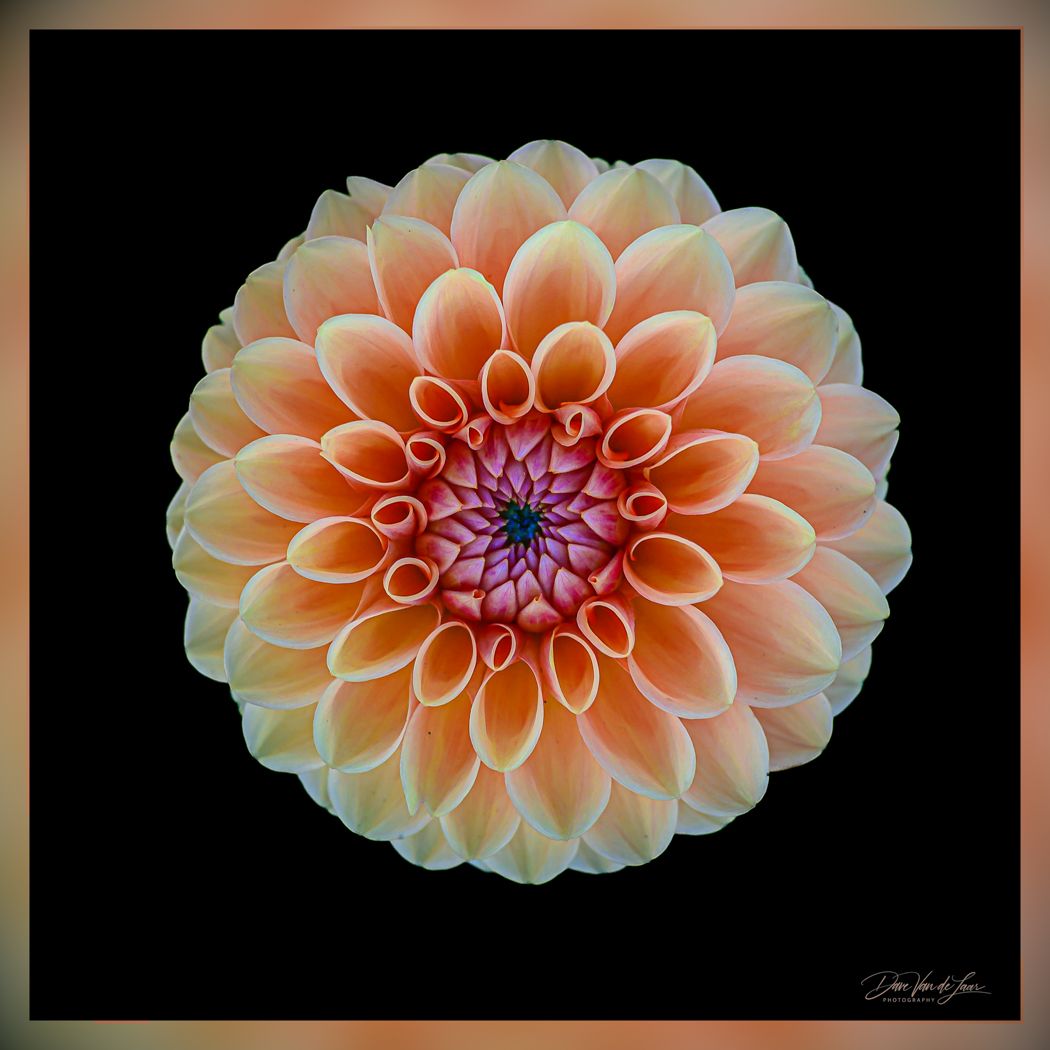
Precise, graphic and hypnotic — your dahlia is a clean study in pattern and symmetry.
Short answer: yes, a couple of small but important adjustments will strengthen it for a contest. This is a macro/fine‑art floral made to celebrate geometry, and you’ve executed it with crisp focus and a beautifully neutral black background. Judges will see many flowers on black; presentation matters. I’d remove the soft border and watermark, tame the warmth a touch, and give the centre a fraction more presence — that will let the craft and symmetry do the talking. What are you hoping the viewer feels here: pure graphic form, or a sense of a living plant with texture and imperfections?
TECHNICAL EXECUTION ★★★★
Focus and detail are excellent from the central florets out to the petal tips, suggesting careful aperture choice or stacking. The black background is clean and noise‑free, giving strong separation. Colours are rich but nudge towards being a little syrupy in the oranges; a small pull‑back in HSL would look more natural and avoid the “processed” feel some judges dislike. I also see a very mild edge glow against the black on a few outer petals, likely from contrast/clarity — easy to tame with a soft edge mask. To reach five stars I’d like to see perfectly natural colour, no presentation artefacts, and absolute neutrality at the edges.
COMPOSITION ★★★★
Centred symmetry suits this bloom and the circular form reads powerfully against plain black. The flower fills the frame with just enough breathing room, keeping the viewer locked into the spiral. However, the added outer gradient frame and the signature in the bottom‑right distract from that purity and compete with the subject. Remove both and this becomes a cleaner, more timeless presentation. A question to consider: would a slightly tighter crop that kisses the circle closer to the edges heighten the graphic tension, or does the current spacing feel more calm and refined to you?
LIGHTING ★★★★
Soft, even light flatters the petals and avoids harsh specular hotspots, allowing the texture to read nicely. The centre is a touch darker than the outer petals, which helps the eye settle before moving outward along the spirals. Still, the light is largely uniform; a whisper of direction from one side (or a subtle dodge on the centre) would add sculpting and depth. For a five‑star result, aim for gentle directionality that reveals more relief in the petals while keeping the softness.
STORY ★★
This image prioritises pattern over narrative; it’s a beautiful specimen but offers little sense of place or moment. There’s no gesture beyond the natural geometry, so the emotional hook is primarily aesthetic. Competitions often reward floral work that adds a twist — a hint of decay, a droplet, a small imperfection, or light that suggests time of day. Ask yourself what extra layer of meaning or character you want the viewer to discover beyond “perfect symmetry.”
IMPACT ★★★★
On first glance it’s striking — the circular form on deep black has immediate presence and will read well in print. The centre’s magenta‑green core adds a welcome colour contrast that prevents monotony. The frame and watermark reduce the sophistication and make it feel more like a social post than a competition entry. Clean those off and refine the colour, and you have a strong, gallery‑ready graphic.
CONSTRUCTIVE NEXT STEPS
✓ Remove the outer gradient frame and watermark; deliver a clean, borderless file. Keep the signature in metadata or a caption for competitions.
✓ In post: reduce Orange/Red saturation by ~5–10 and lift Blacks very slightly (+2 to +4) to avoid an inky, “cut‑out” look; add a subtle dodge to the central florets to anchor the eye.
✓ Retouch tiny specks and petal nicks near the lower‑right quadrant with a low‑opacity heal/clone to keep attention on the spiral.
✓ For future shoots, introduce gentle side light (small reflector/flag) to create soft gradient shading across petals, or try mild backlight through diffusion to add translucence without hotspots.
AI Version 1.22