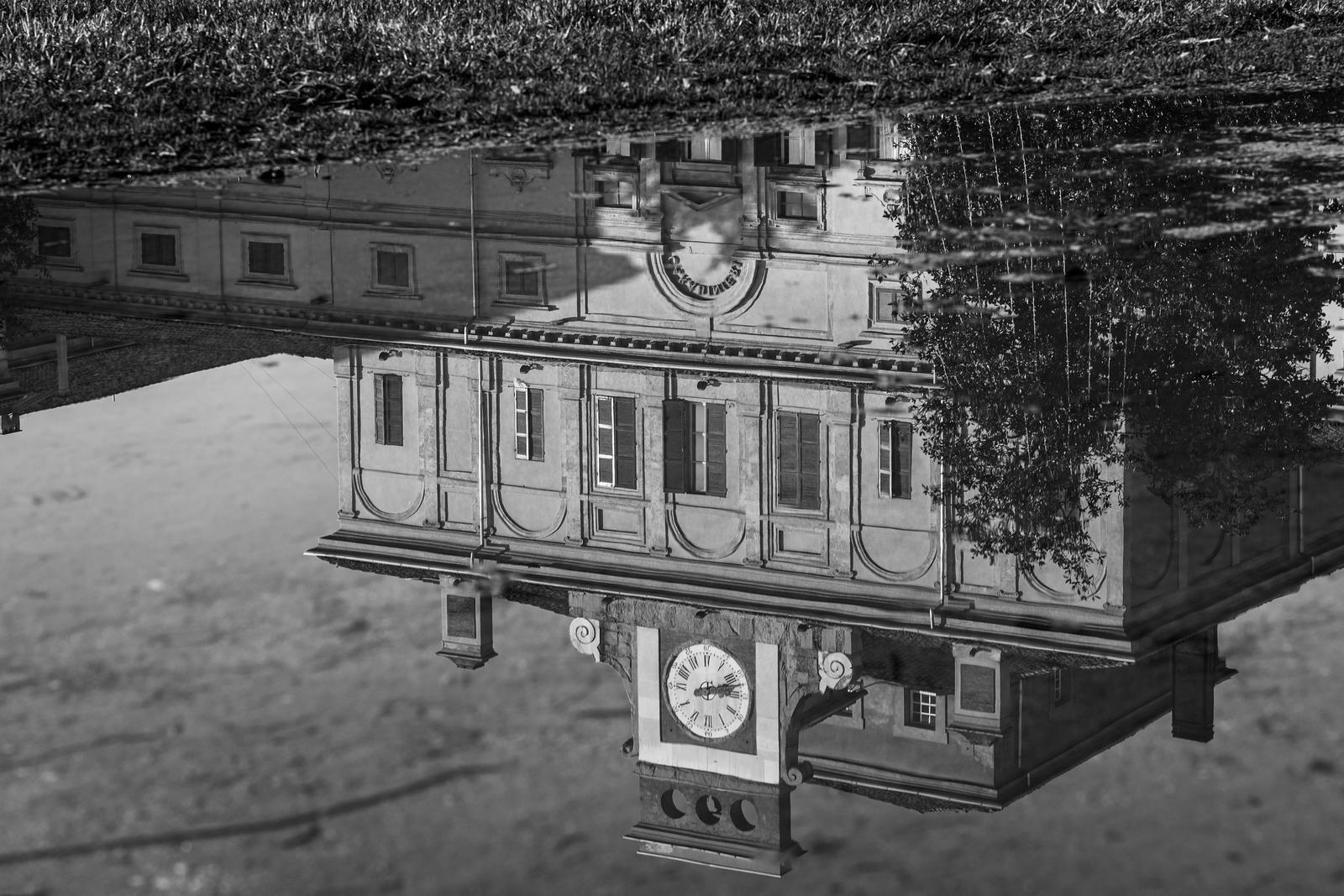
A clever reflection with a classic façade and clock—there’s a strong idea here that just needs tidying and a clearer commitment.
Alessandra, your intent is clear: to make the puddle’s reflection carry the whole scene. That’s a solid creative choice for architectural/fine‑art work, and the monochrome treatment suits the subject’s age and detail. The clean rendering of the windows and the clock gives the eye something recognisable to latch onto. Where the frame stumbles is in how decisively you present the concept—particularly the thin strip of grass at the top, the tight space around the clock at the bottom, and the merger of the tree with the façade. Did you consider either embracing more of the “real” world around the puddle or removing it entirely for a purer, more graphic reflection?
TECHNICAL EXECUTION ★★★★
The file looks clean and sharp for a reflection—good focus on the water plane and a sensible monochrome conversion. Tonal range is decent, with readable detail in the stucco and the clock. Some small surface specks and ripple marks in the water add texture but also introduce minor noise and distraction that could be tidied in post. The right-hand foliage block runs a touch muddy; selective contrast would help separate it from the façade. To reach five stars I’d want crisper micro‑contrast on architectural lines and a spotless water surface or intentionally controlled texture.
COMPOSITION ★★★
The concept works, but the frame feels undecided. The very thin band of grass at the top hints that this is a reflection, yet it reads accidental; either include more of it for context or crop it out completely. The clock sits close to the bottom edge, creating unhelpful tension—another centimetre or two of breathing space would strengthen it as an anchor. On the right, the dark tree overlaps the façade heavily; a slight step left or a tighter crop would prevent that merger and keep attention on the building’s geometry. A bolder commitment—aligning the façade symmetrically or, conversely, going asymmetric and graphic—would lift this to the next level.
LIGHTING ★★★
The light is even and serviceable, which suits a documentary read of the building but doesn’t add much mood. Because we’re seeing only the reflection, subtle changes in light direction are lost, so midtones dominate. Dodging the stone trim and burning the tree mass could sculpt depth and guide the eye towards the clock. Returning when the real façade has stronger side light would create more pronounced highlights and shadows in the reflection, giving shape without needing heavy processing.
STORY ★★
As it stands, this is a thoughtful study rather than a moment. The frame lacks a small, time‑bound detail—a drifting leaf, a raindrop ring, or the shadow of a passer‑by—to turn it from description into scene. The tree provides some context, but it doesn’t interact with the building in a meaningful way. Ask yourself: what tiny event in or on the water could make this feel like today, not any day?
IMPACT ★★★
The reflection idea and the clock give a clear hook, and the monochrome treatment keeps it dignified. However, the near‑miss composition and flat mood keep it from being memorable. A stronger decision about the grass strip and a cleaner relationship around the clock would add punch. An element of surprise—either in timing or orientation—would help it stick.
CONSTRUCTIVE NEXT STEPS
- Commit to the frame: either crop away the narrow grass strip entirely, or include a larger section of the non‑reflected world to make the concept explicit; also leave more space below the clock so it can breathe.
- Control the surface: wait for calmer water after wind or traffic has passed, or deliberately embrace texture by introducing a single raindrop ring/leaf; shoot a short sequence and pick the cleanest or most intentional pattern.
- Post‑processing: use selective dodge/burn and a touch of local contrast on the façade and clock, burn down the tree mass slightly for separation, and heal small specks in the water.
- Consider presentation choices: try a 180° rotation for a surreal read, or re‑shoot with a step or two to the left to avoid the tree merger and explore a fully centred, symmetrical version.
AI Version 2.12