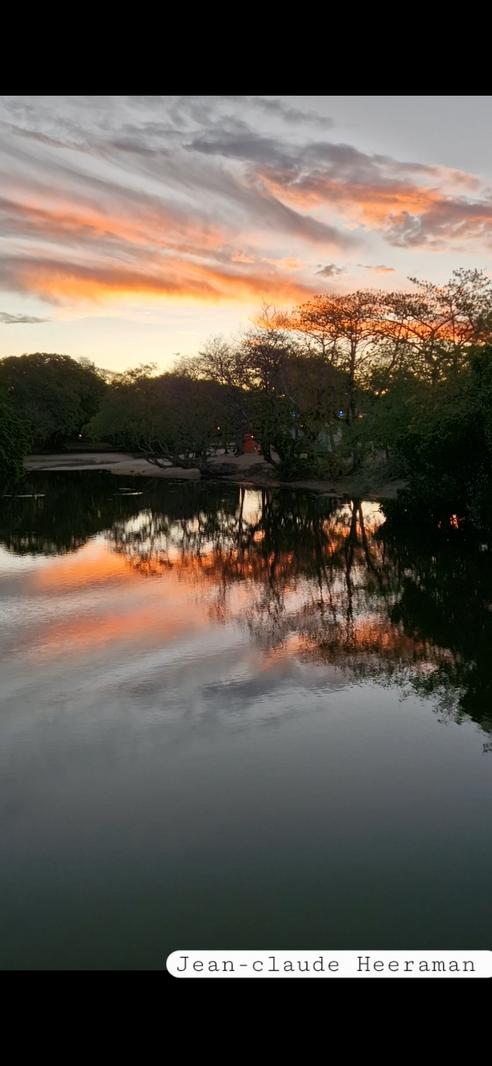
Lovely colour on the clouds, but the frame needs a clearer subject and cleaner execution.
Thanks, Jean‑Claude. Short answer: yes — the light is decent, the angle and colour choices are the weaker links. You’ve made a peaceful sunset-with-reflection, which sits squarely in landscape photography. The warm streaks of cloud and their reflection are the strongest features; the dense foliage on the right and the empty dark water at the bottom are the weakest. Below I’ll break down what’s working and what would move it from “pretty scene” to a deliberate photograph.
TECHNICAL EXECUTION ★★
This appears to be a phone screenshot with black letterbox bars and a “Jean‑claude Heeraman” sticker; those artefacts reduce resolution and add compression. Exposure is handled reasonably — the sky retains colour and the water isn’t clipped — but the tree line collapses into near‑black with little detail. Focus is acceptable for a static scene, though slight edge softness suggests a handheld phone at dusk. Colour looks largely natural, not over‑pumped, which is good. To reach a higher standard, work from the original file (ideally RAW), avoid overlays, and stabilise the camera at base ISO for the cleanest file.
COMPOSITION ★★
The frame gives roughly half the height to featureless dark water while the interest sits in the top third and its reflection. The heavy black mass of foliage on the right pulls the eye out of the frame, and there’s no foreground element to lead us in. The reflection is attractive, but without an anchor the picture reads as a sky study rather than a place. A tighter crop that removes the bottom 20–30% (and the sticker) would strengthen the balance and let the reflection carry the scene. Alternatively, getting low at the water’s edge and including a rock, branch or curve of shoreline would add depth. What did you want the viewer to remember most — the flame in the clouds or the calm water? Let that choice drive the framing.
LIGHTING ★★★
You were there at a good moment: the underside of the clouds is warm and their colour reads well in the reflection. However, the land is in deep shade, so the trees merge into a single silhouette without shape. That makes the image depend almost entirely on the sky — a common, less compelling approach. Five to ten minutes earlier or later, when there’s still a touch of light on the foliage or when the colour peaks, would add dimension. A very still evening would also help; ripples are softening the mirror and reducing drama.
STORY ★★
Right now it’s a pleasant view rather than a moment. There’s no gesture, scale or character to make this specific place feel alive. A lone person on the sand bank, a bird skimming the surface, or a small boat would create a reason to pause. Weather could also be the story — mist, rain or stronger wind would change the mood and give the frame identity. What small event could you wait for here that says something about this spot?
IMPACT ★★
The colours are soothing, but the image is easy to scroll past. The sticker and screenshot presentation break immersion and make it feel casual. Without a focal point or stronger graphic structure, it blends into countless sunset reflections online. Cleaner presentation, a decisive crop, and a small human or natural moment would lift it significantly.
CONSTRUCTIVE NEXT STEPS
✓ Re‑shoot or re‑export from the original file (RAW if possible). Remove the label/borders and crop off the lower 20–30% to eliminate the empty water; aim to place the horizon on the upper third.
✓ Change viewpoint: get low at the shoreline and include a foreground anchor (rock, branch, curve of sand). Step left to reduce the dense dark mass on the right, and keep edges clean.
✓ Control exposure and colour: try −0.7 to −1 EV to protect cloud colour, shoot at base ISO on a tripod, and keep saturation gentle. If you use a polariser, rotate it to retain (not kill) the reflection.
✓ Wait for a moment — a bird crossing the reflection, someone on the bank, or perfect still water. Use continuous drive and around 1/250s if a subject appears; if the scene stays static, consider a short bracket for sky/land balance.
AI Version 2.1