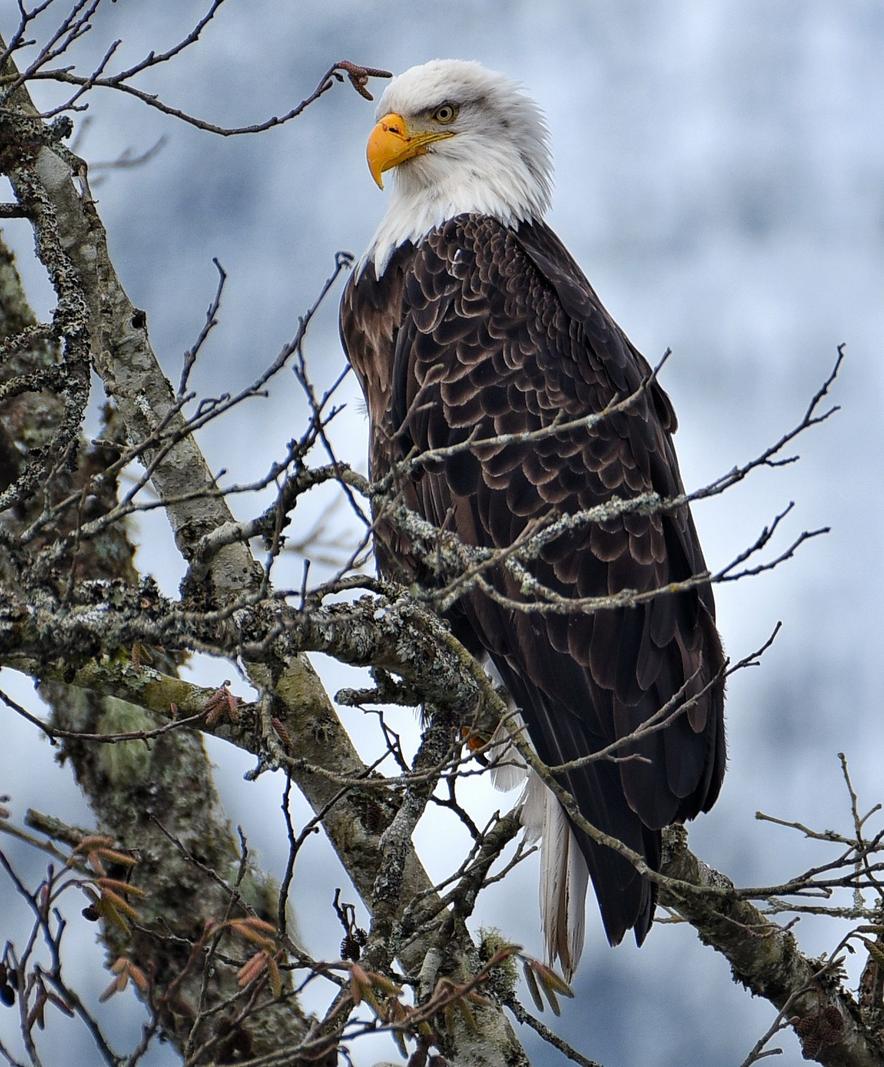
Beautifully sharp raptor portrait in soft, forgiving light — let down a little by busy branches.
Short answer: yes, the light is fine. You’ve shot in overcast, which gives even exposure across the white head and dark body — no blown highlights, no crushed shadows — ideal for a perched bird. It’s a wildlife portrait: the eagle is crisp with good feather detail and a clear catchlight. The limiting factor isn’t exposure but the flatness of the light and the number of intersecting branches around the head and body. Would a lower or slightly right‑hand position have allowed the head to sit cleanly against sky? And, thinking ahead, how often do you plan for first/last light to add shape and mood to these portraits?
TECHNICAL EXECUTION ★★★★
Focus is excellent on the eye, with crisp detail in the feathers and beak. Exposure is well controlled; the white head retains texture and the dark plumage holds detail without noisy lifting. Colour looks natural and not over‑processed, and I don’t see distracting artefacts. Depth of field feels a touch deeper than needed, keeping foreground branches quite defined, which increases visual clutter. A slightly wider aperture would soften those distractions and isolate the bird further. To reach five stars, aim for cleaner separation via DOF control and micro‑contrast on the plumage rather than global clarity.
COMPOSITION ★★★
The vertical framing suits the long body and keeps the tail in frame — good. The surrounding habitat tells us where the bird is, but several branches slice across the torso and near the head; one twig appears to sprout from the crown, which weakens the elegance of the portrait. The bird is close to centre with limited space toward the direction of its gaze, so the pose feels a bit boxed in. A modest shift to the right or a step down would have placed the head against clean background and given it “room to look.” Consider a looser crop with more space to the left of the gaze and less on the right trunk. For five stars, simplify the frame so every line supports the subject rather than competing with it.
LIGHTING ★★★
The overcast light is safe and kind to both white and dark feathers — so yes, the light is “ok.” It renders accurate colour and avoids harsh contrast, but it’s also quite flat, giving minimal modelling on the bird’s form. A low, warm sun from the side would sculpt the feather texture and intensify the eye, while gentle backlight could rim the head and separate it from the background. There is a catchlight, which helps, but the overall mood lacks punch. If you can time these sessions for early or late light, you’ll gain depth and presence without resorting to heavy edits.
STORY ★★★
This is a solid portrait — a vigilant bird at rest, alert and surveying. The moment is clear and respectful, showing the animal in its habitat. However, there’s no behaviour beyond the perch, so the narrative remains simple. A yawn, a call, preen, or lift‑off would add character and elevate the frame beyond a standard field guide look. Think about whether you waited for a gesture and, if not, what signs you watch for to anticipate one.
IMPACT ★★★
The subject is inherently impressive and the file is clean, so the image holds attention. Still, the busy branches and neutral, even light soften the “wow” factor. A cleaner head background and more directional light would make this memorable rather than simply competent. With stronger separation and a moment of behaviour, this could step up a level.
CONSTRUCTIVE NEXT STEPS
- Shift position a metre or two (or lower your stance) to place the head against open sky and avoid the small twig that appears to grow from the crown; clone that twig in post if a clean reshoot isn’t possible.
- Use a wider aperture (e.g., f/4–f/5.6, depending on focal length) to soften the foreground branches while keeping the eye razor‑sharp; single‑point AF on the eye.
- Plan for side or backlit golden‑hour sessions; aim for a catchlight and subtle rim on the head to add depth and separation.
- Post‑process lightly: add selective micro‑contrast and a gentle dodge on the eye/beak, and reduce local clarity on the sharpest intersecting branches to push them back.
AI Version 2.12