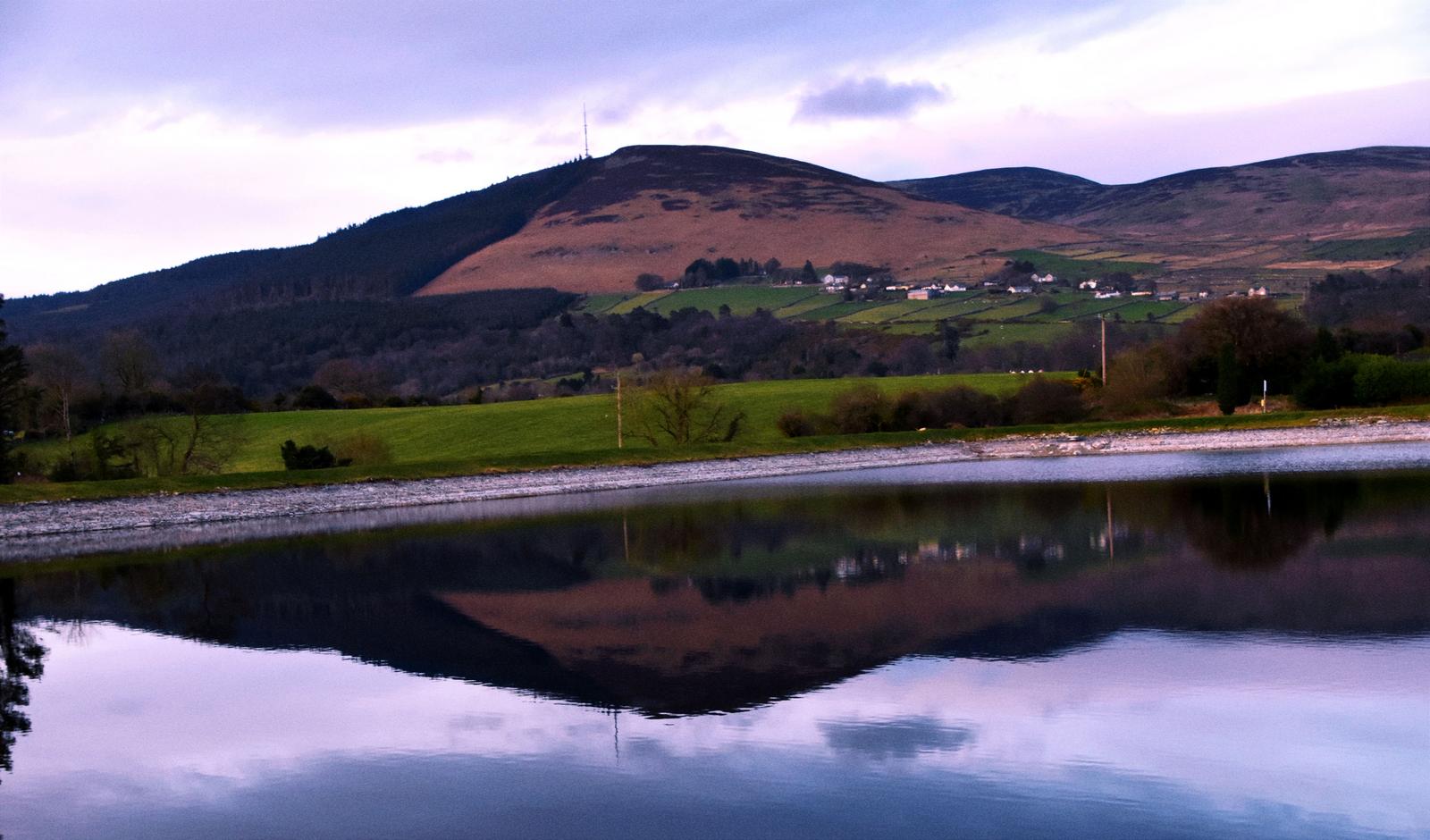
Calm water gives you a clean mirror, but the frame needs a stronger hook to rise above “pretty view.”
You’ve clearly chased the mirror effect, and the still water does a good job of doubling the hill and radio mast. At web size the land looks acceptably crisp, though the reflection and the distant cottages feel a touch soft, likely from low light and a slower shutter. This sits firmly in landscape territory: rolling fields, a simple shoreline, and a symmetrical reflection. The strongest elements are the triangular hill with its mast and the way that shape repeats in the water. Do you want this to be a pure symmetry study, or a landscape with depth and an anchor—what was the intention behind placing the horizon dead‑centre?
TECHNICAL EXECUTION ★★★
Exposure is well controlled with no blown highlights and decent shadow detail in the treeline. Colours are muted, which suits the scene, though there’s a slight magenta cast in the sky and water that flattens the greens. Overall sharpness is okay, but the distant houses and the reflected shoreline feel a little soft—possibly handheld at dusk or focused mid‑frame rather than at hyperfocal distance. Noise isn’t obvious, but micro‑contrast could be better on the hill. For five stars I’d want critical sharpness from foreground stones to the far ridge, neutral colour, and a bit more micro‑contrast without over‑processing.
COMPOSITION ★★★
The centred horizon works for symmetry, and the hill’s triangular form makes a satisfying diamond with the reflection. However, a lot of empty water at the bottom gives the frame a passive feel, and the dark tree intruding from the far left edge is a distraction. The telegraph poles along the mid‑ground also pull the eye away from the mountain. There’s no foreground anchor (a rock, reed, or curve of shore) to create depth, so the scene reads as a flat record rather than an immersive place. To push this higher, either commit to a clean, pure symmetry by eliminating edge clutter, or build a three‑layer composition with a deliberate foreground leading into the hill.
LIGHTING ★★★
The light is soft and even—pleasant, but not shaping the land. The sky is pale and featureless, offering little texture to play off the hills. There is a gentle colour contrast between the brown slope and green fields, but the scene lacks directional highlights or shadows to add depth. This is the kind of light that documents rather than transforms. Waiting for sidelight at golden hour, low mist on the water, or a break in cloud catching the hill would lift the mood significantly.
STORY ★★
The image communicates calm and quiet countryside, but it stops there. Without weather drama, wildlife, a human trace in motion, or a decisive moment, it feels generic. The scattered houses hint at place, yet nothing invites curiosity about life there. Reflection alone isn’t a story; it’s a device. Consider what moment would make this scene matter—a shepherd on the ridge, a passing bird cutting the reflection, or morning mist revealing and hiding the cottages.
IMPACT ★★
It’s a pleasant picture that many viewers will scroll past because they’ve seen similar reflective vistas often. The distractions on the frame edges and the flat sky dilute the “wow” the mirror should deliver. With stronger light or a deliberate foreground, this could step up quickly. Right now it reads as a neat record of a peaceful place rather than a standout image. Aim for either striking purity or layered depth to create memorability.
CONSTRUCTIVE NEXT STEPS
✓ Reframe with intention: either crop to a cleaner panoramic symmetry (trim some bottom water, remove the left-edge tree), or step to the shoreline and include one bold foreground element (a rock bank or reed clump) to lead into the hill.
✓ Remove distractions: clone/heal the telegraph poles and the small sign on the right; if reshooting, shift a few metres to keep these out of frame entirely.
✓ Refine tone and colour: nudge white balance slightly cooler/greener, add a gentle S‑curve, dodge the sunlit brown slope and burn the sky’s top edge for subtle depth; keep saturation restrained.
✓ For a crisper mirror, use a tripod at ISO 100, f/8–f/11, and a 1–4s exposure (or an ND filter) when the water is absolutely still to smooth micro‑ripples without losing detail.
AI Version 2.1