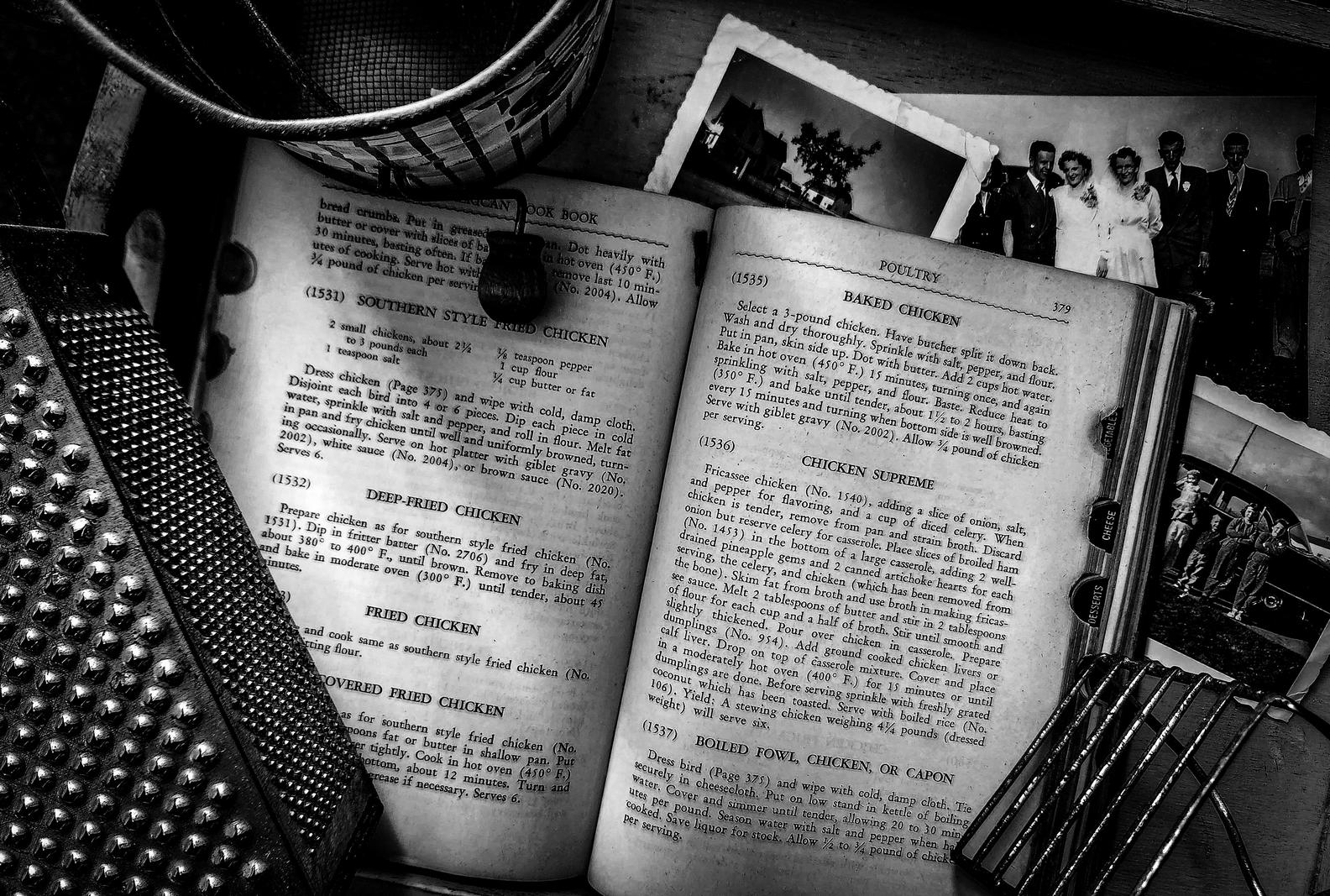
Side light gives this vintage kitchen still life its character; it just needs softer control.
Short answer: no—flat light would make the page easier to read but would strip away the lovely texture you’ve created on the grater, paper and whisk. For a food/still-life like this, directional light is what builds depth and a sense of age; the open chicken recipes, the pitted metal grater on the left, and the old family photos in the top right all benefit from side light. What would improve things is not flattening it, but softening and filling it: a larger diffused source from the left at around 30–45°, plus a white card on the right to lift the heavy shadows, would keep shape while restoring detail in the darker corners. Ask yourself: is the hero the cookbook text or the “memory” props? If it’s the text, give it a little more light and reduce the pull of the bright grater; if it’s the memory, let the shadows stay but keep them readable.
TECHNICAL EXECUTION ★★★★
Focus is crisp across the spread and the monochrome conversion looks clean without crude sharpening artefacts. Exposure is mostly well held, though the left edge and lower right dip into near-black, losing some paper and utensil detail. The specular highlights on the grater are close to clipping but still controlled. Grain and noise are unobtrusive and the file appears robust enough for print. To hit five stars, recover a touch more shadow detail and tame the hottest highlights so the tonal range feels more balanced while keeping the grit.
COMPOSITION ★★★
The open book is a solid anchor and the diagonals from the grater on the left and the whisk on the right create a strong frame. The vintage photos peeking in at the top right add a good secondary beat to the story. However, the grater dominates due to its size and brightness, pulling attention away from the recipe titles; the sieve rim at the top also crowds the frame and competes with the book’s spine. Several edges feel cramped—the whisk wires and photo corners touch the borders—adding unhelpful tension. A little more breathing space or a tighter, more decisive crop would refine the hierarchy.
LIGHTING ★★★
The side light carves texture beautifully—exactly the right direction for the subject. Where it falls short is contrast control: the shadowed page edges and the right-side props sink too deep, and the grater’s highlights verge on shiny distraction. A larger, closer diffuser (softbox or window with sheer fabric) would smooth the micro‑contrast while preserving direction. Adding a small white bounce card camera-right to lift shadows by about 1 stop would improve legibility of the text and the old photos. That balance would lift this to four or five stars without sacrificing mood.
STORY ★★★★
The elements work well together to suggest a clear narrative: family recipes, timeworn tools, and memories laid out on a table. The choice of black and white supports the “handed‑down” theme and unifies the mixed materials. The open spread on poultry gives a specific, tangible anchor instead of vague kitchen props. What’s missing is a slightly clearer priority—book first or memorabilia first—because the grater’s prominence muddies the message. Nudge the light and balance so the viewer reads the page, then discovers the photos.
IMPACT ★★★★
The image has presence and a strong sense of place on first glance; the textures and diagonals pull you in. It feels honest and tactile, not over‑processed, and the monochrome choice suits the subject well. The heavy left-side draw and cramped borders limit how long the eye lingers on the story. With better control of contrast and a cleaner hierarchy, this could be a standout portfolio piece. What would you want a viewer to notice second, after “old cookbook”—the family photo or the tools?
CONSTRUCTIVE NEXT STEPS
- Keep side light but soften it: use a larger diffuser or bounce from a white wall at 30–45° left; add a white card camera-right to raise shadow detail by ~1 stop.
- Reduce the grater’s dominance: either move it slightly back/left or flag it with black card to cut the hottest reflections; in post, burn its brightest patches by about 0.3–0.5 stops.
- Clarify the frame edges: give the whisk and photo corners a little breathing room, or commit to a tighter crop that excludes the sieve rim and any half-shown objects.
- Post-process gently: dodge the recipe titles and the family photos to guide the eye, and add a subtle midtone contrast curve on the paper to keep it the hero.
AI Version 2.12