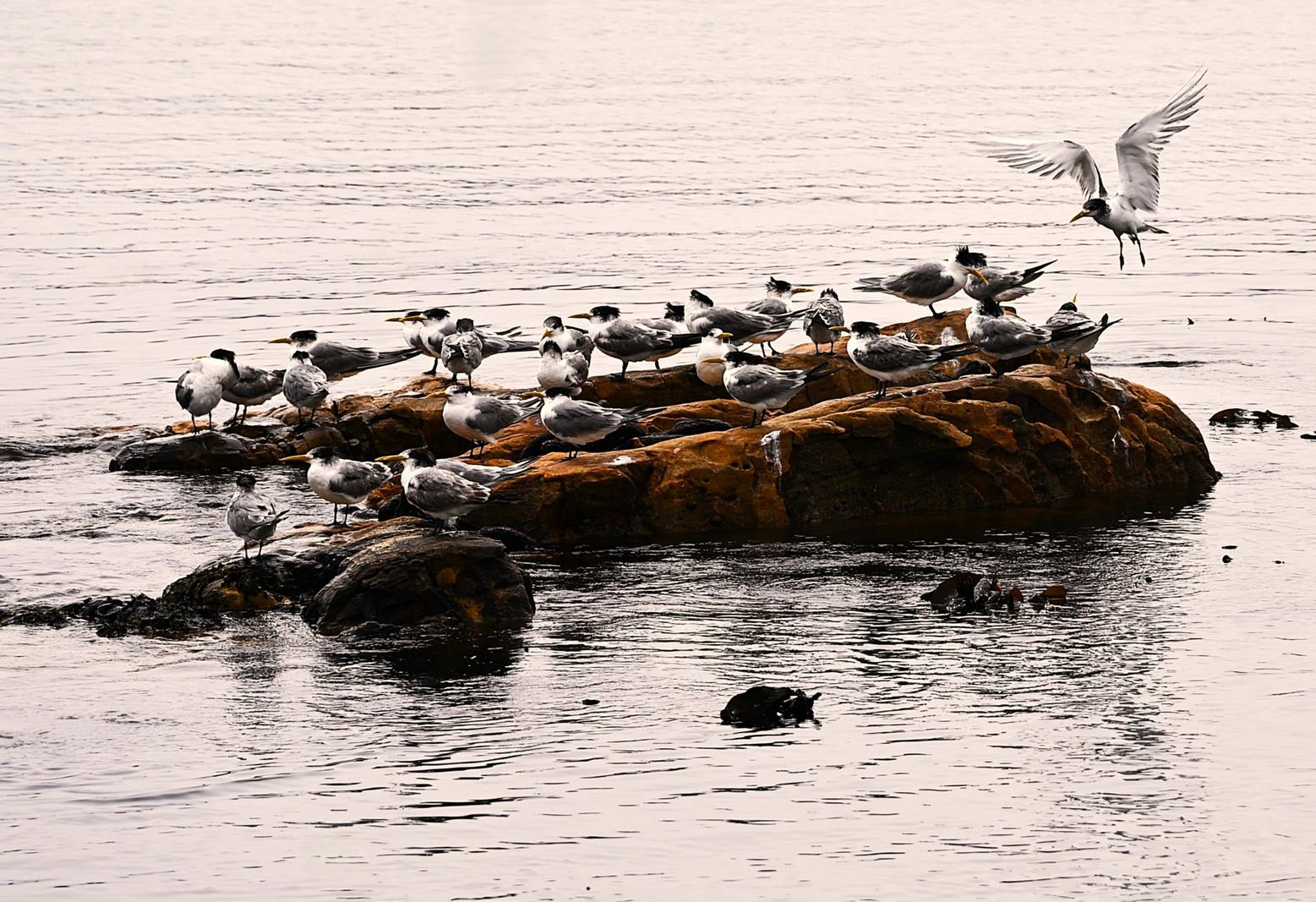
A calm shoreline scene lifted by one well-timed bird coming in to land.
Thanks, PAT. The wide crop gives a panoramic sense of the roost and lets the water breathe, but it also spreads the viewer’s attention thin. This sits in wildlife photography, and the strongest element is the tern arriving top‑right with wings raised — that’s your “moment.” Right now the frame competes with itself: a busy rock full of similar birds, a few dark blobs in the water, and the action bird squeezed near the edge. I’ll focus the critique on how to make that moment read more clearly through tighter framing, timing, and cleaner processing.
TECHNICAL EXECUTION ★★★
Exposure is well controlled for the overcast conditions; whites on the terns are intact and the water holds texture. Overall sharpness looks decent across the rock, though at this distance we don’t get crisp eye detail — acceptable for a colony scene but not engaging for a hero subject. Noise and artefacts are minimal, and colours are restrained, which suits the weather. The landing tern appears sharp enough, but a slightly faster shutter (around 1/1600–1/2000s) would guarantee wing detail if you chase more action. To reach five stars you’d need tack‑sharp focus on a key subject, plus finer micro‑contrast on the plumage.
COMPOSITION ★★★
The rock forms a strong horizontal anchor and the arriving bird provides a natural focal point, but it’s cramped against the right edge. Large areas of empty water above and the dark lumps in the lower water drag attention away from the action. The flock itself is visually noisy; our eye keeps bouncing without landing decisively. A tighter crop from the left and bottom to remove the foreground blobs and give the landing tern more visual weight would clarify the story. Ask yourself: where do you want my eye to settle — the incoming bird or the cluster on the rock?
LIGHTING ★★★
Soft overcast light keeps contrast manageable and preserves feather detail, but it’s also quite flat. The birds and rock share similar mid‑tones so separation is limited, especially among the resting terns. A hint of directionality would help — early or late light to rake across the rock, or shooting from a side that gives shadow modelling. In post, subtle dodging on the landing bird and gentle burning of the surrounding water can add dimensionality without looking forced. For a higher score, aim for light that sculpts the scene or creates a clean rim on the action.
STORY ★★★
The resting colony tells “quiet roost,” and the single bird landing injects a moment. It’s a good start, but the other birds feel indifferent — no raised heads or interaction that amplifies the arrival. Stronger behaviour (a mid‑air squabble, fish pass, or synchronised take‑off) would push the narrative further. Consider whether you wanted to portray the communal calm or the split second of arrival; at the minute it straddles both and slightly dilutes each. What behaviour were you hoping to catch, and how long did you wait for it?
IMPACT ★★★
The scene is pleasant and believable with a small spark from the airborne tern. However, the wide view and scattered distractions reduce the punch and memorability. A cleaner frame focused on the landing gesture would hold attention longer. With a clearer hero subject, more breathing room in the direction of travel, and removal of minor distractions, this could jump a full star. Right now it’s solid but not a stand‑out.
CONSTRUCTIVE NEXT STEPS
- Re‑crop to a tighter 16:9 or 4:3: trim from the left and bottom to remove the dark foreground blobs and place the landing bird roughly on the right third, leaving space ahead of its flight path.
- In post, add subtle local contrast and a touch of dodge on the landing bird’s head/upper wing, and burn the surrounding water by about −0.3 to −0.5 EV to guide the eye. Heal out the small black lumps in the lower water.
- Field craft: wait for interaction — calls, wing‑flaps, fish passes, or multiple birds airborne — and fire short bursts at 1/1600–1/2000s, f/6.3–f/8, ISO as needed, to catch a cleaner peak moment.
- If possible, shift a step or two lower to separate the birds from the mid‑tone water and create a stronger silhouette line along the rock.
AI Version 2.12