A quietly satisfying study of order and materials, lifted by warm late‑day light but held back by a loose frame and thin story.
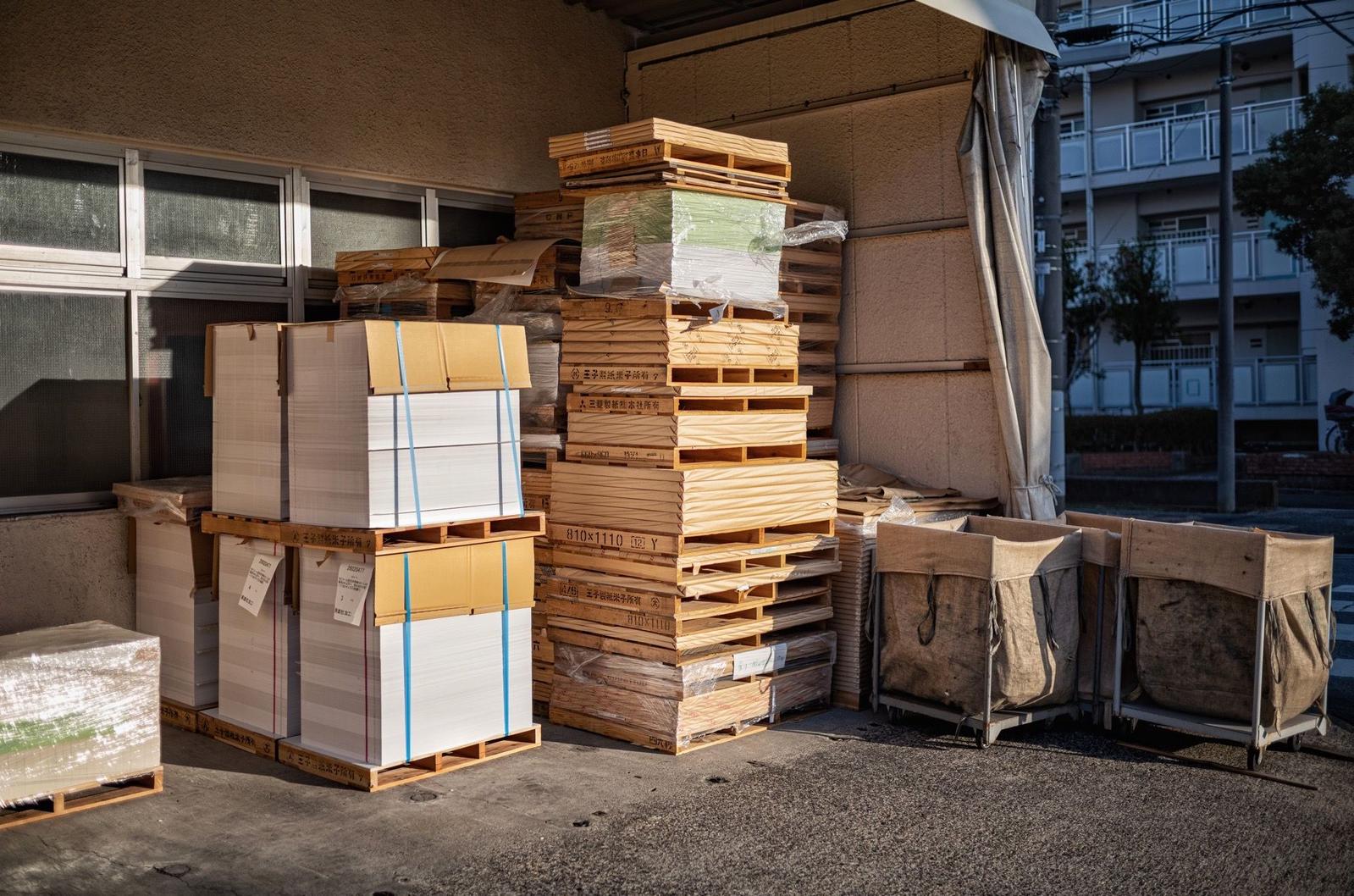
Your attraction to banality and repetition comes through clearly here, Peter: stacked pallets, strapped paper reams, and bins rendered with crisp detail. As an urban still life/documentary scene, it’s technically strong and the side light gives the timber real texture. Where it’s less successful is in giving the viewer a clear anchor or moment; the frame feels descriptive rather than purposeful. Ask yourself: what is the true subject — the central tower of pallets, the rhythm of rectangles, or the late sunlight? Clarifying that would tighten both composition and impact.
TECHNICAL EXECUTION ★★★★
Exposure is well controlled across a wide range, with clean highlight detail on the paper stacks and readable shadows under the awning. The file looks sharp front to back, suggesting a sensible mid‑aperture and steady hand or tripod. White balance leans warm but suits the timber tones and late afternoon feel. I can see a touch of specular glare on the plastic wrap at bottom left and a hint of perspective tilt, both minor. Processing feels restrained — no heavy halos or over‑sharpening. To reach five stars, correct the verticals subtly and mute the brightest plastic highlights so the eye doesn’t snag there first.
COMPOSITION ★★★
The central stack of pallets provides mass and rhythm, and the repeating window panes on the left echo that geometry nicely. However, several edge distractions dilute the order you’re celebrating: the half‑cut laundry carts on the right, the bright shrink‑wrapped bale bottom left, and the sliver of awning at the top. The eye ping‑pongs between these bright edges rather than resting decisively on the timber stack. A step left and slightly forward, or a tighter crop, would either exclude the carts or include them cleanly as a deliberate counterweight. Consider committing to one organising principle — pure geometry and repetition — and remove anything that doesn’t serve it.
LIGHTING ★★★★
The raking sunlight from camera left is the photograph’s strength, carving texture into the wood grain and catching the paper edges. Warm tones feel natural and suggest end‑of‑day, while the shaded right side adds depth. Contrast is handled well; nothing crucial is lost to black. The one caveat is that shiny plastics and the white paper stack pull attention due to their brightness. A touch of local burn on those areas, or waiting for a cloud edge to soften the speculars, would keep the focus on the timber.
STORY ★★
At present the frame documents a place and materials, but it doesn’t quite offer a moment or a clear idea beyond “neatly stacked pallets.” There’s potential: the late light hints at a workday ending, and the labels and straps suggest industry and routine. Without a human action, a sign of movement, or a more assertive concept (e.g., extreme order versus decay), the narrative remains thin. What single detail could carry your idea — a worker’s hand, a moving trolley, or a perfectly aligned pattern that becomes almost abstract? Deciding that would move this from record to story.
IMPACT ★★
The textures and repetition are pleasing, and the light is attractive, but the image doesn’t lodge in the memory because it lacks a decisive focal point or tension. The partial crops at the borders read as indecision rather than intentional roughness. With a cleaner frame or a small human gesture to add scale and purpose, this quiet scene could gain bite. Aim for either ruthless minimalism or a clear moment within the orderliness to raise the stakes.
CONSTRUCTIVE NEXT STEPS
- Make a decisive frame: either crop in from the right to remove the half‑cut carts and from the bottom to lose the bright shrink‑wrapped bale, or step right to include the carts fully as a balancing element. Commit to one.
- Use subtle perspective correction (Transform/Vertical in Lightroom) to straighten verticals and reduce the slight keystone; it reinforces the disciplined, ordered theme.
- Guide the eye with local dodge/burn: burn the plastic highlights (bottom left and top of the central stack) and lift midtones on the central timber faces to declare your subject.
- Consider waiting for or introducing a micro‑moment — a worker passing through the light, a trolley in motion (1/30–1/60 for a hint of blur), or a hand adjusting a strap — to give the scene a narrative hook and scale.
AI Version 2.12