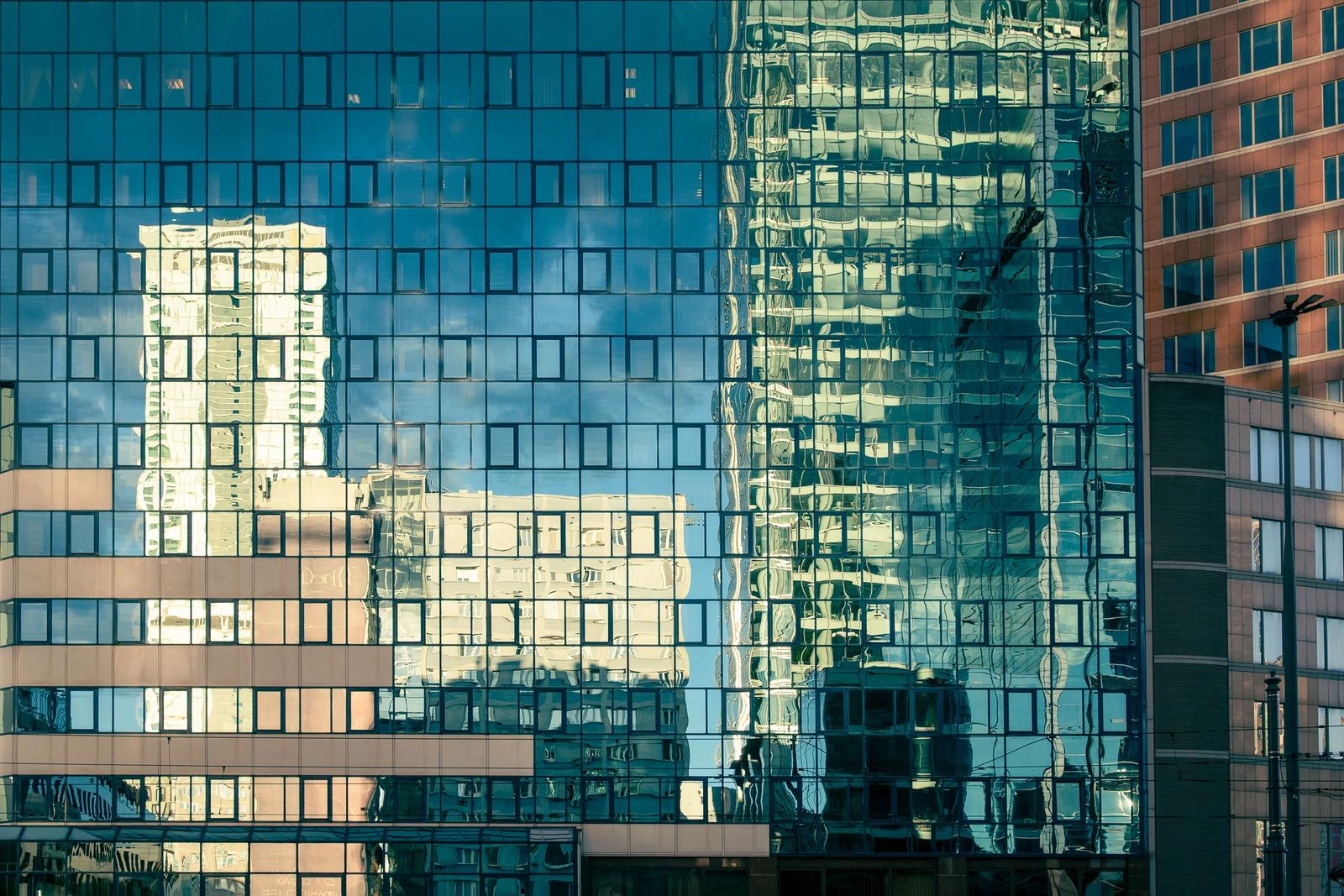
A clean, graphic study of urban reflections with a strong rhythm of windows.
Short answer: yes, it’s a good photograph for form and pattern; story is the weaker side. This sits between architectural and fine‑art abstraction — the grid of blue glass panes reflecting warped towers is the main subject. What works best is the tension between the rigid window lattice and the wavy, molten reflections of neighbouring buildings, especially the pale tower echoing through the middle. Where it falls short narratively is that nothing changes or “happens” in the frame; it’s primarily a design study. Did you intend a pure pattern piece, or were you aiming to say something about the city itself? If the latter, consider what single element could become your anchor — a person in a window, a lit office, or a decisive shaft of light.
TECHNICAL EXECUTION ★★★★
The exposure is well controlled: highlights in the bright reflected façades hold, and the shadows inside the building don’t block up. Focus and clarity look solid across the frame, which is important for this kind of repeated geometry. Colour is tasteful, with cool glass tones and gentle warmth in the reflected buildings; no heavy processing or HDR artefacts are apparent. Vertical lines of the host building are mostly true, suggesting you kept the camera level or corrected in post. To reach five stars, ensure absolutely perfect verticals and consider cleaning minor edge distractions via careful capture or retouch.
COMPOSITION ★★★
The frame is packed with a satisfying grid and multiple layers of reflection, which gives the eye plenty to explore. However, there’s no clear focal anchor; attention drifts between panes rather than landing decisively on one area. The sliver of the orange building and the lamp post on the right edge pull the eye out of the frame, and the horizontal beige bands feel visually heavy without adding meaning. A tighter crop excluding the right-hand elements, or a square crop centring the strongest reflection, would strengthen cohesion. How would the picture read if the brightest tower reflection were placed dead centre or precisely on a third to become the “subject” of the pattern?
LIGHTING ★★★
Daylight gives crisp, legible reflections and the pale towers pop nicely against the teal glass. That said, the light is fairly even and doesn’t add much depth beyond the inherent contrast of glass and sky. There’s little shadow play across the façade, so the mood stays neutral. Returning at golden hour or blue hour could introduce warm interior rectangles and richer colour separation, adding shape and atmosphere. Consider whether you want clinical precision (daytime) or mood and contrast (early evening) for this scene.
STORY ★★
As presented, the image reads as a formal study: order versus distortion. It hints at the bustle of a city but doesn’t show a moment, gesture, or sign of life. Without a human presence or a time‑specific cue, it feels more like a catalogue of surfaces than a scene with a narrative thread. A single lit office, a lone figure in a window, or a window-cleaner’s rig would shift it from pattern to moment. What small, time‑dependent detail could you have waited for to give this structure a heartbeat?
IMPACT ★★★
The repeating panes and warped reflections are engaging and pleasant to look at; it’s a photograph many viewers will enjoy for its graphic quality. Distractions on the right edge and the lack of a focal anchor dull the punch slightly. With cleaner borders and more intentional placement of the strongest reflection, the picture would land harder. Stronger light or a single human element could make it memorable rather than simply attractive. Aim for one dominant idea in the frame, then let the grid support it.
CONSTRUCTIVE NEXT STEPS
✓ Reframe or crop to remove the right-hand orange building and lamp post; try a square crop focused on the brightest tower reflection to create a clear anchor.
✓ Return at blue hour with a tripod (ISO 100–200, around 1/4–1s, f/8–f/11) to capture warm interior lights against the cool glass for added mood and depth.
✓ Keep verticals perfect: shoot perfectly level or apply lens-profile and vertical transform in post; then fine-tune with a subtle geometry check at the edges.
✓ Add a moment: wait for a person to appear in one pane, a lit office, or a passing silhouette to give the pattern a purpose; that single detail becomes your story.
AI Version 2.0