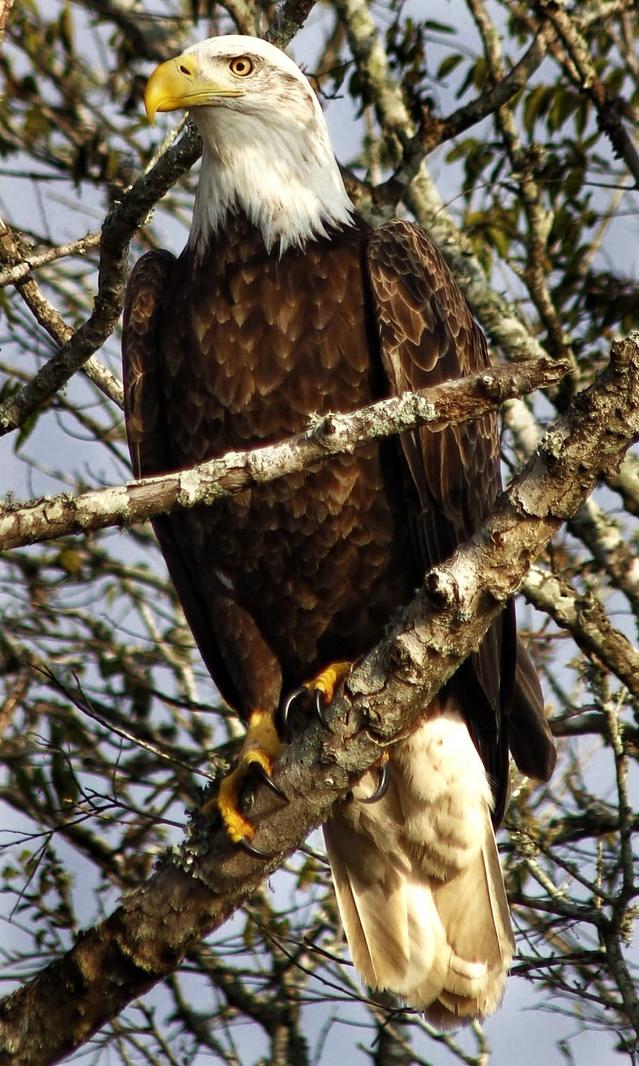
A strong wildlife portrait with excellent detail that’s being held back by a busy perch and slightly cramped framing on the gaze side.
You’re right to question the crop, Sara, but not because you should include more limbs—quite the opposite. Adding more branches would only dilute the eagle. The issue is that the bird is centred and there’s limited breathing room in the direction it’s looking (upper left), so the frame feels a touch boxed in. For a wildlife portrait like this, giving extra space toward the gaze while keeping the background simple is ideal. Here the diagonal perch works, the eye is sharp, and the bird looks dignified; the frame would simply benefit from a little more room left and above, and less visual weight from the foreground branches. How might this have looked if you’d stepped a metre left or right to separate the head from the crossing limbs?
TECHNICAL EXECUTION ★★★★
Focus on the eye is crisp and detail in the feathers and beak is strong—great field craft. Exposure is controlled well; the white head retains detail without blowing out, which is easy to mishandle on a bald eagle. Colours look natural and not over‑pushed. If anything, the midtones on the body could use a touch more separation to tease out texture, and the background shows some busy high‑contrast twigs that sharpen up more than they need to. A touch of noise reduction on the background and selective sharpening on the head would refine it further.
COMPOSITION ★★★
The vertical format suits the tall posture and preserves the full tail, which is good. However, the eagle sits very central and the branches crowd the frame, especially the thick diagonal limb in front of the talons and the cluster near the head. The bird is looking up‑left, yet there’s limited space in that direction; giving it room there would ease the tension and feel more intentional. I wouldn’t include more limbs; I’d include more negative space where the bird is looking and less of the competing twigs. Consider a composition that places the head on an upper third and trims some of the lower foreground branch weight.
LIGHTING ★★★★
Natural light is soft and directional, shaping the white head nicely with a clean catchlight in the eye. The brown body holds detail and there’s no harsh midday glare. The background is brighter in some patches, which draws the eye away from the bird; a slight drop in background highlights would help. Golden‑hour light would add warmth and micro‑contrast to the feathers, but this is already handled with care. Overall the light flatters the subject without feeling manipulated.
STORY ★★★
This is a solid, respectful portrait of a wild raptor at rest. The posture is alert and the talons gripping the branch add character, but there’s no behaviour beyond perching. A call, wing stretch, or launch would elevate the sense of moment. The leg band is an informative detail; it tells us this bird is monitored, though it also competes for attention—decide whether you want that information or a cleaner aesthetic. What behaviour did you anticipate here—were you waiting for take‑off?
IMPACT ★★★
The species’ presence carries inherent power and the sharp eye draws you in. The impact is reduced by the cluttered branches and centred placement, which make the scene feel more like a strong record than a standout portrait. With cleaner separation and a little breathing room in the direction of the gaze, this would jump a grade. A touch more drama in light or behaviour would also lift memorability. As it stands, it’s good, not yet unforgettable.
CONSTRUCTIVE NEXT STEPS
- Reframe for the gaze: when the bird looks left, leave extra space left and slightly above; aim to place the head on an upper third and keep the tail fully in frame.
- Work the perch: move your position to separate the head from crossing twigs; even a small sidestep or lower angle can place the head against distant foliage or sky for a cleaner background.
- Shooting settings: prioritise isolation with a wider aperture (e.g., f/5.6–f/7.1 at 400–600mm), single‑point AF on the eye, and 1/1000s or faster to stay crisp if the bird moves; dial −1/3 EV to protect the white head.
- Post‑processing: darken or desaturate bright lichen and hotspots on the branches; add selective clarity/dodge on the eye and beak. If this isn’t documentary, consider cloning or toning down the leg band which currently grabs attention.
AI Version 2.12