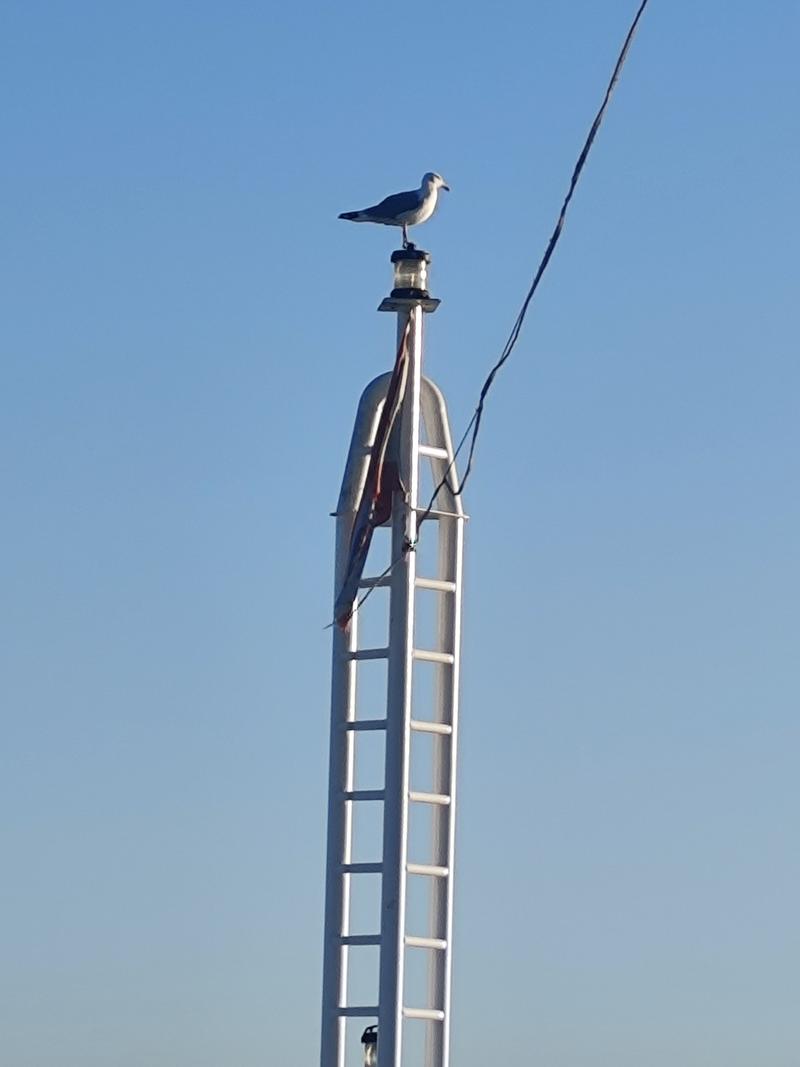
Strong raw ingredients, but the scene needs a tighter, cleaner treatment to sing.
Yes — a decisive crop would help a lot. You’ve got a simple, graphic moment: a gull perched on a mast under a clean sky, sitting somewhere between urban‑wildlife and minimalism. Right now the long length of mast, the diagonal cable entering from the top‑right, the tattered flag and the partly cropped lamp at the bottom dilute the subject. If your intent is a crisp study of the bird on its perch, I’d crop to the top section only and simplify. If, instead, you want to show place and context, then include the mast more fully and commit to the structure as a co‑star. Which version best matches what you felt when you pressed the shutter?
TECHNICAL EXECUTION ★★★
Exposure is clean and the sky renders smoothly without obvious artefacts. Focus looks acceptable, though the critical sharpness appears to sit more on the mast and beacon than the bird, which softens the connection. There’s no obvious noise or over‑processing, which keeps it natural. The diagonal cable and small lamp at the bottom read as in‑camera distractions rather than post work, which is good, but they still hurt the overall polish. A slightly faster shutter (birds sway on their perches) and a touch more micro‑contrast on the bird would strengthen the file. With tighter focus on the eye and a cleaner frame, this could push higher.
COMPOSITION ★★
The gull is very small in the frame and the mast occupies a thin strip, leaving a lot of uninformative sky. The diagonal cable slices the space and competes with the subject’s line; the half‑visible lamp at the base feels like an accidental crop. The tattered flag hanging from the mast adds visual clutter without adding meaning. A tight crop around the top third of the mast would concentrate attention and turn this into a bold, graphic vertical. Alternatively, stepping a metre or two to exclude the cable and framing the mast fully would make a clear, intentional environmental portrait. What role do you want the negative space to play—calm breathing room or just empty pixels?
LIGHTING ★★★
The light is neutral and even, probably mid‑morning or late afternoon with no harsh hotspots—functional but not dramatic. The underside of the bird is slightly shaded, which flattens detail and reduces presence. Earlier or later light would give shape to the bird and mast with warmer tone and a crisper silhouette. A small catchlight in the gull’s eye would add life. As it stands, the light does the job but doesn’t add mood or tension.
STORY ★★
We’re seeing a gull at rest on a man‑made perch—credible but static. There’s no behaviour (call, take‑off, wing stretch) to create a peak moment, and the cable/flag don’t contribute to a narrative. A fraction of movement from the bird, or the flag blowing, would immediately lift the frame. Waiting for a gesture, or capturing a second gull entering the frame, could turn this from a record into a moment. What were you hoping the bird would do, and did you give it time?
IMPACT ★★
The scene has potential for a striking minimalist image, but the distractions and distance from the subject keep it in “nice snapshot” territory. It’s easy to scroll past because there’s little tension or novelty. A cleaner crop and a decisive moment would elevate it to something memorable. Right now, the idea is clearer than the execution.
CONSTRUCTIVE NEXT STEPS
✓ Crop hard to the top section: keep only the beacon, bird and the top 6–8 rungs; place the mast on the left third and leave clean sky to the right for balance.
✓ If you want a graphic study, remove the diagonal cable and the partial lamp via a careful heal/clone; also consider removing the rag of flag — minimalism benefits from ruthless tidiness.
✓ Re‑shoot with intent: move your position to avoid the cable entering frame, use a longer focal length, and wait for behaviour (call, wing stretch, or take‑off). Aim for 1/1000s or faster to freeze micro‑movement and lock focus on the eye.
AI Version 2.1