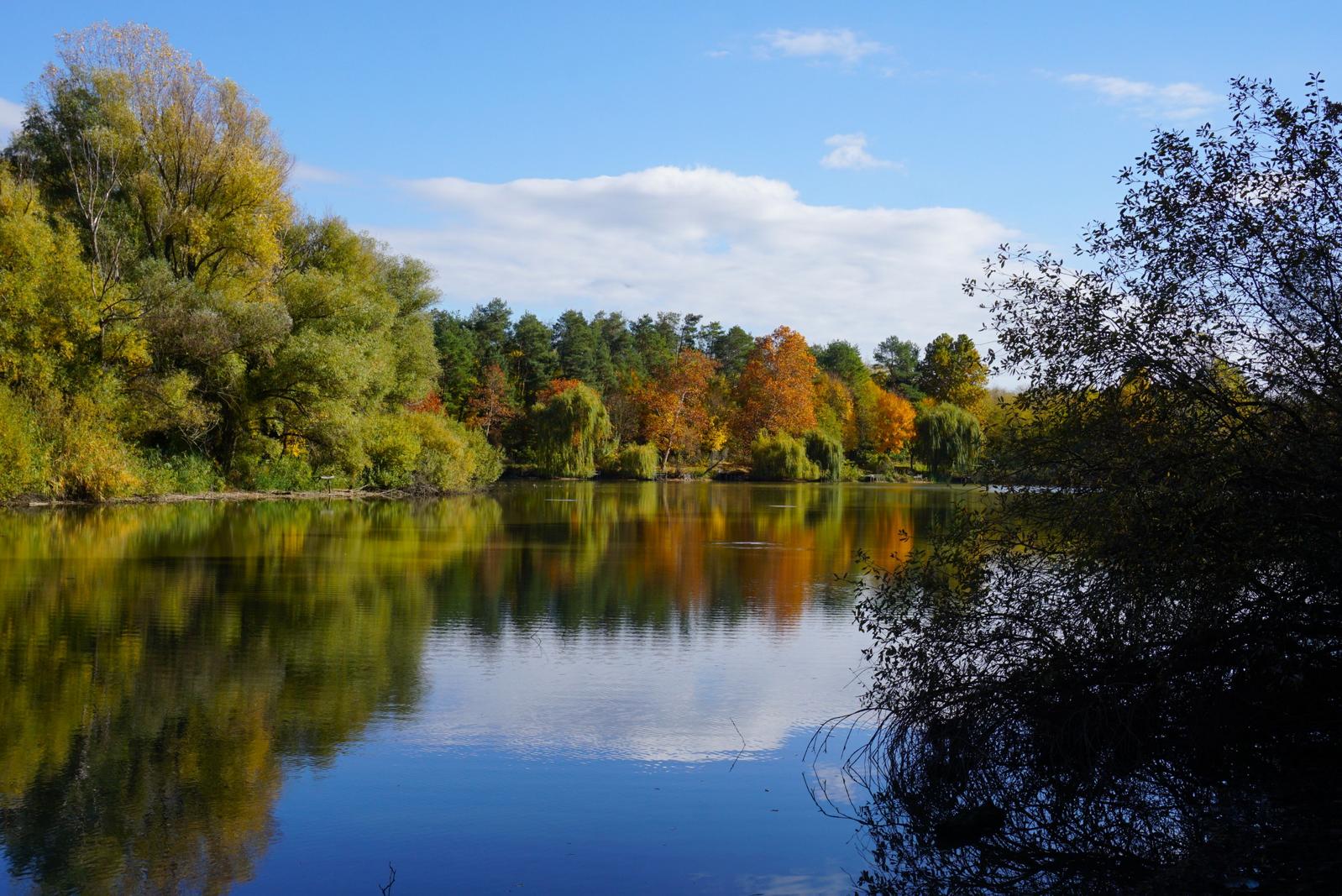
Calm autumn colour and glassy reflections, but the frame is right‑heavy and the light feels safe.
You’re asking the right things here. Lighting first: this was made in clean, midday/early‑afternoon light which keeps detail but flattens the scene; the colour is pleasant yet lacks shape across the trees. For balance, the dense black bush on the right edge outweighs the rest of the frame and pulls the eye away from the beautiful centre reflections. This reads as a landscape study of still water and autumn foliage, and the ingredients are strong — especially the mirrored oranges and willows near the middle distance. With different timing and a lighter touch on that right edge, this would settle more gracefully. Do you want the bush as a framing device, or would you prefer the image to breathe and let the reflections be the star?
TECHNICAL EXECUTION ★★★★
Exposure is well controlled: the sky holds detail without clipping and the water retains texture. Colours feel natural and not overdriven, which suits the scene. Sharpness is good through the midground treeline and reflections; any softness is minimal and likely from the calm ripples rather than focus error. The only technical drawback is the near‑black mass of foliage on the right, where shadows are clipped and lose texture. A circular polariser would need careful rotation here; used strongly it can kill reflections, but a subtle setting could tame glare in the foliage without losing the mirror. To reach five stars, preserve a hint of detail in those right‑hand shadows and keep micro‑contrast consistent across the frame.
COMPOSITION ★★★
The horizon is level and the central band of colourful trees makes a clear focal line. A mid‑horizon works with reflections, but the heavy silhouette on the right crowds the frame and upsets balance. The left bank is open and inviting, while the right edge feels like a curtain pulled too far across. Cropping 10–15% off the right, or stepping a pace left when shooting, would let the bright midground take control. A lower viewpoint could also strengthen the reflection and give the foreground water more presence as an entry path. Consider whether a small, deliberate foreground element (a reed or rock) would anchor the scene without clutter.
LIGHTING ★★★
The light is even and kind to colour, but it’s not doing much sculpting. Side‑light at golden hour would carve depth into the foliage and create brighter highlights on the orange trees, giving the scene shape. Right now the dark right edge blocks the light rather than contributing to it. The clouds are gentle; waiting for a sun‑break to graze across the midground trees would add punch without resorting to heavy processing. A soft 2‑stop grad ND or a subtle linear burn on the sky would also help hold tone while letting you expose more generously for the land. For five stars, aim for directional, low‑angle light that adds depth and gentle shadow play.
STORY ★★★
The image communicates calm — a quiet pond, still water, and the shift into autumn. It’s a pleasant mood, but there’s no small moment to make it personal: a passing bird, a drifting leaf, or a ripple from a fish could give the scene a heartbeat. The right‑edge silhouette hints at being “hidden in the trees,” yet it feels more obstructive than intentional storytelling. If you want that viewpoint, include just enough detail to read it as a bank you’re peering through. Consider how weather (mist, drizzle, or a patch of sun) might change the feeling from generic to memorable. What single element could you wait for that would make this pond feel like a one‑time moment rather than any calm day?
IMPACT ★★★
It’s a lovely, peaceful view with strong seasonal colour, and the reflections are pleasing. However, the familiar composition and flat light keep it from standing out. The dark right edge competes with the best part of the scene, diluting the visual punch. A cleaner frame and more directional light would elevate the photograph significantly. With a decisive weather moment or a refined foreground, this could move into striking territory. For five stars, aim for a refined, balanced frame with light that adds clear depth and a small, memorable detail.
CONSTRUCTIVE NEXT STEPS
✓ Rebalance the frame: crop 10–15% from the right to remove the dense black bush, or on location step one to two metres left and lower your viewpoint to expand the reflection and relieve that heavy edge.
✓ Time the light: return at golden hour with side‑light across the trees; consider a 2‑stop soft grad ND to hold the sky while exposing +0.3 to +0.7 EV for richer foliage.
✓ Post‑processing: lift the right‑edge shadows by ~0.5–1 stop to recover texture, add a selective midtone contrast boost to the orange trees, and gently desaturate greens by 5–10% to keep the palette natural and let the autumn tones lead.
AI Version 2.1